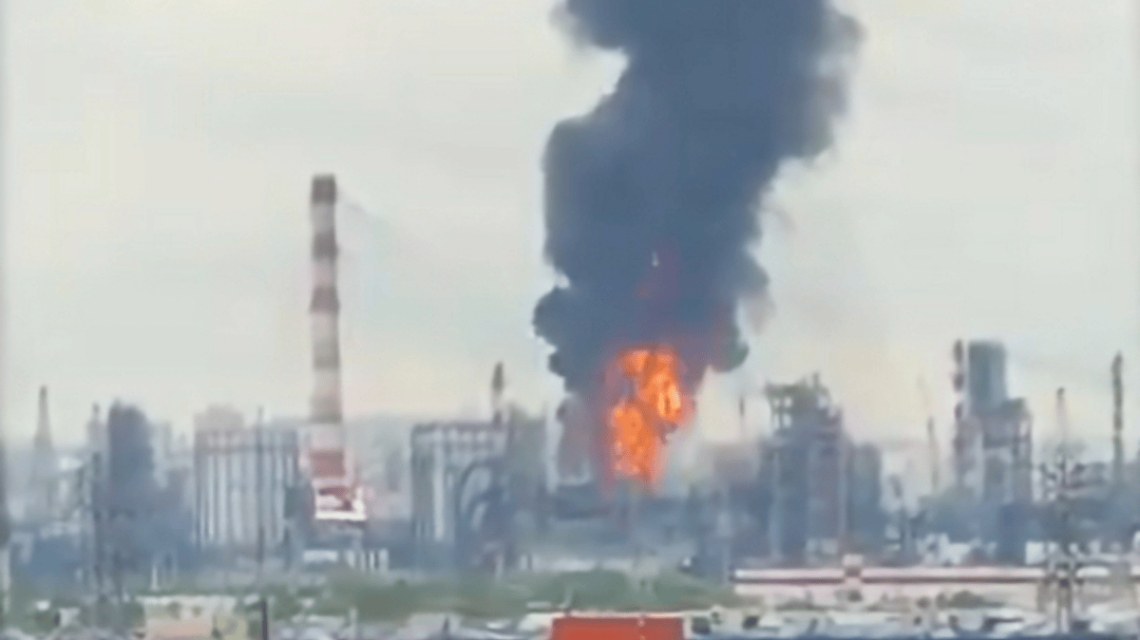
Ukraine conducted a significant attack on a major oil refinery near Moscow overnight, leading to a large fire and dark smoke rising over the Russian capital. This development marks another instance of Ukraine targeting key oil infrastructure far across the border.
The attack followed a massive Russian aerial assault on Kyiv, Ukraine’s capital, the previous day, which damaged a noted cathedral and monastery and drew international criticism. Officials reported at least 11 fatalities across Ukraine.
As major global economies prepared to meet at the G7 summit in France to discuss a ceasefire for the ongoing conflict, Ukrainian President Volodymyr Zelensky confirmed the operation on the Moscow Oil Refinery. He described the drones’ travel of 500 kilometers (310 miles) to reach the refinery as a “just response” to Russian attacks on Ukraine.
The Moscow Oil Refinery is a critical facility, accounting for about 40 percent of the petroleum needs of the area surrounding the Russian capital, according to Ukrainian sources. Moscow mayor, Sergey Sobyanin, stated on social media that Russian air defenses intercepted 60 Ukrainian drones over the city overnight.
One drone caused damage to an unspecified part of the refinery, although no injuries were reported. Andriy Kovalenko, a Ukrainian official, noted that a unit used for processing oil caught fire. Russian state news agency Tass reported that these were among Ukraine’s largest drone strikes on the Russian capital this year.
President Zelensky remarked, “This time, the Moscow region felt the reach of Ukraine’s long-range capabilities.” Kovalenko further commented on the potential impact, considering whether the refinery would face suspension or a critical loss of capacity.
Ukraine has consistently targeted Russia’s oil assets, such as refineries, pipelines, and storage facilities, using drones with long-range capabilities. This strategy aims to disrupt crucial funding for the Kremlin’s war effort.
Russia, a significant oil exporter, faces reductions in crude oil production by hundreds of thousands of barrels daily. The ongoing Iran conflict and Gulf instability have increased demand for Russian oil. The Russian energy ministry mentioned earlier this month that Ukrainian attacks have caused temporary fuel supply challenges in parts of southern Russia, prompting the government to create a task force to address supply issues.
Zelensky stated that Ukraine’s SBU internal security service, drone units, special operations forces, and military intelligence operatives participated in the attack.
 Sen. Thom Tillis Critiques Trump Administration and Reflects on Political Career
  Trump Forms Task Force to Address Artificial Intelligence
  Indiana House District 19 Race: Olthoff vs. Neal
  Hilton’s Campaign Ad Faces Backlash in California Governor Race
  Trump Criticizes Fox News Over Rally Coverage and Ratings Concerns
  FBI Arrests Suspected Chinese Agent in Los Angeles