As July 4th approaches, you might be looking forward to traditional festivities like fireworks. Yet, nature could offer its own spectacular display. The Northern Lights might grace the skies on Friday, say weather experts.
The Space Weather Prediction Center (SWPC), part of NOAA, has monitored two significant sunspot groups. One spot produced an X1 category solar flare. While ‘X’ represents the highest classification, X1 is the least severe level in that range.
“It was a brief and energetic event,” commented Shawn Dahl, a service coordinator with SWPC.
Initially, the potential impact of the associated coronal mass ejection (CME) was uncertain. By Wednesday, though, the SWPC had a clearer picture. They confirmed the CME is likely to affect Earth, causing increased geomagnetic activity. This could lead to moderate geomagnetic storm conditions, resulting in the visibility of the Northern Lights.
Viewing Opportunities on July 3
If conditions align as expected, residents in the northern U.S. might catch the aurora. A G2 level geomagnetic storm can make the Northern Lights visible as far south as New York and Idaho. States such as Washington, Oregon, Idaho, Montana, North Dakota, South Dakota, Minnesota, Wisconsin, Michigan, Vermont, New Hampshire, New York, and Maine might see the lights.
Alaska generally has good chances to see auroras, given its geographical location. Forecasts from the University of Alaska Fairbanks suggest those slightly further south—including Wyoming, Nebraska, Iowa, Illinois, Indiana, Ohio, Pennsylvania, and Massachusetts—could spot the aurora near the northern horizon.
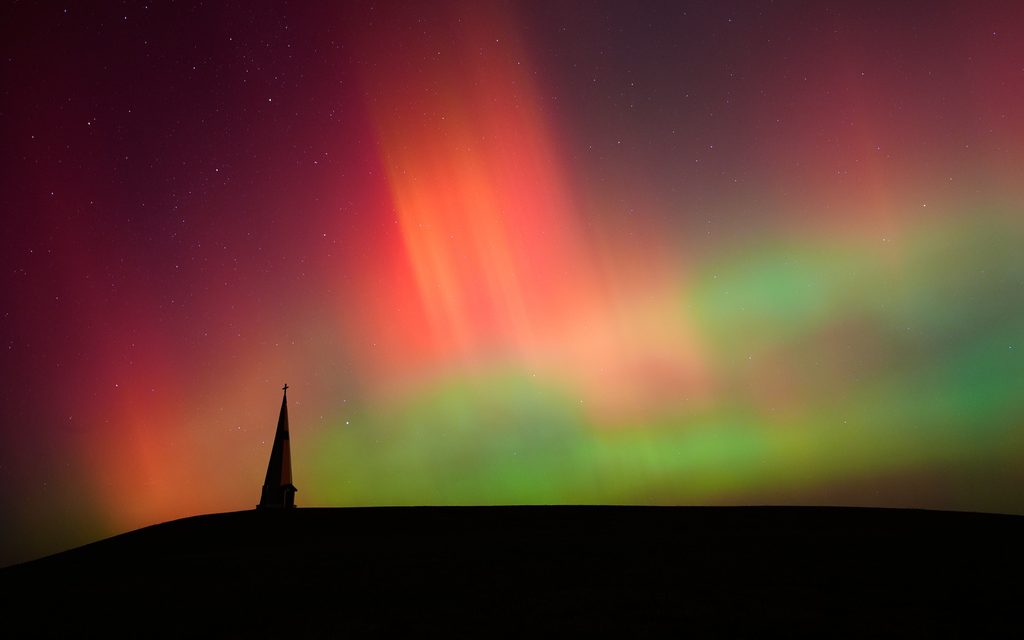
The Northern Lights could put on a stunning show behind landmarks like the Saint Joseph the Woodworker Shrine in Kansas. Timing is crucial. If the strongest geomagnetic activity occurs before sunset, the lights might remain unnoticed. SWPC forecasts suggest activity could commence around 2 a.m. EDT on Friday and extend throughout the day, possibly intensifying near sunset.
Unfortunatley, the required conditions might not fully occur, impacting aurora visibility. It’s advisable to keep up with SWPC forecasts through their official site. For those eager to see the aurora, gazing toward the northern horizon improves chances. If the lights remain faint, using a smartphone could help capture the vibrant colors. Modern digital cameras have better light sensitivity than the human eye, enhancing the view.
Copyright 2026 Nexstar Media Inc. All rights reserved. Redistribution without permission is prohibited.
 The Discovery of Incendiamoeba cascadensis: A Fire Amoeba
  Archaeological Discovery in Germany: Largest Hoard of Roman Coins Found
  Cold Weather Alerts and El Niño Influence
  Turning Home Food Waste into Compost: A Guide
  Chicagohenge: When Sunlight Aligns with City Streets
  Fat Bear Week 2026: A Look at the Contest and Its Competitors