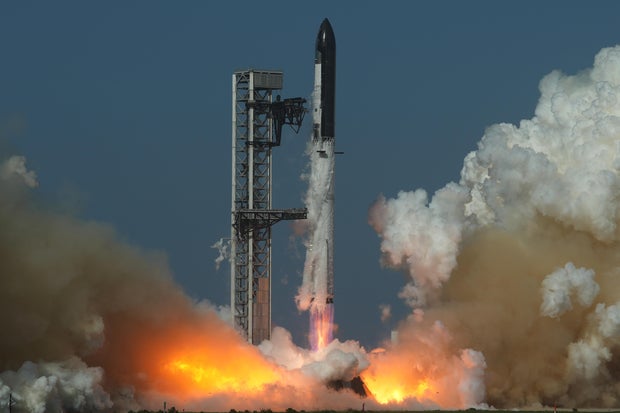
On Thursday, SpaceX successfully launched its thirteenth Super Heavy-Starship rocket. The launch included a significant milestone with a successful sub-orbital hop to the Indian Ocean. The giant booster achieved an on-target but ‘hard’ splashdown off the Texas Gulf Coast.
The 397-foot-tall two-stage rocket, powered by 33 methane-fueled Raptor engines, took off from SpaceX’s ‘Starbase’ in Texas at 5:51 p.m. EDT. The rocket produced around 16 million pounds of thrust, presenting a spectacular sight for locals and tourists. Previously, an attempted launch on July 16 was aborted after a last-second computer-commanded stoppage due to engine issues. After resolving these, the launch proceeded, though delayed by low clouds.
The test was a second trial for the third-generation Super Heavy-Starship, building on lessons from May. During that initial flight, the booster missed its target, and the Starship faced engine shutdowns. This time, the booster completed its ascent and detached from the upper stage for descent. Despite fewer engines restarting than planned, leading to a high-velocity splashdown, the booster’s performance showed progress. SpaceX opted for splashdowns in the Gulf as a safety measure for these initial flights.
The Starship upper stage continued successfully, deploying 20 third-generation Starlink satellites. This process tested a unique payload dispenser. Among the satellites, six were equipped with cameras to assess the Starship’s condition, focusing on its heat shield tiles. To further validate its capabilities, the Starship briefly reignited a Raptor engine, showcasing its restart potential required for future lunar missions. The spacecraft then managed a challenging re-entry and completed a controlled splashdown in the Indian Ocean.
The successful Starship test is promising for NASA, which plans to use an adapted version for lunar landings under the Artemis program. The vehicle demonstrated critical capabilities, including retaining integrity post-splashdown. Future lunar missions require launching several tankers to refuel the lunar lander in orbit.
The Government Accountability Office noted significant hurdles for SpaceX. These include cryogenic fuel management technologies and on-orbit refueling strategies, both crucial for moon landings. Additionally, SpaceX is behind its original schedule for key milestones, such as critical design review and lunar landing tests.
Alongside SpaceX, Blue Origin, led by Jeff Bezos, is also developing lunar landers for NASA. A recent setback occurred when the third New Glenn rocket exploded during engine testing. Despite this, plans to resume flights are underway. NASA continues preparations for intermediate Artemis missions, scheduled next year. These exercises will test crucial procedures for future lunar achievements, involving both Blue Origin and SpaceX vessels.
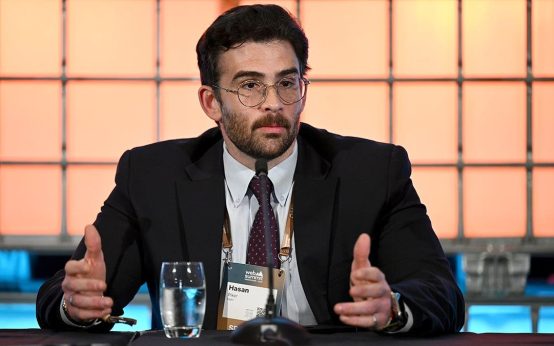 Twitch Streamer Hasan Piker Discusses Controversial Commentary
  A Shifting Political Landscape: The Decline of Autocratic Power
  Trump Delivers Warning to Iran, Cuba at UN General Assembly
  Lukashenko and Putin’s Unique Relationship and Belarus’ Strategic Role
  Alan Ritchson Faces Backlash Over Political Remarks
 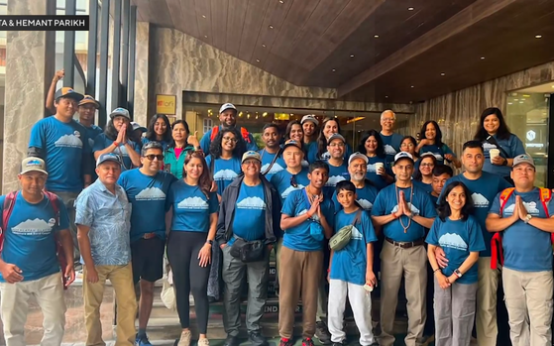 Himalayan Pilgrimage: A Couple’s Narrow Escape and Lingering Questions