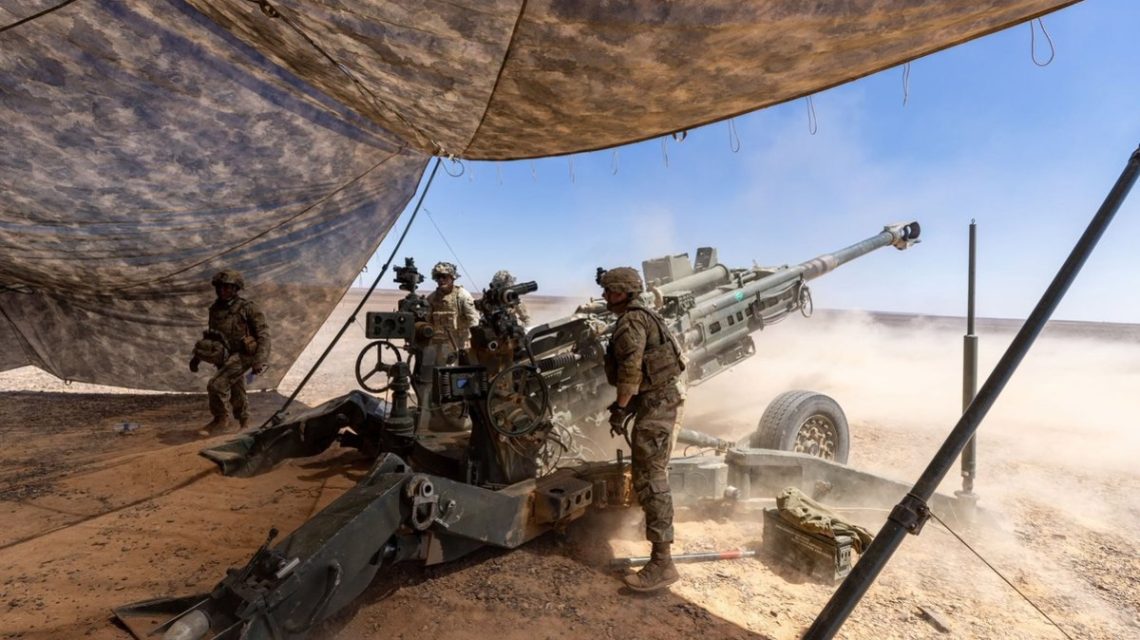
U.S. Military’s Innovative Thinking in the Middle East
U.S. forces deployed in the Middle East are recognized for their innovative thinking and work methods. Captain Timothy Hawkins from the U.S. Central Command (CENTCOM) highlighted this aspect recently. Admiral Brad Cooper, CENTCOM’s top commander, actively listens to ideas from all service levels.
Seeking New Tactics Against Iran
The U.S. military is exploring proposals to counter Iran as the war against Tehran continues into its sixth month. An intelligence officer from CENTCOM mentioned that unconventional methods are under consideration to pressure and penalize Iran, as reported by CNN. They did not disclose the email sender or recipients, nor could Newsweek independently verify these details.
The wording of the request has sparked debates. Some view it as a sign of a poorly planned military involvement by the White House, lacking clear objectives or an exit strategy. Others believe it might be a standard practice within military communications.
Speculation on Potential Strategies
It’s unclear what specific responses were expected from the request. CENTCOM has neither confirmed nor denied the content of the CNN report. As costs rise with the ongoing conflict, the sender might be searching for novel strategies, perhaps akin to Ukraine’s impact on Russia with drone warfare. Jim Townsend, a former Pentagon official, suggests that the underlying question could be: “How can we emulate Ukraine’s success?”
Ukraine has recently targeted Russian assets beyond military sites, influencing negotiations dynamics. In the Middle East, despite U.S. efforts and economic sanctions, Iran retains control over the strategic Strait of Hormuz.
Reactions to the Unusual Request
The context of the CNN-reported message is not entirely clear, making it challenging to gauge its significance. Active-duty personnel can propose new ideas via media or academic platforms, discussing drone usage or enhancing air defense systems. The military also organizes contests to gather strategic insights.
Historically, U.S. intelligence agencies and officials have devised action plans, reviewed by the National Security Council and the president. Townsend notes that while the message’s directness might seem surprising, intelligence officers typically assess enemy vulnerabilities to provide strategic options.
Assessment of the Situation
Critics argue the request indicates a lack of clear planning. While gathering inputs across the military isn’t abnormal, a written appeal is unexpected. Several military officials from the U.S. and Europe find such a method peculiar.
Mark Cancian, a former Marine Corps colonel with CSIS, mentions that innovative suggestions have emerged in previous conflicts, but typically not through formal calls. The approach has raised curiosity and concern among officials familiar with military protocols.
Contact for Further Information
For more insights on this story, contact Newsweek editors Frances Mao and Tony Phillips.
 Trump’s Approach to Iran at the United Nations
  North Korea’s Missile Launches Escalate Tensions
  U.S. Plans for Permanent Army Base in Poland Amid Tensions with Russia
  Berlin’s Mayoral Race: A Candidate Inspired by New York Leadership
  Cuba Faces Sixth Power Grid Collapse Amid U.S. Fuel Blockade
  Daring U.S. Rescue Mission in Iran