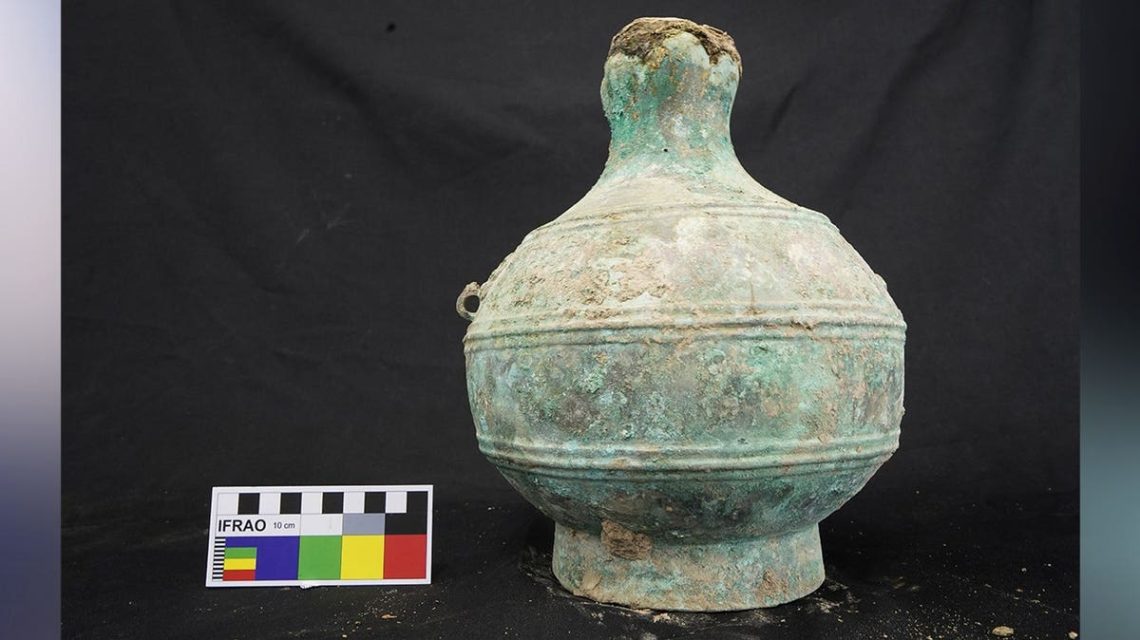
Chinese researchers have recently discovered a remarkable artifact: a large bottle containing an ancient alcoholic drink, estimated to have been sealed for more than 2,200 years. This ancient beverage was unearthed in a bronze vessel within a Qin tomb at the Shanjiabao cemetery in Ningxia Hui Autonomous Region, China. The findings were detailed in the June issue of the Journal of Archaeological Science: Reports.
Historical Context and Initial Findings
The tomb dates back to the Warring States period (475-221 B.C.), a time characterized by rival kingdoms before China’s first unification. Archaeologists identified the liquid as a cereal-based alcoholic beverage, likely a fermented grain drink akin to what is loosely referred to as ‘beer’. What set this discovery apart is that the vessel contained 3,740 milliliters, or 3.74 liters, of well-preserved liquid, rather than just residue.
Ruru Chen, a researcher with Northwest University’s School of Cultural Heritage in Xi’an, noted the surprising volume and preservation of the liquid. She observed no noticeable odor and only a small amount of sediment at the bottom. The liquid appeared clear, with a light blue-green tint.
Analysis and Composition
The bronze bottle featured a ‘garlic-shaped mouth’, a design typical for Qin vessels meant for alcoholic drinks. Through analyses involving organic chemistry, metabolomics, starch grain examination, yeast remnants, and other microscopic studies, researchers identified the beverage’s ingredients and its brewing process. Starch grain analysis revealed that broomcorn millet was the primary ingredient, with wheat and/or barley also involved.
The beverage resembled a non-distilled alcoholic drink made from millet, or a mixture of millet and wheat/barley. High concentrations of lactic and oxalic acids, along with other organic compounds, were consistent with ancient cereal-based alcoholic beverages.
Preservation and Future Research
Researchers remain curious about how the liquid was preserved so well for over two millennia. Chen suggests the dry local environment, the bronze vessel, its sealing method, and the burial conditions might have contributed to its preservation. These aspects warrant further study.
This discovery aims to inspire more research into ancient Chinese alcoholic beverages and traditional brewing techniques. A previous discovery in a Bronze Age cemetery in northwestern China also indicated ancient fermentation techniques, with residue of beer-like drinks inside pottery vessels that date back over 3,000 years.
 Virginia Tech Researchers Investigate Black Bear Hibernation
  Exploring Recommended Reads from Diverse Authors
  Significant Viking Age Silver Hoard Discovered in Finland
  Digital Divide: America’s Two Economies
  Dogs Use Similar Language Recognition Techniques as Human Infants
  Discovery of Tilcayo Tiger Cat, a New Wild Cat Species in Bolivia