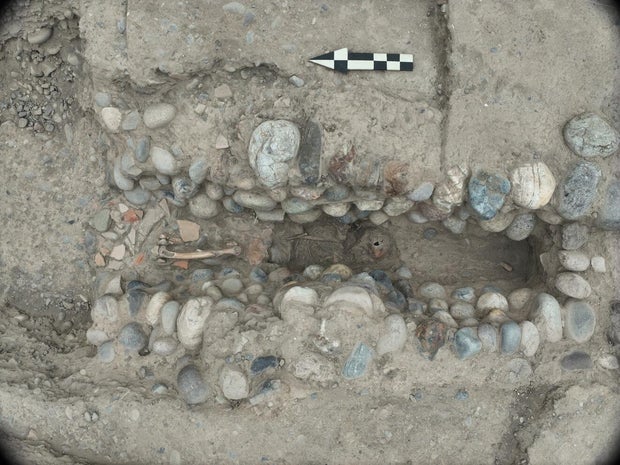
Archaeologists have unveiled the skeletal remains of an adult near the base of Huaca Pucllana, an ancient adobe pyramid located in Lima, Peru. Experts believe the remains belong to a man sacrificed in a ritual, possibly connected to the closure of a canal linked to a ceremonial pool.
The remains have been dated to around A.D. 650, estimated to be approximately 1,400 years old, according to Peru’s culture ministry. Images of the excavation site have been released to the public.
Leading archaeologist Gladys Paz stated that the findings enhance the understanding of Lima culture rituals and help reconstruct ancient ceremonies. The body was discovered lying on its left side, with the skull directed toward the pyramid and the Pacific Ocean.
The culture ministry highlighted the architecture of the ceremonial well as a significant aspect of the discovery. Unlike other structures at Huaca Pucllana known for using small mud bricks, this well was constructed with river stones.
The Lima culture, thriving between the first and seventh centuries along Peru’s central coast, preceded the Inca Empire by several centuries. Huaca Pucllana served as an essential ceremonial and administrative center for the Lima culture. This vibrant civilization vanished long before Spanish conquistadors founded Lima in 1535.
Currently, Huaca Pucllana is surrounded by modern amenities in the districts of Miraflores and San Isidro. It’s open to tourists and features a restaurant offering Peruvian dishes like ceviche and roasted alpaca.
The skeletal remains are from the Lima culture, according to the excavation’s leader Gladys Paz.
Peru is home to more than 400 archaeological sites across metropolitan Lima. Pieter Van Dalen, an archaeology professor at the National University of San Marcos, noted the frequent discovery of tombs, mummified remains, and other burial items along Peru’s coast.
Recent years have seen similar discoveries during construction projects. In July 2025, utility workers unearthed two pre-Incan tombs over 1,000 years old while expanding an underground gas network. In June 2025, a 1,000-year-old mummy of a child was found during pipe installations. Additionally, in April 2025, the remains of a 5,000-year-old noblewoman were discovered at Caral, a sacred site once misused as a garbage dump.
New technology continues to advance archaeological efforts, providing deeper insights into the past.
 Challenges and Future Plans for the Canadian Army
  China’s State Visit and the Implications for Trade and Military Growth
  Russia Criticizes U.S. Base and Nuclear Plans in Lithuania
  Trump’s Influence in Latin America: Political Wins and Strategic Moves
  Flávio Bolsonaro’s Strategic Decision in U.S. Visit
  Russian Scientist’s Death Raises Concerns Over Plague Exposure