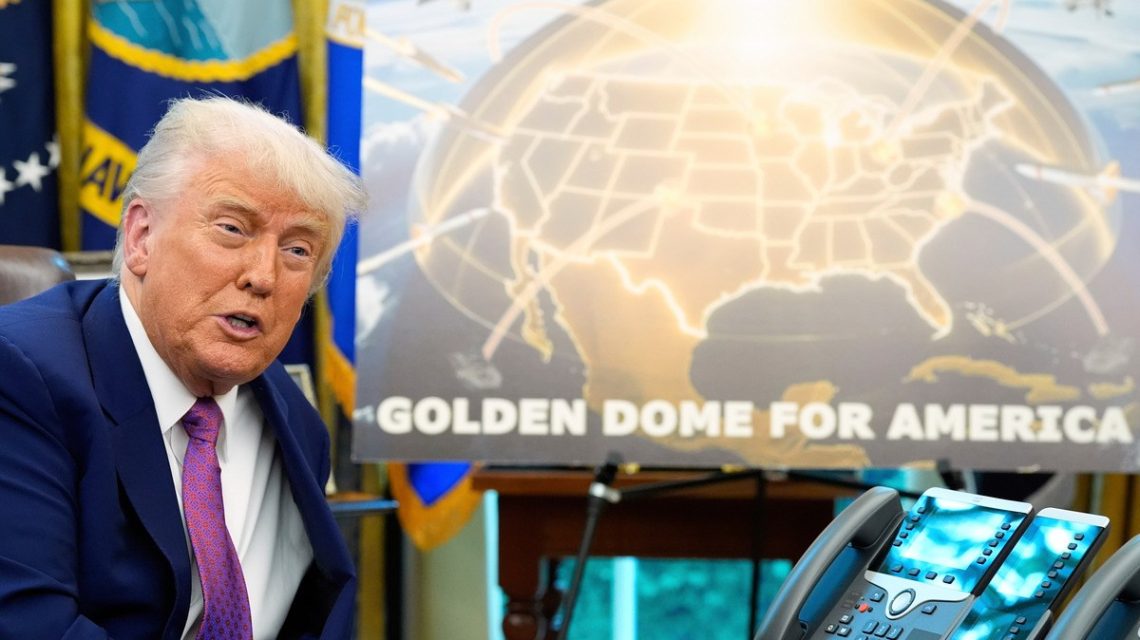
A senior Russian official has issued a stark warning about President Donald Trump’s new defense plans, including the Golden Dome missile shield currently under development. This plan might trigger a new space arms race and have severe consequences for the international community.
Gennady Gatilov, Russia’s envoy to the UN in Geneva, expressed his concerns. Quoting remarks reported by Russia’s Tass state news agency, he said, “The risks of turning outer space into an arena of armed confrontation have ceased to be hypothetical.” He also highlighted that the outcomes would be catastrophic for humanity.
Despite various militaries already employing satellites for intelligence, communication, and missile warnings, orbiting weapons have remained a divisive topic over the decades. A pivotal aspect of the Golden Dome would involve orbiting interceptors to nullify incoming missile threats. These would work in conjunction with early-warning sensors stationed in space. However, details of its comprehensive design are yet to be disclosed by the U.S. government and military.
Further, high-profile leaders such as Russia’s Vladimir Putin and China’s Xi Jinping described the proposal as an “obvious threat to strategic stability.” North Korea remarked that the initiative reeked of “self-righteousness” and “arrogance.” The Trump administration argues that the project is essential to counter next-gen attacks, such as fast ballistic and hypersonic missiles traveling over five times the speed of sound.
Russia and China have made significant advancements in hypersonic weapons, while the U.S. and NATO still lag in this domain. Proponents of the Golden Dome advocate that technological progress now supports building a partial space defense system. Trump has notably linked this initiative to a project from Ronald Reagan’s era, widely known as “Star Wars.” This Cold War-era plan sought to intercept Soviet missiles using space lasers.
Challenges and Cost Concerns
Yet, critics remain skeptical about the Golden Dome’s ability to defend against full-scale attacks from nations like Russia or China. The Congressional Budget Office (CBO), a nonpartisan body advising U.S. lawmakers on funding, projected colossal costs. In May, the CBO estimated the Golden Dome would require approximately $1.2 trillion over 20 years, vastly surpassing the initially allocated $175 billion. The CBO highlighted that 70% of acquisition costs and 60% overall would stem from the space-based components. It noted that while the system might handle small-scale or North Korean assaults, it might be “overwhelmed” by attacks from superpowers.
Several companies compete to develop this system, including defense giants like Lockheed Martin and Northrop Grumman. The U.S. Space Force aims to present an “initial capability” by 2028.
Despite the ambitious timelines, communication gaps persist. CBO official David Mosher mentioned in a Brookings Institution event that his agency hadn’t communicated effectively with the Pentagon’s Golden Dome team, remaining uninformed on the program’s advancements.
Political and Security Implications
Various U.S. politicians, like Oregon Senator Jeff Merkley, caution that this defense initiative could destabilize global peace, and escalate a nuclear arms race with adversaries like Russia and China.
The Golden Dome intends to protect the mainland U.S., Alaska, and Hawaii. Canada is negotiating to be included under the defense shield but needs to contribute significantly to the costs. The current joint U.S.-Canada missile defense is administered by NORAD. Collaboration with Canada remains uncertain, and coordination of air defenses without their involvement remains unclear.
Challenges persist with threats from drones. After recent experiences in the Middle East, the U.S. deliberates on how the Golden Dome might counter unmanned aerial vehicles effectively.
In its January National Defense Strategy, the Pentagon emphasized the need for cost-effective solutions against large missile barrages and advanced aerial threats. Given the high price of defense interceptors, often in the millions, global militaries continue to seek affordable ways to neutralize substantial air threats like drones. Earlier, the Pentagon established a new “hub” for defense companies, academics, and investors. This aims to reduce bureaucratic hurdles typically involved in defense procurement.
 Abdul El-Sayed’s Political Stance Examined
  Supreme Court Evaluates Retirement Fund Management
  Grief and Remembrance: A Mother’s Journey and National Vigilance
  Controversial Trump Statue Displayed in European Parliament
  Generational Debate Over Social Security: Taxes and the Future
  Ohio Senate Race and Congressional Contests: Key Details and Developments