
A newly discovered planet, GJ 523b, is confounding scientists with its unique characteristics. This massive body, over twice the size of Earth, has a surprisingly thin atmosphere despite its size. Researchers from the University of Wisconsin-Madison are trying to understand why this planet, which is more than 2.5 times Earth’s size and nearly 23 times its weight, does not have a thick layer of gas.
GJ 523b is estimated to be around 170 million years old. It is composed primarily of dense rock surrounding a significant core. Lead researcher Max Kroft expressed his surprise at finding such a large dense planet almost devoid of atmosphere. Typically, dense planets are smaller, rocky bodies akin to Earth or Mercury.
What Is a Mega-Earth?
The term ‘Mega-Earth’ refers to an extraordinarily large terrestrial planet, characterized by high density and mass. These planets are more substantial than ‘super-Earths’ and predominantly consist of solid materials like rock and metal. Professor Thomas Beatty suggested that GJ 523b might help to better define this category of planet.
Beatty mentioned that the term ‘Mega-Earth’ had been used for over a decade without a definitive example, but GJ 523b offers a clear representation. To fully understand this planet, expertise beyond astronomy is essential. Geologists need to examine how materials behave under extreme pressure conditions, and atmospheric scientists must analyze the composition of the planet’s surface.
The planet was first detected by NASA’s Transiting Exoplanet Survey Satellite (TESS), which identifies potential planets through detecting periodic dips in the brightness of stars. This dimming indicates a planet transiting in front of its star. Kroft used the WIYN telescope in Arizona and data from the James Webb Space Telescope to further study GJ 523b’s density and atmosphere.
Why Is Its Atmosphere So Small?
Generally, scientists expect a large core of rock and metal to gather a hydrogen-rich atmosphere. Within our solar system, planets like Jupiter and Saturn developed substantial atmospheres after reaching a mass similar to GJ 523b. Kroft questioned why GJ 523b didn’t follow this pattern despite its mass.
The research team suggested that GJ 523b might have once orbited very closely to its star, causing intense heat to strip away much of its atmosphere. Another possibility is that the planet formed from the collision of two planets, with the resulting heat from the impact removing its atmosphere.
Kroft stated that a planet might lose its atmosphere due to high temperatures, which could explain the lack of substantial atmosphere despite its size.
 Gene Otp’s Role Extends Beyond Brain Development
  Orland Park to Bolster Flood Protection with State Grant
  Exploring Geoengineering Concepts to Tackle Glacier Melting
  Inside Colombia’s Powerful Earthquake and Future Risks
 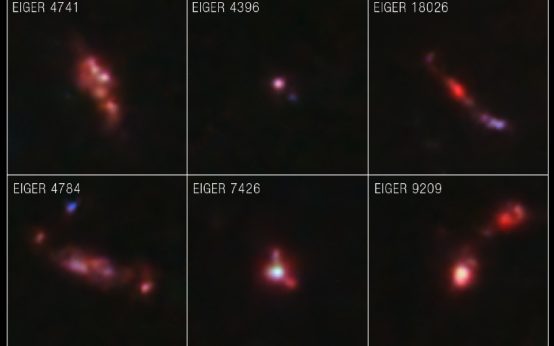 James Webb Space Telescope Uncovers Early Universe Surprises
  Why Mathematician Eugenia Cheng Embraces the Question ‘Is Math Real?’