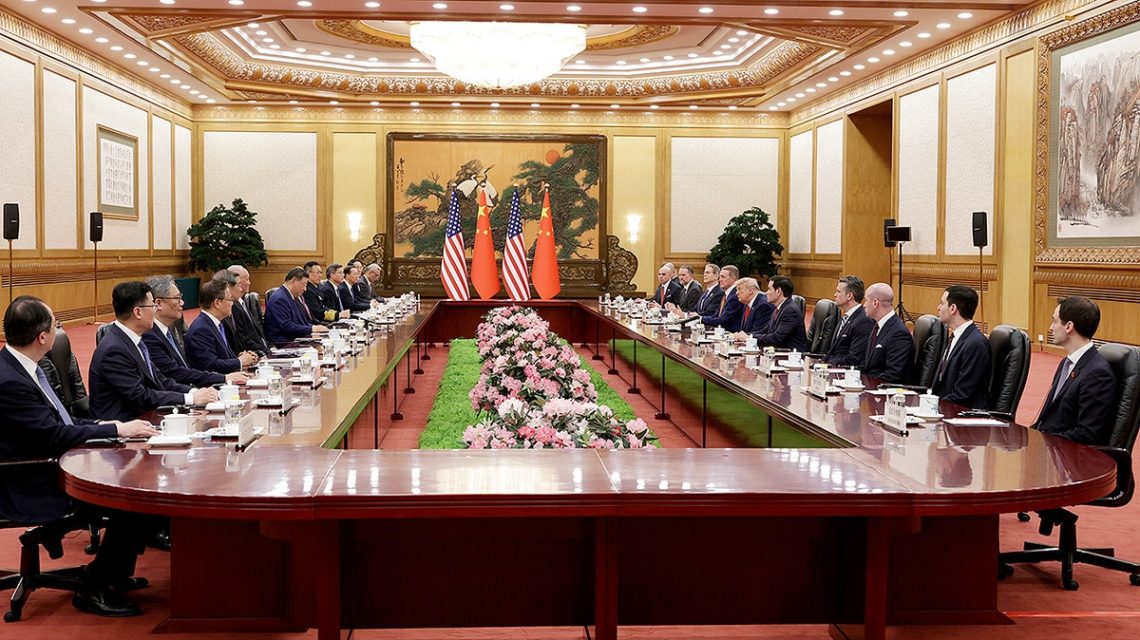
When President Donald Trump meets Chinese President Xi Jinping in Washington this week, a full agenda awaits. Key topics include trade, tariffs, rare earth minerals, national security, and supply chain dynamics. Looming over these discussions is a critical technological rivalry that may shape the future balance of economic and military power: artificial intelligence (AI).
The stakes in this technological competition revolve not only around who can develop the best AI models but who controls the chips, computing infrastructure, and underlying technology ecosystems. The U.S. remains a global leader in advanced AI technology and semiconductor design. However, China is working hard to reduce its dependence on U.S. technology with companies like Huawei playing pivotal roles. For years, the U.S. has imposed export controls to limit China’s access to advanced semiconductors and technology, especially those with military applications, aiming to prevent strategic competitors like China from enhancing their military capabilities.
Yet, these restrictions have prompted China to accelerate its development of an independent AI ecosystem and reduce reliance on American technology. Huawei has expanded its AI chip offerings, and Chinese developers have optimized software to work with domestic hardware. Chinese companies have invested heavily in systems that compensate for domestic chips’ performance limitations. Huawei’s recent strategy includes rapidly advancing its AI processors and expanding their capacity to meet growing domestic demand.
This rapidly evolving situation demands a shift in strategy from Washington. The key question is not solely how to guard American technology from China but how to ensure the global market continues to favor American technology over China’s offerings. If U.S. technology becomes inaccessible, China and companies like Huawei will have incentives to innovate and fulfill demand, impacting global preferences.
Once a software ecosystem is in place with corresponding computing infrastructure investments, shifting becomes challenging. This is why the current situation is not merely a competition over chip sales but a struggle over which ecosystem becomes the global standard. The U.S. aims for a future dominated by American chips, software, and innovation, while China seeks alternative solutions helmed by Huawei and others.
President Trump’s administration has deviated from former policies by maintaining strategic export controls and permitting certain advanced technologies for sale to China under specific conditions. This move aims to protect vital national security technologies without yielding commercial markets unnecessarily to Chinese competitors.
America’s dominance in AI and semiconductor innovation does not guarantee permanence. It requires defense and strategic planning. If American policies make its technology less accessible globally, China could capitalize, offering competitive alternatives. Discussions about slowing AI development or imposing sweeping restrictions in the name of safety are ongoing and merit careful consideration.
AI holds real risks with genuine military applications, and export controls remain a significant national security tool. However, each measure can carry consequences. The primary concern should be whether restrictions enhance American security without inadvertently boosting China’s tech ecosystem. Huawei continues its relentless advancement, and global demand for AI computing shows no signs of waning.
The U.S. has a strategic interest in retaining its central role in the global tech ecosystem. Prior generations of American leaders witnessed vital supply chains shift overseas; repeating this mistake with AI infrastructure could weaken U.S. strategic power. Those controlling advanced computing will gain considerable advantages in various critical sectors, including scientific discovery, healthcare, manufacturing, intelligence, cybersecurity, and military technology.
The Trump-Xi meeting extends beyond immediate trade agreements or diplomatic statements from Washington. It represents a contest over who will shape the technological infrastructure of the 21st century. The U.S. should safeguard its most sensitive technologies and intellectual property while enabling American companies to compete globally. Developing chips domestically, building semiconductor infrastructure at home, and advancing innovative technology are crucial actions. Ultimately, U.S. technology must remain appealing to international markets to counterbalance Huawei’s influence.
 Protecting Your Finances from Increasing Cyber Threats
  Nvidia CEO Jensen Huang Talks AI, U.S.-China Competition, and Data Centers
  Legal Battles Over Sports Betting and Addiction Claims
  Concerns About Rapid Advancements in Artificial Intelligence
  Leading AI Companies Face Antitrust Lawsuit for Alleged Coordination
  Documentary Critiques Elon Musk’s Ambitions