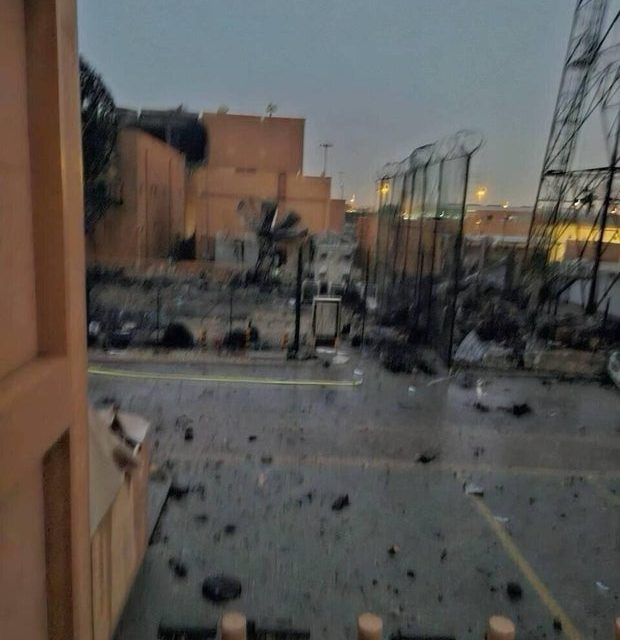
The war between Iran and the United States took a sudden and dramatic turn, with Iran targeting the Navy’s Middle East headquarters in Bahrain on the first day. This attack occurred before the evacuation of military families, leaving some stranded for over a week. Multiple families shared their harrowing experiences with CBS News.
“You’re definitely scared,” one military spouse recounted, describing the daily reality of waking up to and falling asleep amid ballistic missile fire.
Over several days, Iranian missiles and drones continued targeting Bahrain, surprising the U.S. government with the intensity and persistence of the attacks. Three sources in Bahrain at the time noted the unprecedented scale caught officials off guard, with evacuations occurring after the war had commenced.
Despite anticipations of potential retaliation, evacuations of the headquarters’ buildings were completed, but the attack’s magnitude was unexpected, according to a U.S. official. Several families residing nearby remained in peril.
One spouse witnessed the contrails of missiles and drones while another heard the explosions. CBS News maintained their anonymity to protect them from potential backlash for coming forward. Thankfully, no military personnel were killed during these attacks; however, circulating images on social media depicted significant damage, including a crucial radar system destroyed on the war’s first day.
The Pentagon has yet to release an estimated cost for the base’s damages. During an interview with The Epoch Times, Acting Navy Secretary Hung Cao stated Iran’s retaliatory strikes severely impacted Bahrain. Since its establishment as the Navy’s Fifth Fleet headquarters in the 1990s, the base has been pivotal for logistics during operations in Iraq and Afghanistan, catering to over 8,300 military personnel and their families.
Supply Chain Challenges
The damage has extended its effects to sailors at sea, evident in the USS Abraham Lincoln aircraft carrier experiencing food shortages. The Navy adapted resupply routes, deviating from Bahrain, and utilized Diego Garcia, an island roughly 2,200 miles away. This change in logistics saw cycle durations extend to 14 to 18 days, as opposed to the previous 5 to 7 days from Bahrain, according to a Pentagon Inspector General report.
During a recent town hall, Chief of Naval Operations Admiral Daryl Caudle acknowledged the logistical restructuring necessary for Middle East supply. “There was some early learning there on getting the logistics process in place that I think now we have in a very good situation,” Caudle noted.
Caudle also informed a sailor evacuated from Bahrain of ongoing efforts to retrieve belongings left behind, emphasizing the absence of immediate plans to reoccupy the base to its former extent.
Evacuation Challenges for Families
Navy spokespersons have clarified that service members stationed in Bahrain can directly manage the shipment of household goods and vehicles, or appoint someone on their behalf. Evacuated families face complicated circumstances, having been moved from Bahrain to areas such as Norfolk, Virginia, or Tampa, Florida.
Since the war began, roughly 1,450 service members and their families relocated from Bahrain. Many now face financial strains because they maintain households in both Bahrain and the U.S. “We have burned through our savings,” a spouse informed CBS News. In some instances, college funds for children have been used to manage bills.
The Pentagon offers reimbursements for housing costs in these situations, though families report lengthy processing times for claims. A Navy spokesperson assured continuous communication with affected individuals, emphasizing case management support.
Military families are granted until the end of November to transition from a safe haven to a designated residence to preserve entitlements.
Support From Non-Profits
Blue Star Families, a non-profit organization aiding military families, has offered supplies to evacuees in Tampa. Suzy Malloy, the executive director of the chapter, recounted providing backpacks, clothing, and cooking appliances to help families adapt temporarily.
Malloy remains optimistic, noting evacuees are gradually settling into Tampa despite remaining uncertainties. “My opinion is [U.S. Central Command] and their family readiness program have done a remarkable job keeping the train on the tracks,” she added.
Although families express frustration at the situation’s unpredictability, they acknowledge no fault with the military, rather, the ongoing evacuation complexity.
“Nobody expected this to go on so long,” lamented a spouse.
 State Department Alerts on Middle East Travel Amid Rising Tensions
  United Russia’s Dominant Election Result: Implications for Putin’s Ukraine Policy
  Canada’s Tariff Reduction on Chinese EVs Raises Security Concerns
  Hunter Shoots Woman Mistaken for Deer in Delaware
  Logan and Jake Paul’s Visit to the Pentagon Raises Eyebrows
  Trump’s Shift in Foreign Policy and Its Implications