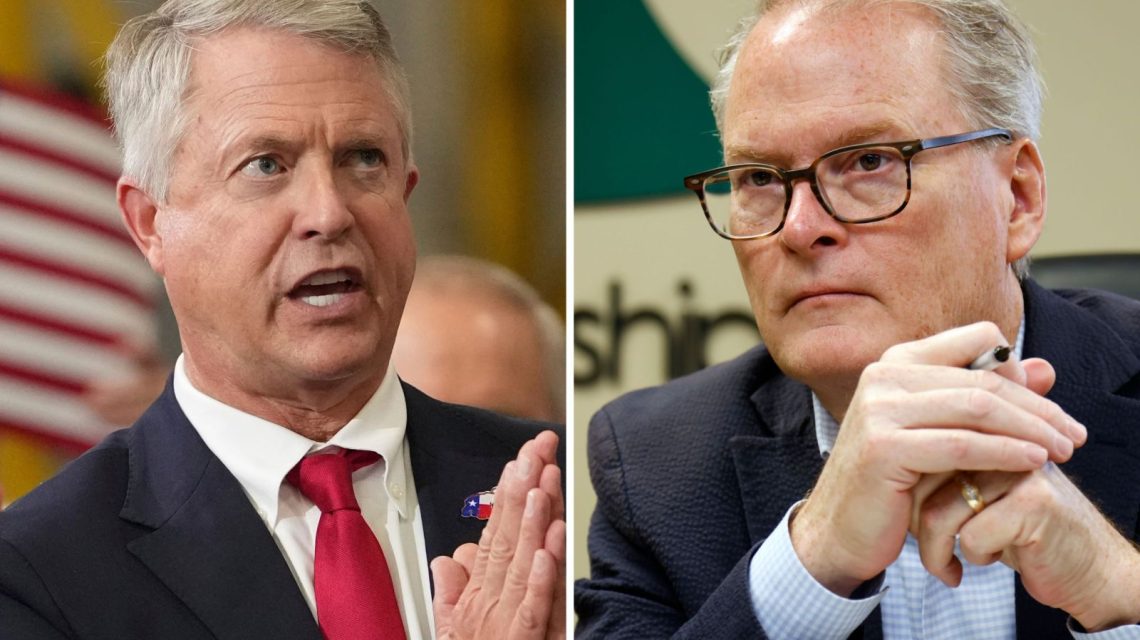
Kansas’ Senate race is becoming more competitive than expected in a state where Democrats haven’t won a Senate seat in nearly a century. A new Emerson College Polling/Nexstar Media survey shows Democratic candidate Adam Hamilton leading with 45 percent over incumbent Republican Senator Roger Marshall, who has 43 percent, while libertarian candidate David Graham captures 4 percent. This poll, conducted between September 15-16, is the first of its kind this cycle to indicate Hamilton ahead.
Marshall is aiming for a second term. Hamilton, founder of the largest United Methodist Church in the nation, seeks to become the first Democrat elected to the Senate from Kansas since 1932. Vice President JD Vance is scheduled to visit Olathe, Kansas, to back Marshall soon.
Polls and Predictions
Despite the closeness suggested by the latest Emerson College poll, Marshall is still the likely favorite. Spencer Kimball, executive director of Emerson College Polling, notes that Hamilton’s appeal to independent voters is considerable, with a 15-point lead among them.
Earlier data from co/efficient polling conducted September 8-10 showed Marshall leading Hamilton 49 percent to 44 percent. Other surveys have also reflected a close race, such as a Global Strategy Group poll conducted August 12-16, where Hamilton was narrowly ahead, and a Public Policy Polling survey from August 7-8, which had Marshall modestly leading.
The Cook Political Report now rates the race as “likely Republican,” down from “solid Republican,” following Hamilton’s nomination in August. Prediction markets, like Kalshi and Polymarket, largely favor Marshall, giving him a 71-74 percent chance of winning.
Influence of Independents
Independents appear to play a crucial role in the competitive nature of the Kansas Senate race. According to Emerson polling, Hamilton has a significant lead among independents, outpacing Marshall 42 percent to 27 percent.
Favorability is nearly equal, with Marshall at 41 percent favorable and Hamilton slightly better off at 41 percent favorable as well, yet 13 percent of voters are still forming opinions about Hamilton.
President Trump’s approval in Kansas is relatively low at 40 percent, while Governor Laura Kelly has a 46 percent approval rating. The economy emerges as the main concern for voters, significantly overshooting other issues like healthcare and education.
A Red State’s Complex Politics
Kansas has consistently supported Republicans for Senate seats. Marshall has never lost a race by more than single digits. However, Kansas shows political complexity in statewide offices and ballot measures. Governor Laura Kelly has been elected twice, and a 2022 ballot measure to restrict abortion rights was overwhelmingly defeated.
Marshall continues to appeal to the traditional Republican base, targeting rural voters and cautioning that an electoral win for Hamilton might aid Democrats in overtaking the Senate.
Hamilton presents himself as a centrist. He highlights his church’s diverse political makeup, nearly balanced among Democrats, Republicans, and independents, reflecting the cross-party support he hopes to garner.
Hamilton’s Background and Campaign
Newbie candidate Hamilton founded Church of the Resurrection in Leawood, growing it from humble beginnings to become the nation’s largest United Methodist Church with 25,000 members. He won the Democratic nomination in August, positioning himself as a faith-based moderate able to compete in conservative Kansas. His early fundraising success, having raised $3.6 million within two months, has invigorated Democrats about their prospects.
Marshall has labeled Hamilton “too woke,” while Hamilton maintains his message of unity and moderation.
Marshall’s Legal Record
Roger Marshall has been involved in numerous lawsuits concerning unpaid medical bills over his career. The New York Times highlighted that more than 700 patients were sued for debts, some as little as $101, with half the lawsuits under Marshall’s name and the rest by Heartland Regional OBGYN.
The litigation affects rural Barton County, where uninsured rates and poverty are notably high. Some challenged patients faced 18 percent yearly interest rates and account garnishments.
While lawyer Steven Johnson justified arrests to enforce court dates, Marshall’s campaign defended his practice’s method of providing uncompensated care akin to other healthcare institutions in Kansas.
 Federal Appeals Court Decision Against Trump’s ‘Third-Country’ Deportation Policy
  President Trump’s Controversial Ban on Media Outlets Sparks Press Freedom Concerns
  U.S. Security Agreement in Greenland Sparks Optimism and Concerns
  Cook County’s Property Tax Bridge Loans
  A Controversial Stance on Immigration Policies Sparks Debate in South Carolina
  Trump Administration Challenges In-State Tuition for Undocumented Students