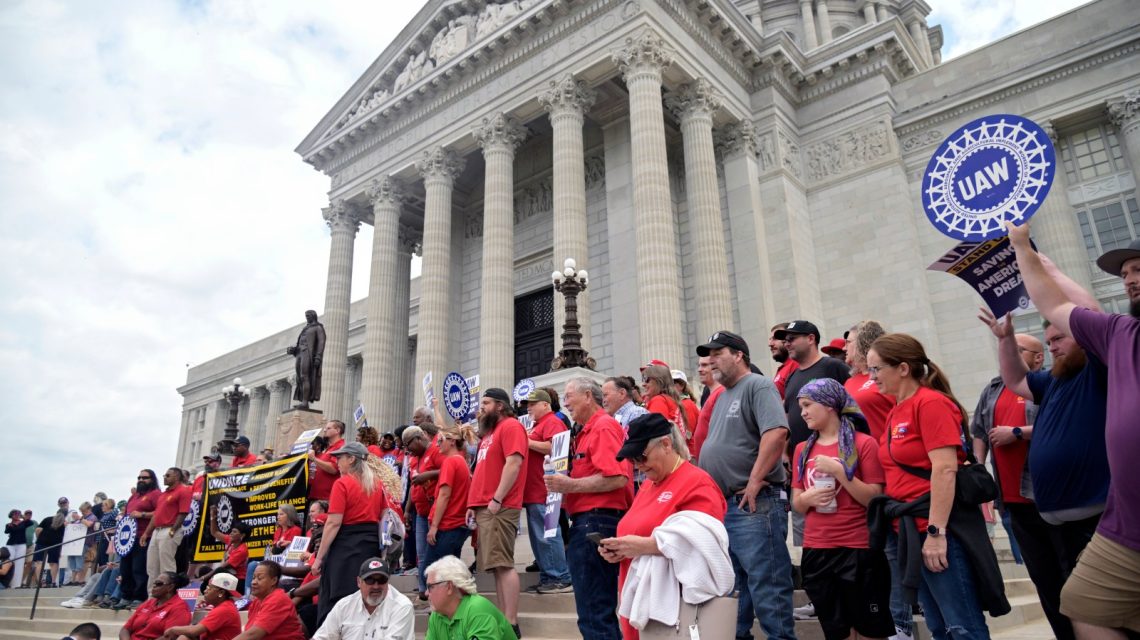
The Supreme Court has once again declined to reinstate Missouri’s Trump-endorsed congressional map for the upcoming midterm elections. This decision concludes a protracted legal struggle that endangered the voting process, especially since absentee ballots were already in circulation.
Supreme Court’s Decision
In a brief and unsigned opinion, the justices highlighted the potential for “electoral chaos” if maps were modified at such a late stage. Missouri is thus permitted to continue employing the congressional districts established following the 2020 census.
Republicans had hoped the newly proposed map would afford them an additional seat in the House. Consequently, Missouri voters will be casting their ballots according to the same district demarcations used in previous elections from 2022 and 2024.
Reaction from Missouri Leaders
Reacting to the decision, Missouri Republican Governor Mike Kehoe expressed dismay on social media. He noted his disappointment that the state’s general election would utilize a different map than its primary. He emphasized that voters should have had consistency and certainty, lamenting the change in electoral rules between elections. Nonetheless, Kehoe affirmed Missouri’s compliance with the Court’s ruling.
The court’s opinion pointed out the impracticality of switching maps with the election process already active. The bench noted, “Ballots using the 2022 map have been printed and mailed.” Missouri election officials declared reverting to the 2025 map “practically impossible.”
Richard von Glahn, the executive director of People Not Politicians Missouri, remarked on the ruling. “We are done with corrupt politicians trying to force their map into effect outside the process outlined in the Missouri constitution,” he asserted. He reiterated that Missourians, not politicians, should make decisions about such power moves.
Controversies and Legal Maneuvers
Friday’s decision emerged from weeks filled with conflicting orders in both state and federal courts. The crux was which map Missouri should adopt. Missouri lawmakers gave the green light to a novel congressional map in 2025, championed by former President Donald Trump. This was part of a broader initiative by Republicans to reshuffle Missouri’s districts before the midterms.
The Missouri Supreme Court dictated on September 3 that the map would require voter approval through a referendum. Until then, the state was directed to employ the districts established after the 2020 census for the 2026 election.
On September 8, the U.S. Supreme Court upheld the state ruling. On the same day, U.S. District Judge Stephen Clark issued a contrary order advocating the 2025 map. The Supreme Court intervened on September 10, blocking Clark’s directive.
The turbulence persisted as the 8th U.S. Circuit Court of Appeals, on September 21, favored the Trump-backed map and demanded the district court mandate its use for November’s elections. The Supreme Court’s decision Friday reversed this change.
Implications of Missouri’s Map Change
The 2025 map significantly altered Missouri’s 5th Congressional District, mainly encompassing Kansas City, led by Democratic Representative Emanuel Cleaver. The changes removed parts of Kansas City from the district while extending it east into more rural Republican territories.
Republicans aimed to convert these district adjustments into an added House seat. Though six out of Missouri’s eight seats are held by Republicans, the newly proposed map was seen as a potential tool to gain a seventh.
Missouri utilized the revised districts in the August primary, yet the November elections would revert to former boundaries. November would determine the fate of the 2025 map.
State Republican Senator Rick Brattin clinched the GOP primary for the 5th District under adjusted boundaries. Cleaver faced no opposition in the Democratic primary. Both retain their candidacy for the general election despite the boundary shifts.
Brattin, alongside Republican Representative Bob Onder and two more voters, initiated a federal lawsuit prompting the Eighth Circuit’s ruling and the subsequent Supreme Court appeals.
Legal Battles Over Redistricting
Missouri’s redistricting triggered a significant legal contest. Over 16 lawsuits have been filed across state and federal courts on this matter.
Most challenges against the new map floundered in court. Arguments claiming mid-decade redistricting breached state constitutional provisions, or that the new boundaries lacked necessary compactness, did not hold.
Secretary of State Denny Hoskins rejected a petition seeking a statewide vote on the map on August 4, citing legal limitations related to congressional redistricting. Subsequently, the Missouri Supreme Court ruled the referendum valid and instructed Hoskins to desist from employing the new map.
The U.S. Supreme Court maintained this ruling on September 8, but Clark issued a conflicting order minutes later. The Supreme Court then impeded Clark’s order on September 10.
On the same day, due to compliance with Clark’s directive, the Missouri Supreme Court briefly held Hoskins in contempt for instructing local officials to adopt the new demarcations.
Later, the Eighth Circuit supported the Trump-backed map, setting the stage for the Supreme Court’s definitive ruling.
Note: Newsweek utilized Martyn, an AI assistant, for story production.
Contact Newsweek editors on this story: Edward T. Cummins.
 Talarico’s Narrowing Poll Lead Over Paxton in Texas Senate Race
  House Democrat Introduces New Articles of Impeachment Against Trump
  The Maine Senate Race: Susan Collins vs. Troy Jackson
  Iran War Debate Among Senate Nominees
  Texas Senate Race: Talarico Challenges Paxton to Fox News Debate
  Judge Holds DHS in Contempt Over Deportation