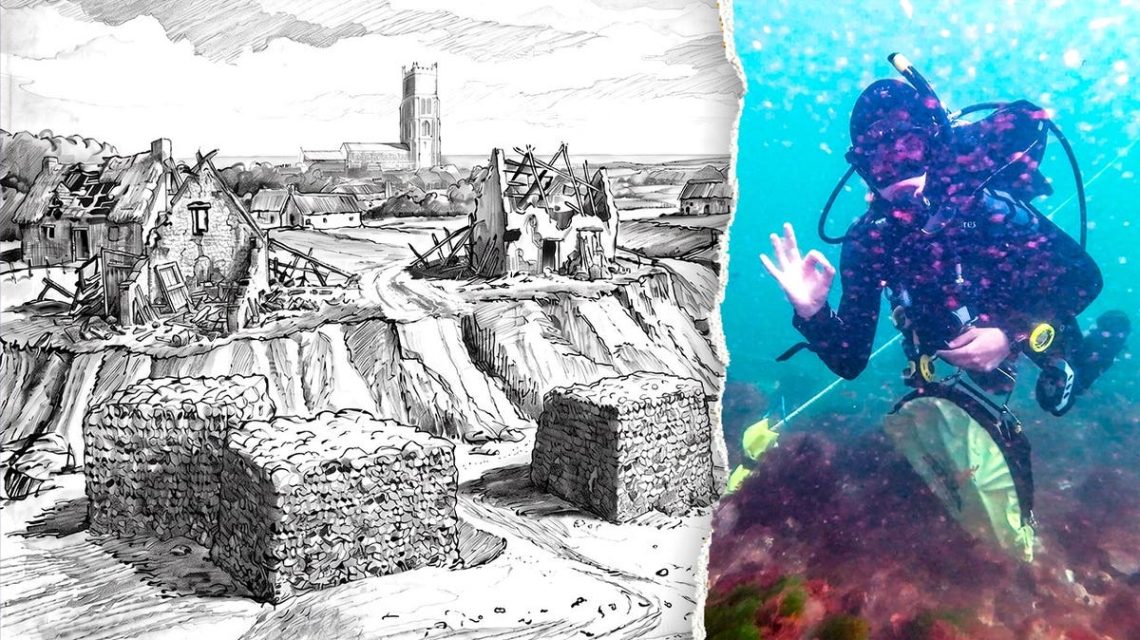
Divers have captured images of underwater structures believed to be remnants of a village engulfed by the sea 700 years ago. These images and video were taken off the coast of Norfolk, UK, as reported by Jam Press.
The remains are thought to be the town of Shipden, a medieval settlement consumed by the North Sea in the 14th century. At the site, divers photographed and mapped 25 man-made features. Pictures reveal large, marine-covered stone structures rising from the sandy seabed.
Volunteer divers from the East Anglian branch of the British Sub-Aqua Club (BSAC) assisted in the survey and mapping for the Alfred Savin Project. The North Sea’s usual rough conditions were calm during the dives, allowing for better documentation.
Structures made of flint and other cut stones were found, including stone foundation structures known as caissons. While caissons might have been part of a 14th-century effort to hold back the sea, their exact purpose remains unclear.
Shipden once had 117 residents, recorded in the Domesday Book of 1086. The town featured a harbor, two churches, meadow, and woodland. By the 14th century, mentions of Shipden faded, and Cromer became the known name for the area.
“For the present, we’re putting forward ideas rather than conclusions.” – Nick Schiller, Lead Diver
Historical records confirm the loss of a church to the sea, but definitive remains have not been found. Legends suggest the tower of St. Peter’s Church lies beneath the waves on Church Rock.
Lead diver Nick Schiller said the team originally aimed to find remains of the Victoria wrecked on Church Rock in 1888. It’s believed Church Rock might instead be medieval sea defenses.
Peter Stibbons, project director, stated that examining medieval records alongside physical findings could provide more insights. The story of Church Rock is well-known in Cromer, but the legend’s accuracy is questioned.
 El Niño Forecast: Long-lasting and Powerful Impacts on Weather Patterns
  Nor’easter Pummels U.S. East Coast with Heavy Rain and Strong Winds
  Oregon’s Wildfire Crisis Calls for New Solutions
  Microplastics in the Great Lakes: A Growing Concern
  Virginia Tech Researchers Investigate Black Bear Hibernation
  Reviving Ancient Methods to Combat Plastic Waste