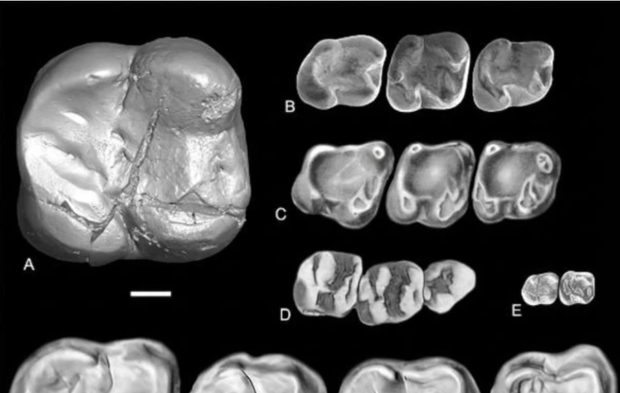
On November 5, 2026, researchers announced the discovery of a giant rodent species that lived in what is now southern Thailand 33 to 35 million years ago. This previously unknown species was identified from two fossilized teeth. The find offers fascinating insights into how early rodents grew to considerable sizes during the Paleogene period.
The study, published in the journal Scientific Reports, revolves around a molar and an incisor found in 2004 at a coal mine in Krabi province, Thailand. Pannipa Tian, a geologist with Thailand’s Department of Mineral Resources, discovered the incisor and initially misjudged its type due to its significant size.
“Initially, I thought it was a bone,” Pannipa, 51, shared. “My supervisor recognized it as a giant rat’s tooth,” she explained in an interview with AFP.
The fossil was notably cream-colored, contrasting against the dark coal, while a team member found the dark-colored molar soon after. Krabi Basin has a history of yielding fossils from various ancient creatures like primates and carnivores. However, identifying the species was a challenge due to limited evidence and technology back then.
More than 20 years later, researchers from Thailand, France, and Canada analyzed the teeth in detail. They concluded that the rodent weighed about 30 kilograms, roughly half the size of a large capybara, which is the biggest rodent living today. Although the prehistoric creature belonged to the extinct Ischyromyidae family, different from the South American capybara, it provided insights into past biodiversity.
Yakamys sirindhornae, named after Thailand’s Princess Sirindhorn for her support in scientific research, showed that ancient rodents might have originated in Thailand before dispersing globally. Despite the breakthrough, the species’ appearance, diet, and behavior remain mysteries due to the limited fossil evidence.
This discovery highlights the diversity of prehistoric rodents. In recent years, other significant finds include a human-sized rat in the Amazon rainforest discovered in 2020 and other massive rodents in South America, such as the 1-ton creature identified in 2008.
 Swift Observatory’s Final Journey Ends in Earth’s Atmosphere
 Coastal Flooding Highlights El Niño’s Impact on Southern California
 Radiation Risks for Satellites as Solar Storms Breach Boundary
 Study Explores Effects of Physically Interacting With Dogs on Stress
 Reassessing Josephus’ Account of Jesus
 Cannabis and Sleep: Surprising Research Findings