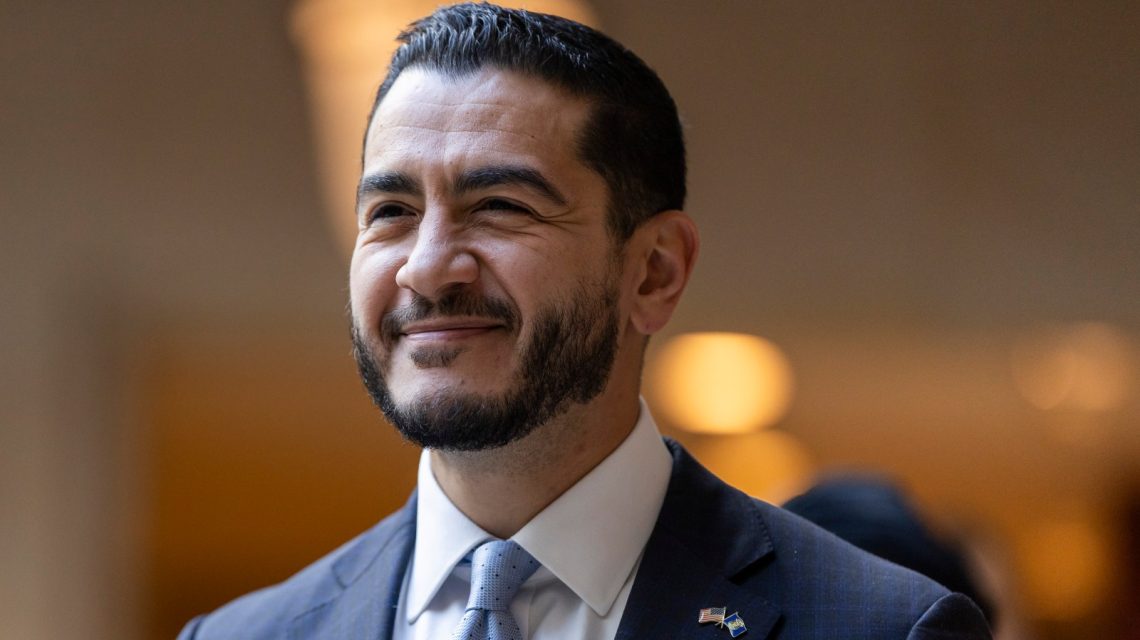
Michigan Senator-elect Abdul El-Sayed recently shared images of a mock gold “TrumpCare” card featuring President Donald Trump’s signature. This move aims to persuade Trump to support Medicare for All. “This is a message for @realDonaldTrump,” El-Sayed wrote on X. “Donald, this is on the table. Guarantee healthcare for every American, from cradle to grave.” The card’s back reads, “Show this card at any doctor, hospital clinic, or pharmacy in the United States.” Its appearance resembles the Trump Gold Card, a visa program for wealthy foreigners costing over $1 million.
The timing of El-Sayed’s post aligns with U.S. health costs remaining significantly higher than those of other wealthy nations. Americans spent an average of $14,775 per person on health care in 2024, nearly $5,000 more than Switzerland, the next-highest spender, according to the Peterson-KFF Health System Tracker. Other comparable countries spend approximately half that amount. It is estimated that U.S. citizens owe at least $220 billion in medical debt, with around 14 million adults having debts exceeding $1,000.
Before entering politics, El-Sayed served as head of Detroit’s health department. As a physician and son of Egyptian immigrants, he maintains that a single public insurance program could resolve many issues, with the gold card being his latest strategy to urge Trump’s support.
El-Sayed’s focus on universal healthcare has been central to his political ideology since 2018, when he lost the Democratic primary for governor in Michigan. Despite never having held elected office, he defeated Republican former Representative Mike Rogers on November 3. He advocated for single-payer coverage, reducing external financial influence in elections, and critiquing policies toward Israel. Beginning in January, he will replace retiring Democratic Senator Gary Peters, becoming the first Muslim in the U.S. Senate.
The mock “TrumpCare” card idea emerged publicly on November 6. In a conversation with Zeteo editor-in-chief Mehdi Hasan, El-Sayed expressed his openness to the president branding the program with his name. “If he wants to pass Trumpcare-for-All, I’m ok with it. He seems to like to put his name on things,” El-Sayed stated. He reaffirmed this position in a CNN interview with Kaitlan Collins, emphasizing his commitment to ensuring healthcare access for everyone in the U.S., regardless of the program’s name.
El-Sayed aims to achieve cradle-to-grave coverage without copays, premiums, or deductibles, eliminating the risk of medical debt. His plan has evolved, with previous descriptions of Medicare for All as a comprehensive version of traditional Medicare covering all Americans for life. During campaign debates, he proposed a wealth tax and a Federal Reserve-modeled governing board. El-Sayed has also stated that workers should retain supplemental private insurance from unions or employers.
Parallel to El-Sayed’s proposal, Vermont Senator Bernie Sanders highlighted during an interview that there is uncertainty regarding Trump’s potential support for a bill to lower the Medicare age. Sanders has urged a reduction in eligibility from 65 to 55 as a viable early step, possible to pass with 51 Senate votes through budget reconciliation. Despite this push, the Medicare for All Act and its House companion, sponsored by Representatives Pramila Jayapal and Debbie Dingell, have not received a floor vote. House Democratic Leader Hakeem Jeffries and Senate Democratic Leader Chuck Schumer have yet to endorse them. A separate proposal by Representative Rosa DeLauro aims to let citizens keep private insurance while opening an expanded Medicare program to all.
Trump’s stance on single-payer healthcare has fluctuated over time. In his 2000 book, “The America We Deserve,” Trump advocated reevaluating the single-payer plan. Shortly before taking office, he emphasized broad insurance coverage, though without endorsing single-payer explicitly. By 2018, his views had shifted, criticizing the Democratic proposal as “Medicare for None” in a USA Today op-ed.
Trump recently critiqued large insurance companies, signaling a new tone. El-Sayed, then a candidate, responded by suggesting Medicare for All. While Trump pledged to become “Mr. Veto” should Democrats gain Congress, he has expressed willingness to negotiate on healthcare legislation.
The Trump administration’s health policies brought significant changes through the One Big Beautiful Bill Act in July 2025, reducing federal Medicaid spending by $1.1 trillion over a decade. This law also implemented work requirements for certain Medicaid recipients. The expiration of enhanced Affordable Care Act premium tax credits led to coverage losses for approximately 130,000 Michiganders. In response, the administration unveiled the Great Healthcare Plan, offering direct subsidies for insurance purchase and enforcing “most-favored-nation” drug pricing agreements.
Trump’s continued branding within office extended to various initiatives, including TrumpRx.gov, a discount drug site, and the Trump Gold Card. His likeness now appears on items such as a gold commemorative coin and special edition passports. Presidential historian Jeffrey Engel remarked on the unprecedented consistency of naming initiatives after a sitting president.
El-Sayed’s principal campaign focus included affordability, reducing corporate political influence, advocating for Medicare for All, and curbing funding for international conflicts. In a Detroit victory speech, he connected Republican challenges to his faith with systemic issues like energy costs.
El-Sayed’s agenda has faced criticism, including accusations of altering his stance on private insurance from the Democratic primary runner-up, Michigan state Senator Mallory McMorrow. Opposition also arose regarding his views on Israel and participation in events alongside controversial figures. Prior to the election, El-Sayed’s Democratic opponent Haley Stevens endorsed Republican Mike Rogers, citing inadequate response to community concerns from El-Sayed.
With Democrats gaining congressional control in January, legislative progress remains contingent on clearing a Senate filibuster and potential presidential vetoes. Newsweek indicated that targeted measures, like restoring ACA subsidies and adjusting Medicare Advantage policies, might have a greater chance of enactment. Estimates from the House Budget Committee suggest Medicare for All could elevate federal deficits by $47.4 trillion from 2027 to 2036.
 Defense Secretary Hegseth Faces Controversy Amid Political Challenges
 Pence Contemplates 2028 White House Run, Calls for Conservative Principles
 Gavin Newsom to Decide on 2028 Presidential Bid by January
 Trump Claims He Could Defeat Obama in Hypothetical Matchup
 Stephen A. Smith Criticizes Trump and Warns Democrats