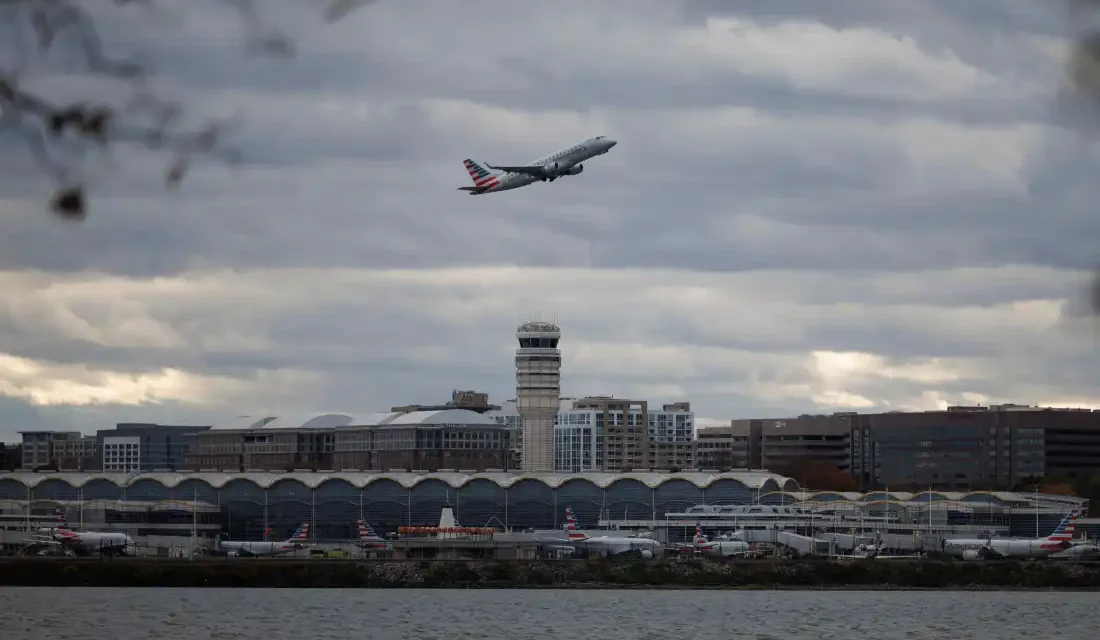
On Saturday, November 14, 2026, aircraft were observed at Ronald Reagan Washington National Airport in Arlington, Virginia, after a nationwide grounding of flights by the Federal Aviation Administration (FAA). Thousands of passengers continue to face disruptions as airlines work to reschedule canceled flights. According to FlightAware.com, more than 2,300 flights have been canceled, and over 8,000 flights within, into, or out of the U.S. have experienced delays by Sunday evening.
Airports in Dallas-Fort Worth and Atlanta encountered significant delays, each with over 250 flights affected. U.S. Transportation Secretary Sean Duffy assured that normal operations would resume shortly. “By the end of today, end of tomorrow, I think we will be back to normal,” Duffy stated during NBC’s Meet The Press. He explained that grounding flights leads to aircraft and crews being out of position, requiring time for realignment.
Duffy attributed the ground stop to maintenance issues by L3Harris Technologies Inc., a federal contractor. L3Harris was in the process of upgrading equipment, replacing old copper wires with fiber-optic cables, when the FAA’s legacy system became overloaded, causing communication disruptions. Potential problem sources included a radar site in Amarillo, Texas, and a radio site in El Dorado, Arkansas.
L3Harris emphasized the seriousness of the situation in a statement, mentioning that safety and reliability are top priorities. “With safety and reliability as our highest priorities, L3Harris, together with its telco partners and the FAA, has completed more than 70% of the planned airspace communications conversion from legacy copper wires to a fiber optic system,” the company said.
President Trump urged Congress to approve additional funding to update aging air traffic control systems. He highlighted past investments and called for an immediate $50 billion emergency fund. Trump previously secured $12.5 billion in 2025 for upgrades. “We need to put money into it to make sure that it’s still resilient for the future,” Duffy remarked on the need for continual investment.
However, there is concern about spending practices. Representatives André Carson and Rick Larsen pointed out that while $12.5 billion was authorized for upgrades, only $4.3 billion had been obligated with $1 billion spent, leaving significant funds unallocated and unspent.
Nick Daniels, president of the National Air Traffic Controllers Association, acknowledged the challenges faced by controllers during the disruption. He praised their ability to manage an unexpected nationwide airspace shutdown effectively. “It shows what air traffic controllers can do when an entire national airspace system is shut down while working on unreliable equipment,” Daniels commented.
 Carmelo Anthony’s Defense of Baltimore Sparks Controversy
 Thanksgiving Remembrance: A Family’s Tribute to NYPD Detective Wenjian Liu
 Developments in Bar-tailed Godwit’s Migration, Trump-Cornyn Dispute, and Measles Resurgence
 Princeton Student Detained by U.S. Immigration After Conference
 Schaumburg Staff Settle into New Village Hall
 Clarification of Policy on LGBTQ+ Discussions in Liverpool Central School District