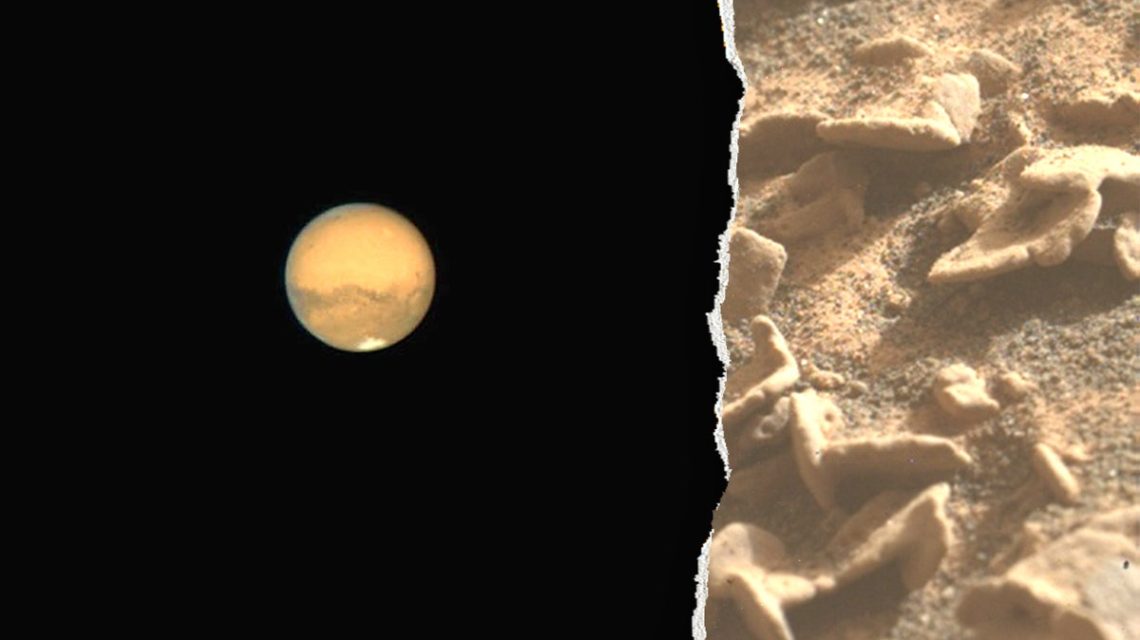
NASA scientists are investigating peculiar formations on Mars’ surface. These formations, resembling potato chips, are under scrutiny to understand their composition and formation process.
The announcement came through NASA’s ‘Curiosity’ blog on November 11. The Curiosity rover, which has been on Mars since 2012, recently focused on these formations during a drilling campaign at a site named ‘Nazca’.
Located in a Martian region with distinctive disk-shaped features, the Nazca site intrigues scientists. The NASA blog described the area as having bedrock with crystal forms appearing as disks or potato-chip shapes.
‘This is an area characterized by bedrock containing disk-shaped (or, in a liberal interpretation, potato-chip shaped) crystal forms,’ the NASA blog noted.
The Curiosity rover collected samples from the Nazca drill hole for analysis using its onboard SAM instrument, which examines the chemical makeup of Martian samples.
Additional analysis involved the ChemCam instrument, equipped with a laser, aimed at a formation nicknamed ‘Colca’. This helps determine its chemical composition. At night, the Mars Hand Lens Imager (MAHLI), using white-light and ultraviolet lamps, photographed the crystal formations.
NASA aims to better characterize these formations to understand their origin. The rover’s recent findings contribute to ongoing Martian exploration efforts. Following its examination, Curiosity plans to continue its journey southward to explore further.
Fox News Digital reached out to NASA for comment on these formations. These chip-like structures are under investigation as scientists explore Mars and beyond.
In related astronomical news, a potential dwarf planet nicknamed 2026 ED138 was discovered beyond Pluto. Using the Vera C. Rubin Observatory in Chile, astronomers estimate the object’s size between 370 and 930 miles across, marking it as one of the largest dwarf planets known.
 Lego Fortnite Supply Llama: A Tween’s Dream Gift with Huge Savings
 Developments in Bar-tailed Godwit’s Migration, Trump-Cornyn Dispute, and Measles Resurgence
 Jensen Huang’s Controversy Highlights Challenges for Corporate America
 Federal Agencies Face Cybersecurity Challenges
 FBI’s Crime Database Faces Hacking Threat
 November’s Beaver Moon: A Celestial Event to Watch