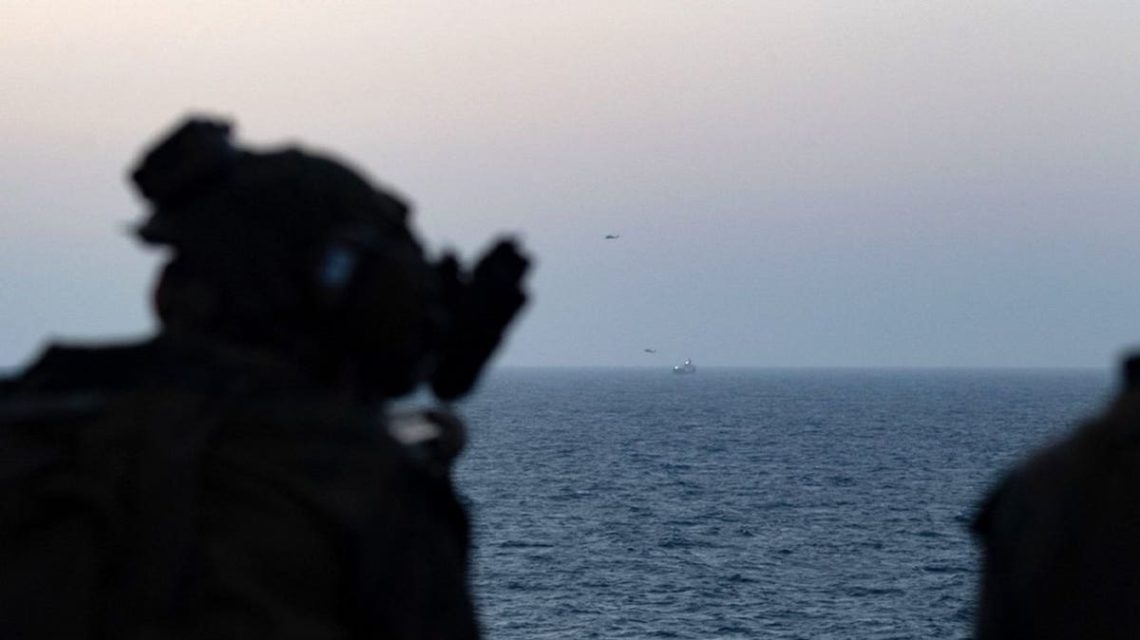
Donald Trump has emphasized the effectiveness of the United States Navy’s blockade against Iran, claiming control over the Strait of Hormuz. This military strategy significantly impacts Iran’s economy and diminishes its naval and air force capabilities. It also targets key terrorist figures. The U.S. maintains its military dominance, outpacing rivals like Russia in submarine technology.
Recent reports suggest Iran plans to send numerous tankers through the U.S. blockade, raising concerns about possible conflict. A maritime security expert warns of a potentially dangerous situation if Iran challenges the American naval presence in the Gulf. Trump expressed confidence that any Iranian attempt would fail.
“I hope they do, they’ll all be at the bottom of the sea like the rest of the navy,” Trump stated in response to questions about Iran testing the blockade’s limits.
The proposed Iranian operation involves tankers departing from Kharg Island, a crucial oil export site. Maritime experts view this as likely propaganda with minimal chance of success.
Charlie Brown, with experience in maritime sanctions, dismissed the plan. He noted the blockade extends beyond the Strait of Hormuz across the Indian Ocean.
“The ability of the United States Navy to enforce this blockade extends across the entire Indian Ocean and beyond,” Brown commented.
The United Kingdom Maritime Trade Operations (UKMTO) recently noted an incident involving a tanker in the Gulf of Oman, but details remain limited. The Institute for the Study of War (ISW) warns of increasing likelihood Iran will try to break the blockade due to economic pressures.
A report indicated Iran amassed 14 tankers at Kharg Island to breach the blockade. Attempting this could jeopardize the tanker fleet or escalate tensions with the U.S.
Brown remarked that Iran’s strategy is likely a bluff. He mentioned satellite observations show no significant tanker loading at Kharg Island.
Coordination issues would arise if Iran attempted a 14-vessel convoy. Danger to civilian crews refusing U.S. military orders adds complexity to Iran’s plans.
“They would obviously be going into an area of great risk, and they would have to decide whether to comply with the instructions to stop or face action,” Brown noted.
The U.S. Central Command (CENTCOM) has warned ships participating in Iranian ship-to-ship cargo transfers could face interception.
Brown explained that U.S. forces could issue commands over radio from naval ships or aircraft, with non-compliance potentially escalating military responses. The U.S. Navy’s global reach allows oversight even beyond the 5th Fleet in the Indian Ocean.
“It’s a mission of the United States, not merely a mission in CENTCOM,” Brown stated.
 Negotiators Struggle to Agree at UN Climate Talks in Turkey
 Mass Shooting at Private Concert in Tulare County: Nine Injured
 A Family’s Struggle Amid Devastation in Zawtar al-Gharbiyah
 Concerns Rise Over Tear Gas and Reproductive Health in France
 Escalating Paris Protests Lead to Violent Clashes
 Flavio Bolsonaro’s Allegations and Political Exile