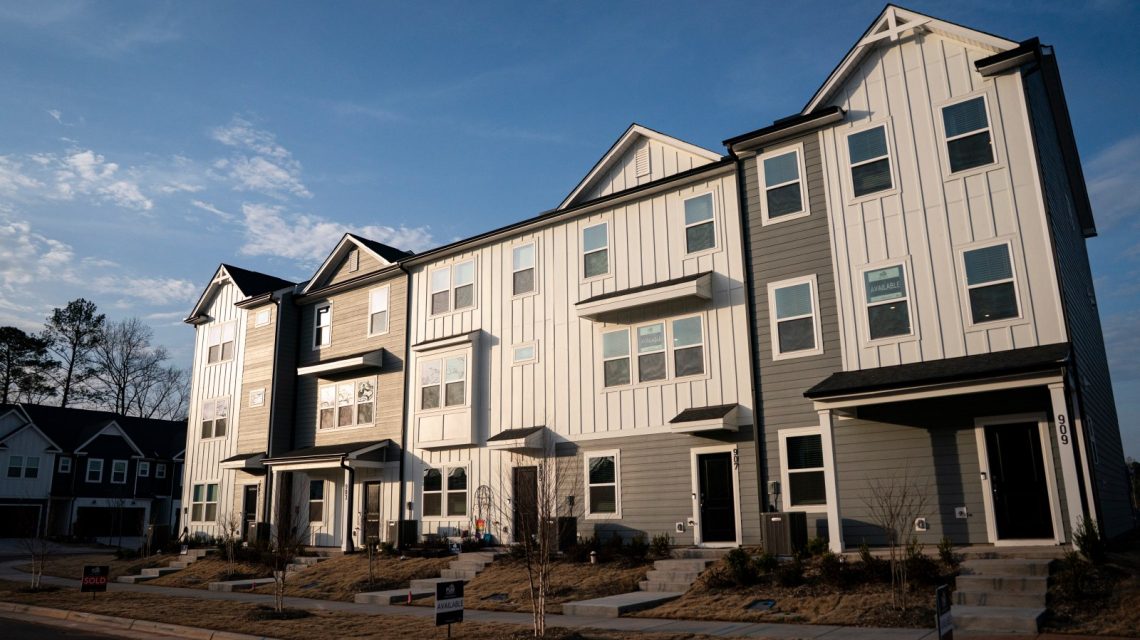
The National Association of Home Builders (NAHB) reports a significant shift in the housing market. Newly built homes are now nearly $40,000 cheaper than existing homes, reversing historical trends. The NAHB/Wells Fargo Cost of Housing Index (CHI) identified that in the third quarter, new homes averaged $393,300—9.2% less than the $432,900 price of existing homes.
This price difference provides relief for families facing high housing costs. Families earning the national median income of $106,800 need to spend 33% of their income on a new home’s mortgage. Comparatively, they would need 36% for an existing home’s mortgage.
“Low-income families face an even greater gap,” NAHB says, “needing to spend 66% on new homes versus 73% on existing ones.”
Historical Market Shift
Traditionally, existing homes have been cheaper due to costs for repairs and upgrades. The current market, however, is unique. Home prices are over 30% higher than pre-COVID levels. Inventory remains low nationwide, despite increases in states like Florida and Texas. Estimates suggest a shortage of at least 10 million single-family homes.
Mortgage rates have risen sharply. As of November 19, the average 30-year fixed-rate reached 7.28%, compared to 6.26% the previous year. This rise, along with elevated property taxes and insurance premiums, is discouraging potential buyers.
Home Sales at a Low
October saw national home sales fall to a 16-year low of 3.75 million, an 8.8% decrease from the previous year, according to the National Association of Realtors (NAR). Pending home sales dropped 4.7% month-over-month and 16.7% year-over-year.
NAR’s chief economist, Lawrence Yun, remarked, “It’s puzzling that sales are low despite population growth.”
Cost-Burdened Buyers
NAHB data highlights the most cost-burdened markets. In San Jose-Sunnyvale-Santa Clara, California, a family spends 79% of their income on an existing home mortgage. Urban Honolulu, Hawaii, follows with 73%. California cities such as San Diego and San Francisco also feature among the top five costly markets.
Conversely, the Midwest, especially Illinois, offers more affordable housing. Decatur, Illinois, leads as the least cost-burdened market, where families spend 17% of their income on mortgages. Other affordable regions include Elmira, New York and Peoria, Illinois.
New Homes Hold Affordability Advantage
The affordability of new homes improved in the third quarter, offering the largest advantage since the CHI began. The median new-home price dropped over $17,000, reducing the needed income share from 34% to 33% for families. For low-income families, the share fell from 67% to 66%.
Builders are reducing prices to attract buyers amid rising costs. In a recent survey, 43% of builders cut prices and 65% offered sales incentives. These measures help buyers but challenge builders facing rising construction costs and labor shortages.
U.S. single-family homebuilding rebounded in October, but future permits dropped to their lowest in over three years, indicating potential short-term improvement.
“Policymakers should eliminate regulatory barriers and encourage affordable home construction,” urged NAHB Chief Economist Robert Dietz.
 Navigating Life Next to a Golf Course
 Rustic Tiny Home with Customization Options for $21K
 Controversy Surrounding North Texas Development with Mosque at Its Center
 Silicon Valley’s Luxurious Growth Amid Anthropic’s IPO
 Swanky Hotel to Transform Historic Minneapolis Building
 Amazon Offers Affordable Prefabricated Tiny House with Scenic Views