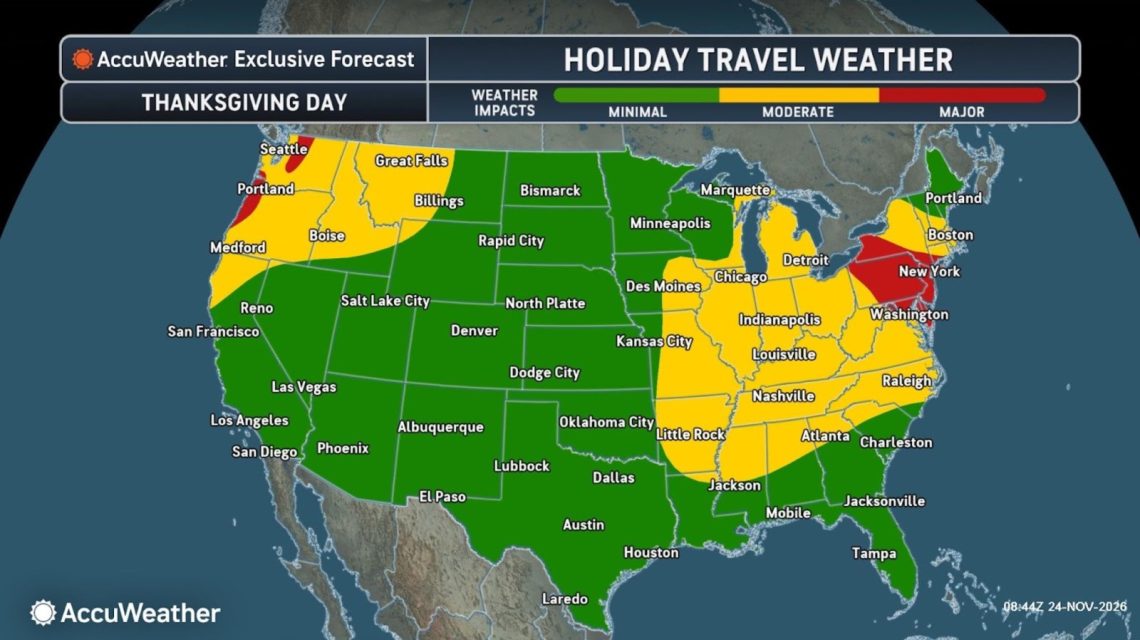
Thanksgiving travel and celebrations across the United States face disruption as an eastern storm and high Pacific tides pose challenges for both coasts. Forecasters anticipate heavy rain, strong winds, and snow could affect the Northeast and Midwest, potentially disrupting flights, road conditions, and holiday parades. Meanwhile, the West Coast faces coastal flooding risks due to a combination of storms, king tides, and elevated water levels linked to El Niño.
Eastern Storm to Disrupt Travel
The American Automobile Association (AAA) expects 81.5 million Americans to travel at least 50 miles from home between November 24 and November 30. However, weather conditions could complicate these plans. AccuWeather forecasts a storm will develop in the Gulf on Tuesday, stretching northward through the Southeast by Wednesday. The storm may reach the Northeast and Midwest on Wednesday night, continuing into Thanksgiving Day.
Heavy rain and strong winds could disrupt flights in Atlanta and slow travel along parts of I-75, I-85, and I-95. Affected areas may include eastern Missouri to eastern Illinois, where wet, heavy snow totaling 1 to 3 inches may hamper driving on I-55, I-64, and I-70. Flight delays and difficult conditions are anticipated on the I-95 corridor between Washington, D.C., and New York City on Thanksgiving Day.
The storm is expected to deliver two to four inches of rain across a region from the eastern Carolinas to southern New England on Thursday. Strong winds and rains could also impact parades in cities like Philadelphia and New York. Gusty winds, rain, and snow showers may disrupt flights and Black Friday shopping in the Northeast and Great Lakes, affecting routes like I-80 and I-90. Florida could see additional rainfall, adding to recent historic flooding in parts of the state.
King Tides on the West Coast
The West Coast will also experience adverse conditions with a sequence of Pacific storms bringing rain, wind, and mountain snow to California, Oregon, and Washington. Fox Weather forecasters indicate that king tides, related to the full moon, are expected to merge with storm-driven waves and onshore winds, heightening the threat of coastal flooding.
El Niño, a naturally occurring climate pattern, raises water levels due to thermal expansion as warmer Pacific waters expand. According to AccuWeather senior meteorologist Heather Zehr, king tides are typically the highest tides of the year, leading to elevated water levels. Coupled with El Niño, these tides could lead to substantial coastal flooding.
The worst flooding is predicted between Tuesday and Thanksgiving Day, especially around high tide times. Some roads might close due to flooding, affecting low-lying and previously unaffected areas. Water depth will vary with the tide, leading to repeated flooding at each high tide.
 FAA Implements New Runway Taxi Policy
 Federal Officials Plan Controlled Detonation at Iowa Ammunition Plant
 Challenges and Perspectives on Welfare and Municipal Responsibility in Chicago
 Nvidia’s CEO and the Stock Market Rollercoaster
 Turkeys Enjoy Luxurious Stay Before White House Pardoning
 California’s Electricity Rate Hikes Amid Commission Changes