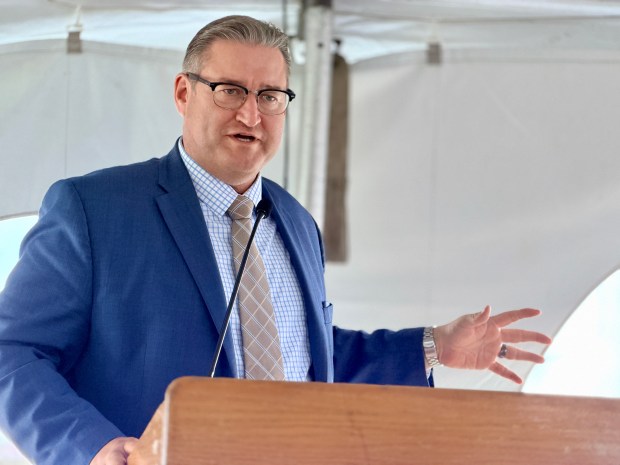
On his second day as the president of the Northern Indiana Commuter Transportation District (NICTD), Mike Noland attended a public meeting in Munster. The focus was on the South Shore Line expansion from Hammond to Dyer. This meeting, held at Munster’s Center for Visual and Performing Arts on October 28, 2014, introduced potential routes to the public through poster board displays.
Noland, recently retired, recalled his early involvement in the environmental process for the West Lake Corridor. The new 20-year strategic plan of the Regional Development Authority (RDA) proposes further extensions to towns like Crown Point, Merrillville, and Valparaiso.
Despite retiring, Noland continues to work on the final details of the Monon Corridor project, which commenced full service on April 1 under his successor, David Dech. Noland’s experience with commuter rail service is extensive. He began with Metra Electric in 1983 when freight railroads were exiting passenger service, and legacy commuter systems were financially struggling. The Chicago Rock Island and Pacific Railroad declared bankruptcy in 1976 and was liquidated four years later.
The South Shore Line’s management structure is reminiscent of Metra’s inception, where a government agency assumed control of commuter services. Today, echoes of past fiscal challenges resurface. In Illinois, the legislature faced demands for more public transit funding, while Indiana’s General Assembly reached an agreement with NICTD for additional resources, with a commitment to biennial fare increases to offset pandemic-related losses.
Noland’s career began in Metra’s personnel department, later human relations. He attended law school and became Metra’s chief HR officer at age 30. Five years later, he was appointed general counsel. His tenure was marked by challenges, such as the suicide of troubled Metra CEO Phil Pagano. Before assuming leadership at NICTD, Noland gained experience with Iowa Pacific, a short-line railroad, which prepared him for managing South Shore Line operations.
South Shore Line operates with a lean staff structure, similar to short-line railroads. Kelly Wenger, NICTD’s strategic planning director, manages multiple responsibilities typically handled by several people at larger railroads. This approach emphasizes efficiency and adaptability.
Noland’s transition to NICTD was guided by Gerald Hanas, his predecessor, who served as a consultant. Hanas helped preserve institutional knowledge and decision-making insights. Noland quickly immersed himself in NICTD’s 20-year service plan, questioning its timeline and pushing for acceleration. He, too, mentors Dech, ensuring knowledge transfer as Dech acclimates to the role.
One of Noland’s early actions was hiring former Metra COO George Hardwich to evaluate South Shore Line operations. Hardwich provided candid feedback on opportunities for improvement. He suggested mutually beneficial projects with Metra, including funding evaluations and infrastructure improvements.
Hardwich’s recommendations led to changes in East Chicago and Hegewisch. Freight trains shifted 18 inches from passenger platforms to increase speed. The completion of major infrastructure projects, including the Double Track NWI, significantly reduced travel times by establishing dual-directional travel lanes.
However, these projects necessitated property acquisitions, such as the Monon Corridor project’s relocation of 200 homes, including 60 in Hammond, although no lawsuits were filed. Coordination with Metra led to scheduling improvements by addressing train speed restrictions and collaborating on additional rail infrastructure improvements.
Noland anticipates further efficiency gains by relocating the South Bend station and reducing multiple at-grade crossings. This relocation will provide federal funding advantages and significantly cut travel times.
Under Noland’s leadership, the South Shore Line achieved substantial improvements, yet opportunities for further enhancements remain. His legacy reflects a commitment to service optimization and commuter satisfaction.