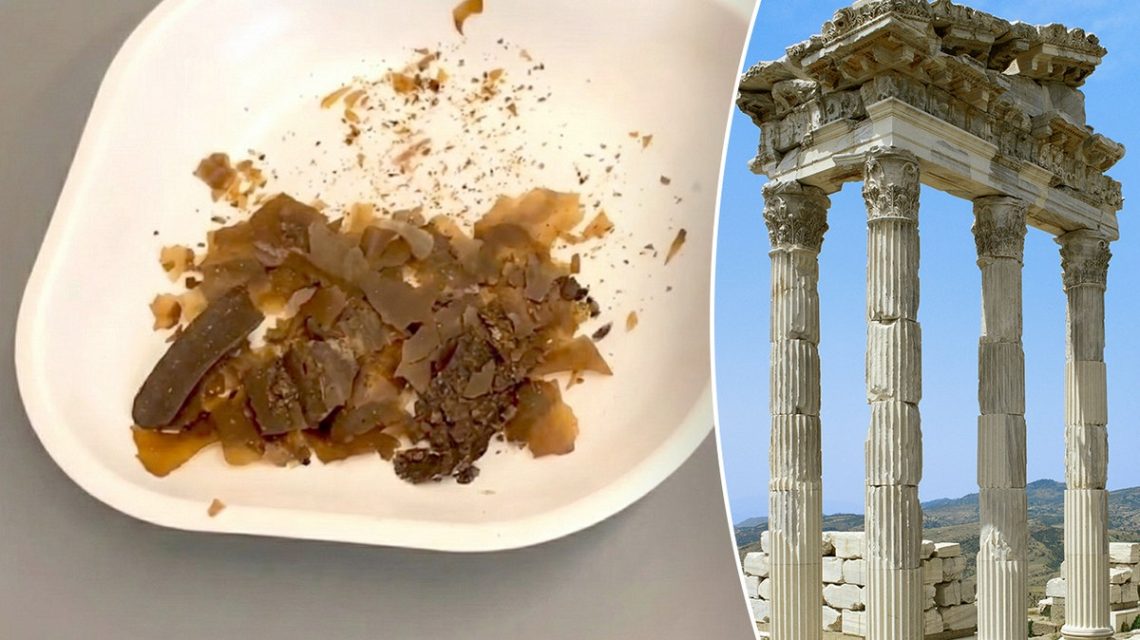
Recent findings by researchers have unveiled intriguing insights into Roman medical practices, featuring the use of unexpected materials in treatments, including substances far from sanitary by modern standards. A study centered around an artifact uncovered in Pergamon—a former Greek city that fell under Roman control in 133 B.C., now located in İzmir Province, western Turkey—has shed light on these practices.
The unearthed vessel, initially appearing ordinary, revealed a surprising medical purpose upon closer examination. Researchers identified dark, brownish flakes in the residue, determined to be fecal matter, providing the first ‘direct chemical evidence for the medicinal use of fecal matter in Greco-Roman antiquity,’ according to a study published in the April 2026 edition of the Journal of Archaeological Sciences.
“The practice of using fecal matter in ancient Roman medicine was noted in historical texts, but a significant debate surrounded its actual application,” said Cenker Atila, an archaeology professor at Sivas Cumhuriyet University in Turkey and study co-author, as he explained to Fox News Digital.
The practice was rooted in the work of Galen, a prominent physician in antiquity. Atila and his research team uncovered this vital archaeological evidence in a vessel, or unguentarium, found in the Bergama Museum. These vessels, typically used to contain perfumes, appeared to have served dual purposes, repurposed as medicine containers.
Upon examining several vessels for a separate project, Atila noticed the residue and collaborated with chemist İlker Demirbolat and medical historian Rana Babaç Çelebi to thoroughly analyze the contents. Their analysis confirmed the residue’s composition: human feces combined with thyme and olive oil.
“Recognizing this as a medicinal concoction described by the renowned physician Galen, we documented our findings with urgency,” Atila noted.
The thyme served not only as an antibacterial agent but also to mask the scent of the fecal content. Remarkably, even though such materials were used, Atila pointed out that upon opening the bottles, no noticeable odor remained.
This discovery underscores the importance of examining all archaeological finds, as seemingly ordinary objects may hold materials of significant scientific value. It also highlights Pergamon’s rich historical association with Galen’s medical contributions.
 Medieval Tunnel Discovered Within Ancient Burial Site in Germany
  Archaeological Discovery Reveals Coexistence of Christians and Zoroastrians in Ancient Iraq
  Celtic Trumpet Discovered in Britain Offers Insight into Ancient Iron Age
  Understanding Animal Imagination: Can Bonobos Play Pretend?
  Roman Industrial Complex Unearthed in Northern England: Insights into Roman Life and Industry