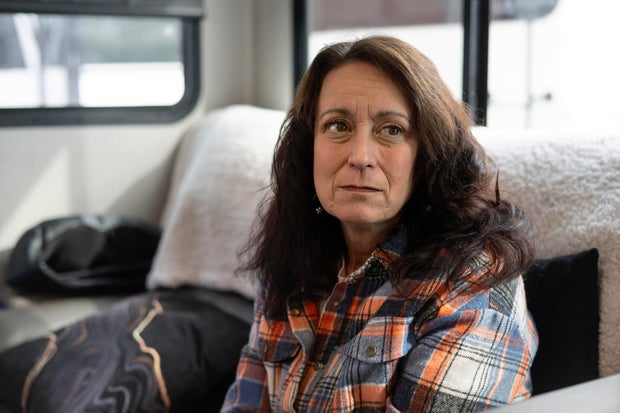
Lori Kelley, a 59-year-old resident of Harrisburg, North Carolina, has been struggling with declining vision that has severely impacted her ability to maintain steady employment. Due to her visual impairment, Kelley had to shut down her nonprofit circus arts school last year as she was unable to handle the necessary paperwork. Following the closure of her school, she worked briefly at a pizza shop making dough and currently relies on sorting recyclable materials, such as cans and bottles, at a local concert venue for her primary income. The seasonal nature of this work means it isn’t a year-round source of revenue.
“This place knows me, and this place loves me,” Kelley noted about her employer. “I don’t have to explain to this place why I can’t read.” Living in a camper, she survives on less than $10,000 annually, partially due to her Medicaid health coverage which covers her medications for arthritis and anxiety and allows for doctor visits to manage her high blood pressure.
However, Kelley is anxious about potentially losing her Medicaid coverage next year. New rules will require millions of individuals, much like Kelley, to participate in work, volunteering, education, or other approved activities for minimum of 80 hours a month to maintain their health insurance benefits.
As Kelley explains, “I’m scared right now.” This apprehension is shared by others who could lose access to care under these new requirements, which affects their ability to manage health conditions like high blood pressure and anxiety.
Prior to these coverage changes being signed into law, Republican lawmakers argued that some unemployed young men were exploiting the government health insurance intended for low-income or disabled individuals. “Medicaid is not meant for 29-year-old males sitting on their couches playing video games,” House Speaker Mike Johnson mentioned in a CNN interview.
However, Jennifer Tolbert, deputy director of the Program on Medicaid and the Uninsured at KFF, highlights that adults between the ages of 50 and 64, especially women, are more likely to suffer under the new rules. For people like Kelley, these requirements will pose challenges to retaining their coverage, potentially endangering their physical and financial well-being.
Come January 2027, approximately 20 million low-income Americans across 42 states and Washington, D.C., will be required to meet activity criteria to obtain or retain Medicaid health coverage. States such as Alabama, Florida, Kansas, Mississippi, South Carolina, Tennessee, Texas, and Wyoming, which did not expand Medicaid under the Affordable Care Act, won’t need to implement the work rules.
The nonpartisan Congressional Budget Office anticipates at least 5 million people will lose Medicaid coverage in the coming decade due to these work requirements. Critics argue these rules are largely driven by the GOP budget law, which cuts nearly $1 trillion to subsidize tax breaks for the wealthy and fortify border security. “We’re talking about saving money at the expense of people’s lives,” said Jane Tavares, a researcher in gerontology at the University of Massachusetts Boston. “The work requirement is just a tool to do that.”
According to Andrew Nixon, a Department of Health and Human Services spokesperson, requiring “able-bodied adults” to work is intended to ensure Medicaid’s “long-term sustainability” and protect it for vulnerable populations. Exemptions apply to individuals with disabilities, caregivers, pregnant and postpartum persons, veterans with total disabilities, and others experiencing medical or personal challenges.
Medicaid expansion has provided vital support to middle-aged adults who would otherwise lack health insurance, as noted by researchers at Georgetown University. Currently, Medicaid provides coverage for one in five Americans between the ages of 50-64, offering them access to care before they become eligible for Medicare at age 65. Among women on Medicaid, those aged 50-64 are more likely to struggle with eligibility compared to their younger counterparts and often have more pressing healthcare needs.
Fewer middle-aged women meet the required hours due to caregiving responsibilities or personal health challenges, according to Tolbert. Research by Tavares and others indicates that only 8% of the total Medicaid population is considered “able-bodied” and not working, a group mainly composed of impoverished women who have left the workforce to care for family members. Among them, 25% are aged 50 or older.
“They are not young, healthy adults just sitting around,” the researchers noted. Making it more difficult for these individuals to maintain Medicaid coverage “may actually undermine their ability to work” as untreated health issues continue, Tolbert said. Even if coverage is lost, these people will still need to address chronic health conditions.
Adults often begin experiencing health issues before they become Medicare-eligible. Without the means to address these concerns before age 65, they risk being sicker once they qualify, potentially increasing Medicare expenses, health policy researchers indicated.
Many in their 50s or early 60s are no longer working because they provide full-time care for children or older family members, as noted by caregiver advocates who refer to this group as “the sandwich generation.” Although the GOP budget law permits some caregivers to be exempted from Medicaid work requirements, these exceptions are “very narrow,” according to Nicole Jorwic, chief program officer for Caring Across Generations. She fears many people needing exemption might fall through the cracks.
“You’re going to see family caregivers getting sicker, continuing to forgo their own care, and then you’re going to see more and more families in crisis situations,” Jorwic commented.
Paula Wallace, 63, of Chidester, Arkansas, shared her challenges. Having worked most of her adult life, she now spends her days caring for her husband who has advanced cirrhosis. Recently, she gained Medicaid coverage through the state’s expansion program, which means she’ll soon have to comply with the new work requirements. However, she finds that difficult.
“With me being his only caregiver, I can’t go out and work away from home,” Wallace explained. Her husband receives Social Security Disability Insurance, meaning she should technically be exempt from work rules as a full-time caregiver for someone with a disability. However, federal officials have yet to provide specific guidance on how exemptions are defined. Experience from Arkansas and Georgia, where similar Medicaid work programs ran, showed many enrollees struggled to navigate the benefits system complexities.
“I’m very concerned,” Wallace expressed.
KFF Health News is a national newsroom specializing in in-depth reporting on health issues and is one of KFF’s core operating programs, an independent source for health policy research, polling, and journalism.
 The Impact of Diet on Coronary Heart Disease Risk
  New York Times Editorial Board Reconsiders Stance on Marijuana Legalization
  The New York Times Reevaluates Stance on Marijuana Legalization
  Comfort Essentials to Ease Cold and Flu Symptoms
  Tennessee Hospital Rebuilding Amid Flooding Concerns
  Apolipoprotein B: A Crucial Indicator for Heart Disease Risk