After a 12-year hiatus from the Olympic Games, NHL players are ready to hit the ice again at the 2026 Winter Olympics in Milan. Their absence from the games in PyeongChang in 2018 and Beijing in 2022 was due to disagreements with international governing bodies and the disruptions caused by the COVID-19 pandemic.
Canada’s captain, Sidney Crosby, one of the few veterans from the Sochi 2014 Winter Olympics, expressed his excitement about returning to the Olympics. He commented during a press conference in Milan, It was difficult. You try not to get your hopes up too much, but you also had to be ready in case we did go.
He added, It was a bit of a roller coaster. I am really happy we have the opportunity to come back here. It is an amazing experience.
Tournament Format
The format for the men’s hockey tournament resembles that of the 2014 Olympics. A total of 12 teams are participating, comprising the top eight IIHF-ranked nations, host country Italy, and three qualifiers (Slovakia, Latvia, and France) who made it through other tournament performances. These teams are divided into three groups, with Canada leading Group A, Finland heading Group B, and the United States spearheading Group C.
Throughout February 11-15, each team will play against every other team within its group. The tournament scoring system awards three points for a regulation win, two points for a win in overtime or a shootout, and one point for a loss in overtime or a shootout. The top team from each group and the second-place team with the most points automatically progress to the quarterfinals. The remaining teams enter a playoff round.
The playoff round winners will then face the top four quarterfinalists. The losing teams in the quarterfinals will be eliminated, while those advancing will compete in the semifinals. The semifinal losers will vie for the bronze medal, and the winning teams will play for the gold medal.
Canada vs. USA
The rivalry between Canada and the United States might reach new heights at the 2026 Olympics. Over the past 12 years, the gap between these teams has narrowed significantly. However, a difference in team compositions might influence the competition’s dynamics.
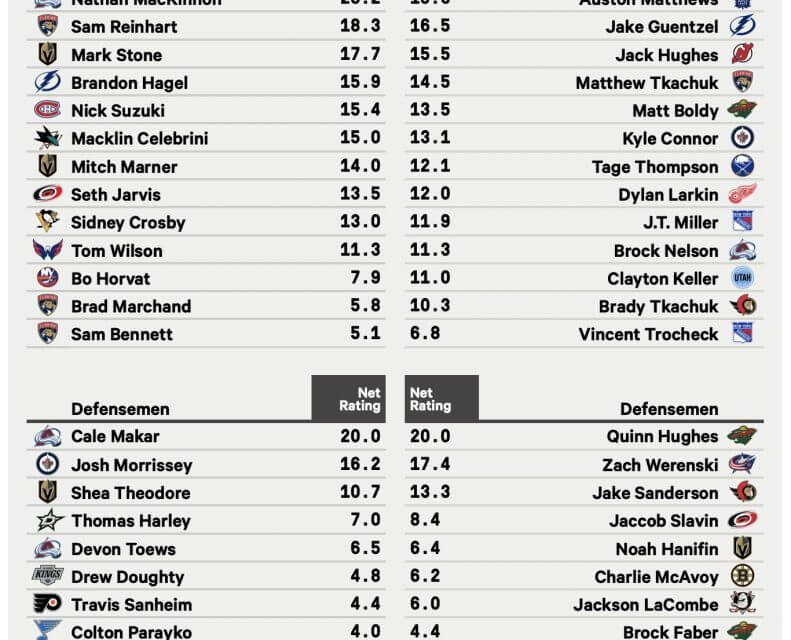
The U.S. roster lack key players such as Jason Robertson, Cole Caufield, and Alex DeBrincat, who remain in the NHL, which could impact the team’s performance. Meanwhile, Canada features superstars Connor McDavid and Nathan MacKinnon, providing them with a competitive edge.
The U.S. team is not without talent, as Auston Matthews, Jack Eichel, and brothers Matthew and Brady Tkachuk present formidable challenges. However, Canada’s depth, including veteran Sidney Crosby and emerging talent Macklin Celebrini, stands strong.
On defense, Canada’s Cale Makar, regarded as one of the world’s best, contrasts with the American alternative, Quinn Hughes. Both teams possess strong defensive lineups, with players like Zach Werenski providing offensive capabilities for the U.S.
In terms of goaltending, the U.S. has Connor Hellebuyck, while Canada has encountered issues with Jordan Binnington, who might be replaced by Logan Thompson if necessary. Thompson has proven himself a strong performer in the NHL.
Other Medal Favorites
Despite some initial concerns around player injuries, Sweden remains a top contender for a bronze medal. Defensemen Victor Hedman and Rasmus Dahlin contribute to their strong defense, while William Nylander offers prowess upfront.
Finland faces challenges without Aleksander Barkov, a crucial player. Nevertheless, they maintain talented players such as Miro Heiskanen and Mikko Rantanen.
The Czech Republic is perceived as potential dark horses, thanks to star forward David Pastrnak and solid goaltender Lukas Dostál.
The Rest of the Field
- Switzerland features accomplished players such as Roman Josi and Kevin Fiala, but lacks depth to challenge for a medal.
- Slovakia boasts young talent like Juraj Slafkovský, yet the absence of an NHL-caliber goalie is a significant disadvantage.
- Germany presents a few top-level players, such as Leon Draisaitl and Tim Stützle, yet the overall team struggles to match the strongest teams.
- Denmark’s Nikolaj Ehlers and Frederik Andersen present potential, though a lack of depth limits their prospects.
- Latvia brings in NHL forwards like Zemgus Girgensons and Teddy Blueger but lacks depth overall.
- France enters as an underdog with players like Alexandre Texier but is not expected to make a significant impact.
- Italy, benefiting from host-nation status, fields a team of dual citizens working to elevate Italian hockey performance.
The Schedule
The tournament schedule is as follows:
- February 11: Finland vs. Slovakia and Sweden vs. Italy, marking the first games at Milano Santagiulia Ice Hockey Arena.
- February 12: Canada faces Czechia, the U.S. takes on Latvia, and Germany meets Denmark—critical for determining quarterfinal entries.
- February 13: Key matchup between Sweden and Finland, with Italy attempting a win against Slovakia.
- February 14: Slovakia plays Sweden, and matchups include the U.S. vs. Denmark and Germany against Latvia.
- February 15: Czechia faces Switzerland, Canada closes group play against France, and Latvia plays Denmark with potential implications on seeding. The U.S. concludes the day versus Germany.
How to Watch
In Canada, viewers can catch the Olympic men’s hockey games on CBC, TSN, Sportsnet, and CBC Gem. In the United States, NBC, USA Network, and CNBC will carry games. At least one quarterfinal, along with semifinal and gold-medal games, will air on NBC. Games can also be streamed on Peacock and NBC Sports platforms.
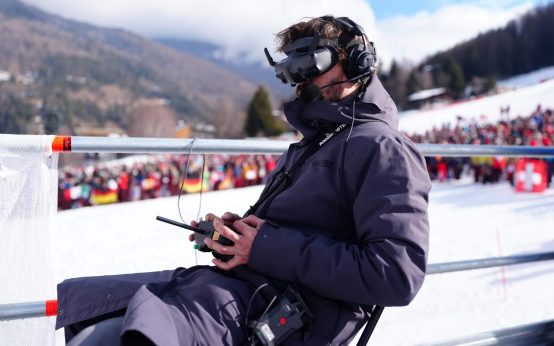 FPV Drones Steal the Show at 2026 Milan Cortina Olympics
 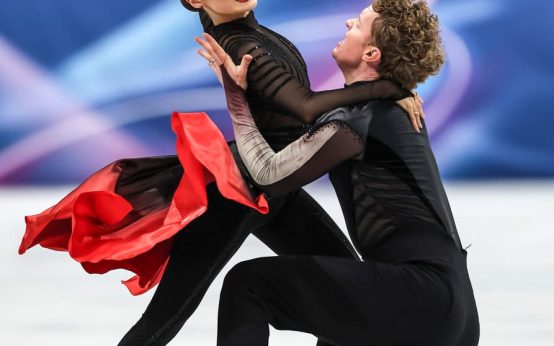 France Triumphs in Ice Dance as Team USA Secures Silver
 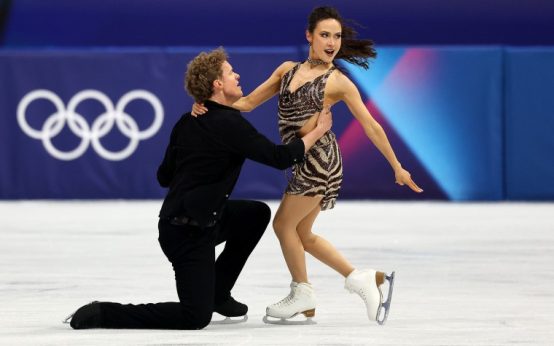 Chock and Bates Set Their Sights on Olympic Gold in Ice Dancing
  Lindsey Vonn Faces Recovery After Milan Cortina Olympic Crash
  Jordan Stolz’s Historic Gold Medal Win in Speedskating at Milan Olympics
  Chloe Kim Advances to Halfpipe Finals at Milan Cortina Winter Games