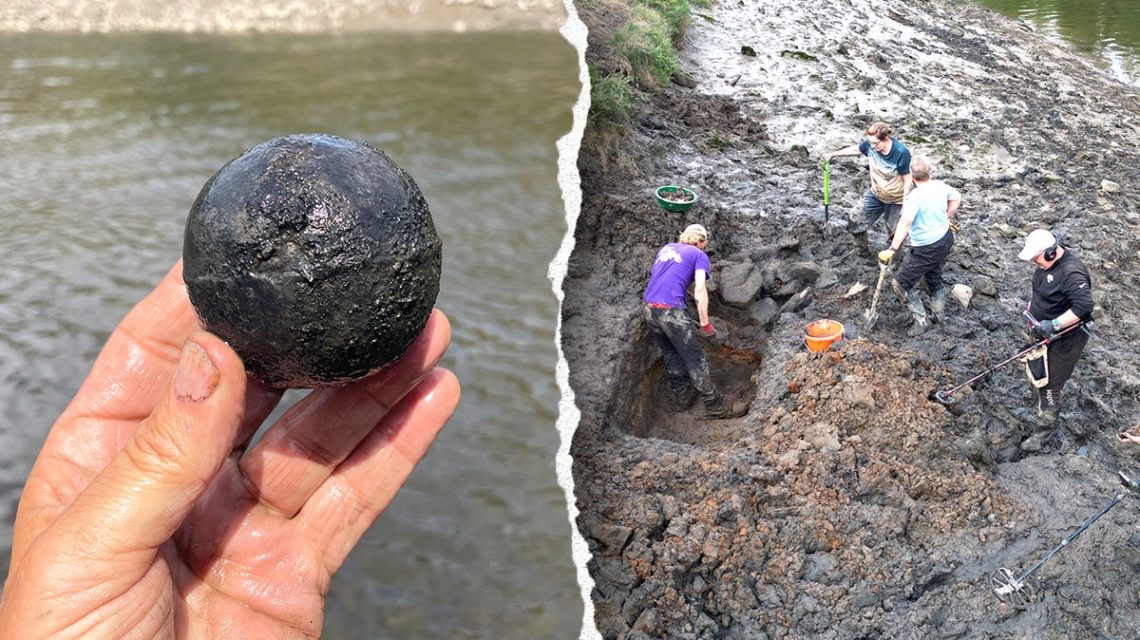
Archaeologists have made a significant discovery in northern England, unearthing a sprawling Roman industrial complex that provides rare insights into the lives and labor of the Romans. The excavation, conducted by researchers from Durham University, focused on a site at Offerton, near Sunderland, along the River Wear.
The team uncovered more than 800 whetstones, essential tools used by the Romans to sharpen weapons and other instruments, along with 11 stone anchors, which are believed to have been instrumental for river transport. This find is particularly noteworthy; Durham University has described it as “the largest known whetstone find of the period in North West Europe.”
“It places North East England firmly within Roman Britain’s sophisticated manufacturing and trade network,” the university stated in its press release.
Alongside whetstones, archaeologists also discovered artifacts from later periods, such as iron and stone cannonballs and lead shot, dating back to the English Civil War. These finds date between 42 and 238 A.D., as confirmed by sediment analysis which verified Roman-era activity.
The crucial role of whetstones in Roman daily life cannot be overstated. Gary Bankhead, an archaeologist at Durham University, highlighted their importance, noting, “Without whetstones, Roman tools simply wouldn’t function properly. They were as fundamental to daily life as chargers or batteries are today.” The Offerton site is thus recognized as a significant production hub in Roman Britain.
Potential for Further Discoveries
Archaeologists believe there could be hundreds, if not thousands, more whetstones still buried under the riverbank. Many of the stones that have been discovered were likely intentionally discarded. This finding suggests that the known timeline of human activity along the River Wear could be extended by more than 1,800 years.
Whetstones were indispensable to various crafts and trades in Roman times, from metalworking and carpentry to agriculture and shipbuilding. Bankhead remarked, “Every craft — metalworking, carpentry, leatherworking, agriculture, shipbuilding, and even domestic food preparation — relied on sharp tools.” The tools produced at the site might have been exported broadly across Roman Britain.
Uncovering Roman Britain’s Manufacturing Network
The manner of whetstone disposition is revealing. Bankhead detailed how their position in one of the trenches shows they were dumped directly into the riverbank, mixed with shatter and flakes from the manufacturing process. “This pattern of deposition strongly suggests that waste material was routinely tipped into the river as part of day-to-day industrial activity,” he explained.
Bankhead emphasized the Romans’ exacting standards for whetstones: “Whetstones had to be uniform, durable, and typically cut to a standard length of one Roman foot. If a stone didn’t meet that standard, it was discarded.” Most of the recovered stones were production rejects, breaking during shaping or containing flaws.
Sunderland, already known for its industrial heritage, has its history traced back even further due to these discoveries. Previously, it was believed that the Romans hadn’t reached this part of the River Wear. Still, the evidence now points to substantial Roman manufacturing activities, producing whetstones on an industrial scale.
Bankhead shared that future explorations are being considered, given the site’s “enormous research potential.” The work at Offerton has challenged existing views on Roman Britain, suggesting that a more complex network may remain undiscovered.
 Ancient Roman Medical Practices: Discoveries from Pergamon
  Medieval Tunnel Discovered Within Ancient Burial Site in Germany
  Archaeological Discovery Reveals Coexistence of Christians and Zoroastrians in Ancient Iraq
  Celtic Trumpet Discovered in Britain Offers Insight into Ancient Iron Age
  Understanding Animal Imagination: Can Bonobos Play Pretend?