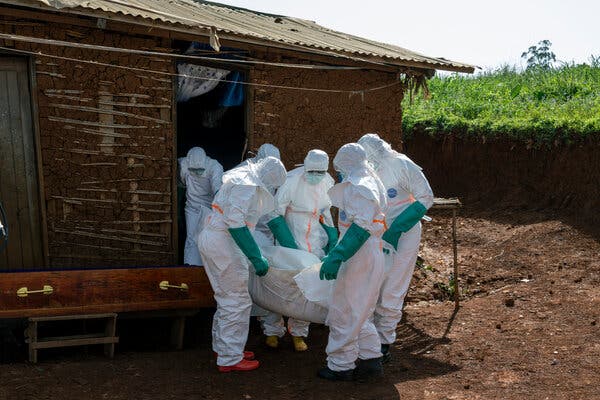
The town of Mongbwalu in the Democratic Republic of Congo has relied on mining for decades, but now it faces a new threat. The mining activities are linked to the spread of a severe Ebola outbreak.
Last week, Red Cross workers in protective suits removed the body of Mumbere Saidi, a gold miner, in Mongbwalu. This town in Ituri province has become the focal point of an Ebola outbreak.
Impact of Violence and Work on Lives
Mumbere Saidi fled his farm after it was attacked by the local affiliate of the Islamic State. He traveled 200 miles to reach the gold mines in northeastern Congo, crossing dangerous war zones.
In the mines, Saidi engaged in demanding work, panning for gold. The earnings were meager. In good times, he sent some money back to his parents. During tougher periods, feeding his wife and baby daughter became difficult. Despite these challenges, Saidi felt relatively safe until he contracted Ebola last week.
The Role of Gold Mining
Gold mining has been central to Mongbwalu’s economy for over a century. Many people from across Congo come here seeking work. Unfortunately, this activity now contributes to the spread of Ebola.
Experts believe the outbreak began in Mongbwalu in February. Authorities did not detect the outbreak until May 15. The delay was partly due to the involvement of a lesser-known virus, Bundibugyo, which has no existing treatment.
Current Challenges
As the third-largest outbreak on record, Ebola’s spread in this mining community has become a serious concern. Efforts to contain the virus are ongoing.
 Joe Biden’s Battle with Prostate Cancer: A Deeper Look
  Rising Cases of Vibrio Vulnificus Infections in Louisiana and Florida
  Ethan Suplee’s Approach to Weight Loss and Sobriety
  MaineHealth to Close Lincoln Hospital Maternity Unit Despite Community Opposition
  A Personal Journey with Cancer: Strength, Family, and Hope
  Coping With Cancer: A Personal Journey