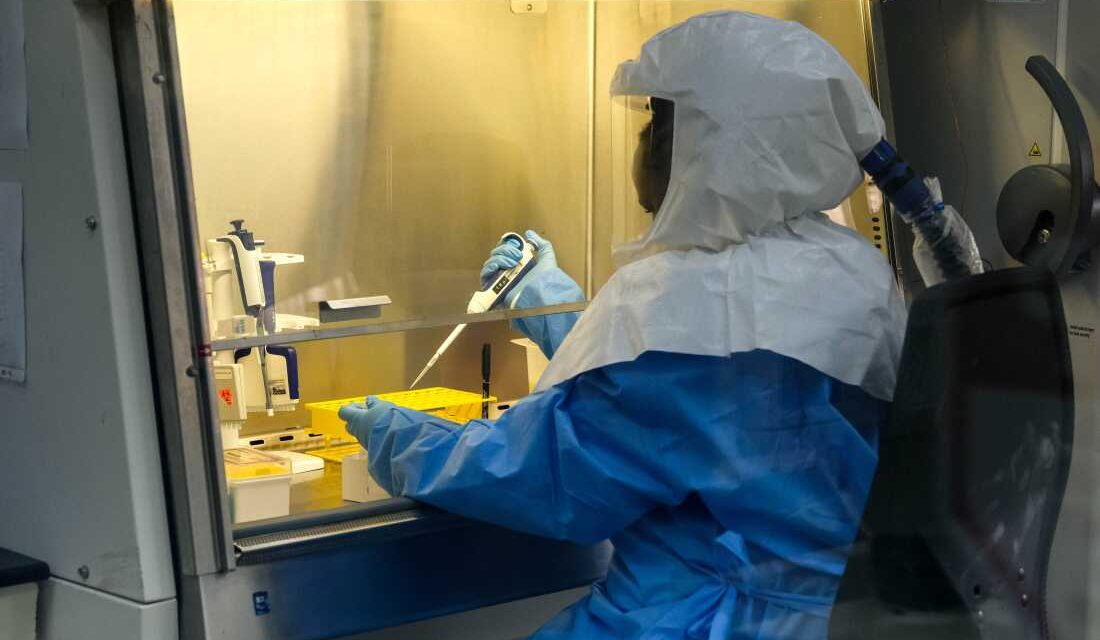
Sophia Mulei, a laboratory technologist, works with a control sample inside the Viral Hemorrhagic Fever Laboratory at Uganda Virus Research Institute in Entebbe, Uganda. This lab is one of the main centers for Ebola sample testing.
In mid-April, health officials in the Democratic Republic of Congo (DRC) noticed potential Ebola cases. Suspicious deaths in the northeastern region led officials to collect samples for testing. These first samples were sent to a lab in Bunia.
The first samples were tested on April 30th,
stated Jean-Jaques Muyembe, head of INRB, DRC’s national biomedical research center. The lab used GeneXpert, a machine that automates detection of viral DNA pieces. Initial tests returned negative for Ebola. Additional samples also tested negative. However, when samples reached Kinshasa for more detailed testing, they tested positive for Ebola.
The GeneXpert machine couldn’t detect the rare Ebola species present, Muyembe noted. This delayed the outbreak declaration until mid-May when Ebola Bundibugyo was confirmed. This delay allowed the outbreak to grow into a substantial crisis, with suspected cases exceeding 1,100 as labs struggled to keep pace with incoming samples.
Caia Dominicus, a senior adviser at the International Pandemic Preparedness Secretariat, emphasized that the lack of timely diagnostics hindered the early response. Without prompt testing, officials couldn’t properly isolate patients, allowing the virus to spread further.
Abdirahman Mahamud from the World Health Organization stated that diagnostic capacity has improved. Yet, the U.S. Centers for Disease Control and Prevention estimates the potential for cases to rise to 20,000 by August. Mahamud highlighted the need for further surge in testing capacity in case transmission spreads geographically or case numbers rise.
Advancements and Challenges in Diagnostics
The introduction of a machine named RADI-One has improved testing capacity. This device can detect Bundibugyo in samples and requires less technical training and equipment compared to traditional lab-based testing. This allows deployment in smaller clinics closer to affected areas, like Mongbwalu, a heavily impacted mining town. Seven labs and one mobile lab currently process tests across northeastern DRC. Larger facilities, such as Bunia, can test over 100 samples daily.
An unnamed technician noted, We really don’t have a backlog now. Samples are analyzed promptly, with turnaround time between one and twelve hours.
Yap Boum from Africa CDC said plans to acquire 50 RADI-One machines by June are underway, but more machines might be needed, according to Dominicus. WHO is negotiating with KH Medical, a South Korean company, to obtain additional machines.
Other tests exist, but using them involves training staff, as they deviate from traditional methods. Distance between patients and labs further complicates testing. Sample transport can take days due to difficult access to some areas where conflict, displacement, and community mistrust prevail.
The Role of Rapid Tests
Rapid tests, similar to those popularized during COVID, could expedite validation. A simple blood test could deliver results in minutes rather than hours or days. Stanford University’s Abraar Karan noted how important it is to detect positives quickly to isolate and prevent further spread.
While less sensitive than lab tests, rapid tests could help understand the outbreak’s full extent. Muyembe suggested using these tests for both living patients and the deceased. This is crucial as burial customs in DRC involve contact with the deceased, posing virus transmission risks.
No rapid tests are presently approved for Bundibugyo. Tests for other Ebola strains might work, based on lab research, but field efficacy is uncertain. Robert Garry from Tulane University mentioned developing a specific test could take months and scaling up production quickly would be feasible.
Ranu Dhillon, who advised during the 2014 Ebola outbreak in Guinea, asserted the importance of testing validation. He suggested assessing traditional and rapid tests parallelly to gauge performance. Scaling up both types of tests requires substantial investment. Diagnostics often receive less funding compared to treatments or vaccines, as pointed out by Dominicus. Without these tools, we’re flying blind,
Dominicus stated.
Bundibugyo, while rare, is not unknown. Dominicus indicated that early diagnostic capabilities might have contained this outbreak.
 Potential Changes in Medicare Reimbursement for Lab Tests
  Understanding and Addressing the Complexity of Suicide
  Recall of Meat Products from Star Meat Delivery Inc.
  Questions Arise After Presley Gerber’s Death in Rehab
  Upcoming Concerns and Influence in Health Politics
  Fraud Task Force Saves Billions by Tackling Obamacare Misuse