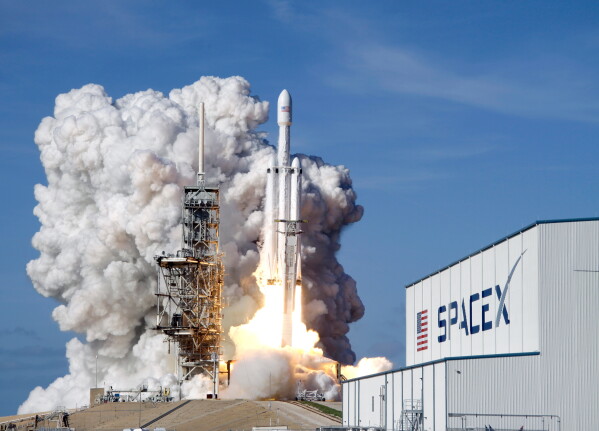
Elon Musk has reached a historic financial milestone by becoming the world’s first trillionaire. Shares of SpaceX, his rocket company, soared during Wall Street’s largest initial public offering (IPO). SpaceX’s stock increased by 24% following its market debut, underscoring investor optimism despite the company’s financial losses. Investors are betting on SpaceX’s ambitious projects involving satellites, orbital data centers, and artificial intelligence.
SpaceX’s stock opened at $150 a share and quickly climbed to approximately $168. This gave the company a market value of $2.2 trillion. Musk, who also leads Tesla, now has an estimated net worth of $1.2 trillion according to Forbes.
Why SpaceX Decided to Go Public
Musk stated that SpaceX, founded in 2002, is pursuing a public offering to secure funds for launching satellites and data centers into space. The ultimate goal is to establish a human colony on Mars. Musk participated in Nasdaq’s ceremonial bell ringing from Starbase, SpaceX’s facility in South Texas, and spoke about his vision for making life multiplanetary. He emphasized that SpaceX aims to enable anyone watching to travel to the moon and Mars in the future.
Known for his technological advancements, Musk has managed to generate enthusiasm for the IPO, even though SpaceX is losing billions annually. Investors flocked to purchase shares at $135 each before trading began. The $75 billion generated from the IPO surpassed the previous record set by Saudi Aramco in 2019. SpaceX trades under the symbol “SPCX.”
Alongside plans for a Martian colony, the company promises to launch space outposts and orbiting data centers while competing with rivals Anthropic and OpenAI in AI development. However, SpaceX acknowledges significant financial needs to achieve these objectives as it lost $8.7 billion between early 2025 and March 2026.
Investor Opinions and Company Challenges
Bankers on Wall Street supporting SpaceX’s public offering express enthusiasm, driven in part by fees earned, but others question the stock’s valuation. Analysts at Morningstar view the IPO as overvalued due to unproven technology and substantial capital requirements, estimating the company’s worth at $780 billion — less than half of its IPO value.
SpaceX has disclosed potential challenges, mentioning in regulatory documents that some business strategies involve untested technologies. The artificial intelligence segment, xAI, also lacks a defined path to profitability, competing against better-positioned rivals. Despite these concerns, Musk’s vision of moon hotels and Earth-orbiting data centers captures the imagination.
The Financial Journey of Elon Musk
Elon Musk’s journey to immense wealth began with his companies Zip2 and PayPal, which he sold for approximately $200 million. He reinvested in SpaceX and Tesla, overcoming hurdles to create reusable rockets and popular electric vehicles. Though his wealth primarily exists in stock and potential grants, these investments have turned into substantial returns. Tesla shares have provided a 20,000% return since its 2010 public listing, enhancing over $1.2 trillion in investor wealth.
SpaceX is the first of three major companies expected to go public this year, followed by Anthropic and OpenAI. Nasdaq revised its rules, allowing SpaceX to enter index fund portfolios within 15 days. This adjustment means that investors could hold SpaceX shares much sooner. Nonetheless, some stakeholders, including pension funds for public sector workers, have raised concerns over SpaceX’s IPO provisions, such as mandatory arbitration for shareholder claims and the extent of Musk’s control over the company.
 July Jobs Report Puts Economy in Focus
  July Jobs Report Highlights Economic Concerns
  U.S. Stocks Rise Amid Job Cuts and Interest Rate Speculations
  Asian Stocks Decline as Big Tech Weighs Down Markets
  Consider a 1-Year CD for Savvy Savings Choices
  U.S. and Japan Coordinate to Impact Dollar-Yen Exchange Rate