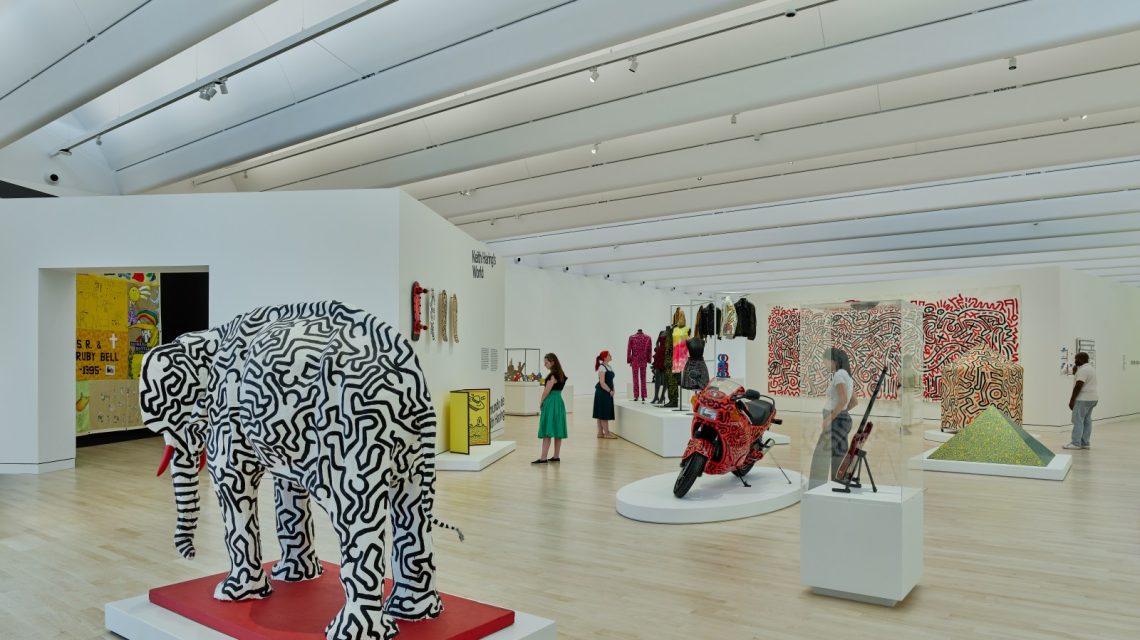
Larry Warsh began his journey into art collection early. His current focus is Keith Haring’s unique ability to transform lines, objects, and public spaces into a unified visual language. As co-editor of Keith Haring in 3D, an art book that supplements the major exhibition at Crystal Bridges Museum of American Art, Warsh makes a case that Haring, despite his widely recognized status, remains partially misunderstood. The exhibition in Bentonville, Arkansas, open from June 6, 2026, to January 25, 2027, is the first major showcase of Haring’s three-dimensional works. This event features sculptures, totems, masks, painted objects, clothing, boomboxes, and even a 1963 Buick Special, illustrating his artistic reach beyond paintings and subway art.
Early Influences
Warsh describes his early exposure to art in tactile terms. He recalls a family environment rich with objects meant to be closely observed. A pivotal influence was his uncle, who introduced him to galleries and auction houses at about age 12, which helped Warsh see objects as carriers of history and energy. His interest in collecting began with diverse items, including antiques and baseball cards, as a habit of looking that persisted over time.
The New York Art Scene
Living near Astor Place in the early 1980s placed Warsh near pivotal artists and venues. He found himself amidst the vibrant community that included Keith Haring, Jean-Michel Basquiat, and Kenny Scharf. This proximity is vital to understanding the importance of the Crystal Bridges exhibition, which aligns Haring’s object-based works with the same downtown networks that influenced them. Warsh demonstrates a deep instinct for collecting, frequently driven by a risk-taking anticipation of future value. He sensed a dynamic force in Haring’s art, tied to the artist’s environment and New York City’s pulse.
The Downtown Art Ecosystem
The scene Warsh recalls, involving figures like Haring, Basquiat, and Scharf, was one of collaboration and energy. It grew from a complex network where galleries and underground spaces merged. Warsh identifies key spaces like Fun Gallery and key figures like Patti Astor as contributors to this cultural movement. He remembers the scene as a living network marked by artists like Futura, Rammellzee, Tseng Kwong Chi, and Rene Ricard, who were involved in shaping downtown New York’s identity.
Accessible Art
Haring achieved a notable impact through his understanding of scale, both visually and socially. Warsh notes Haring’s direct engagement with audiences through his broadly appealing artworks. Haring’s Pop Shop, launched in 1986, extended the reach of his subway art into retail settings while maintaining his public artistic mission. The Crystal Bridges exhibition similarly highlights Haring’s ability to translate his artistic language into interactive, immersive experiences. According to Warsh, Haring followed a tradition shared by figures like Andy Warhol and Salvador Dalí, involving art in public culture while retaining its impact.
Sculpture as Central Art Form
Warsh views Haring’s sculptural works as integral, not secondary, to understanding the artist. These works include painted appliances and odd objects, demonstrating how ordinary items became canvases for Haring’s creative vision. Crystal Bridges emphasizes these elements, showcasing materials transformed into art by adapting to space, weight, and form without losing momentum or wit. Warsh remarks that Haring was motivated by inspiration, seeing potential in everyday materials and transforming objects into platforms for artistic invention.
A Legacy of Generosity
Generosity plays a central role in Haring’s legacy, according to Warsh. Many pieces in exhibitions originated as gifts from Haring to friends. His foundation has continued this generous ethos, supporting AIDS organizations and children’s education. Haring was involved with his community, donating works to auctions and painting in hospitals. Warsh emphasizes this generosity as a crucial part of Haring’s legacy. The Crystal Bridges exhibition aims to present a comprehensive view of Haring, emphasizing that his work in sculptures and objects was not peripheral but a core part of his artistic vision.
 Artistic Chronicle of Communities’ Recovery Post-Hurricane Helene
  Chicago History Museum’s Latin American Exhibit Sparked by Student Protests
  DNA Links Jefferson to Hemings Descendants
  Ari Emanuel’s Memoir: A Business-Centric Narrative
  Celebrating Day of the Dead: Students Craft Calaveras in Pilsen
  Controversial Revelations from Charles Spencer’s New Book on Princess Diana