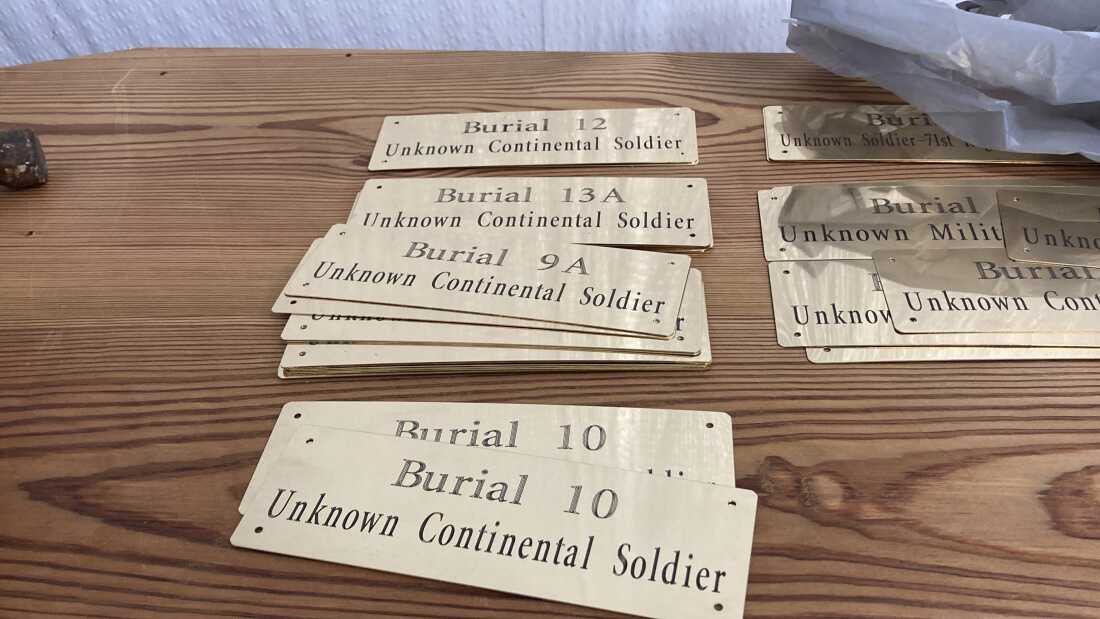
On March 30, 2023, plaques commemorating 14 unknown soldiers who perished at the Battle of Camden were displayed in Columbia, South Carolina. Recent DNA analysis has identified one soldier, shedding light on these forgotten heroes.
Pvt. John Pumphrey enlisted in the 7th Maryland regiment of the Continental Army as a teenager in January 1777. He participated in crucial battles, including Brandywine, Germantown, and Monmouth. After enduring harsh winters at Valley Forge and Morristown, he ventured south once more to confront the British. The Battle of Camden in August 1780 marked his final stand.
Pumphrey was struck by a British musket ball and buried in a shallow grave in South Carolina. In 2022, archaeologists from the University of South Carolina unearthed his remains and sent them for DNA analysis to determine his identity. FHD Forensics utilized historical genealogy records, identifying modern connections, including Nancy White, age 71, who learned of her distant relation as a remarkable discovery.
White, residing on Maryland’s Eastern Shore, was intrigued. “This miraculous discovery connected us to history,” she said. The match revealed Pumphrey as her fourth great uncle.
Allison Peacock, FHD President, explained the usage of three DNA analysis types to confirm Pumphrey’s identity, despite him likely having no direct descendants. The analysis yielded impressive DNA matches, about 20,000 modern relatives. White was among those who participated in the process, seeking family trees and verifying results, even involving family members gathering archival and tax records.
Pumphrey was unexpected among the Pumphrey family due to their Quaker heritage, known for pacifism. White explored the family’s genealogy through a DNA database, discovering their connection to Pumphrey, despite initial doubts.
Pumphrey’s circumstances, including being orphaned, may have influenced his decision to join the Continental Army, which he considered home. Uncommon for re-enlisted soldiers, Pumphrey viewed the army as a place of belonging.
Peacock noted Pumphrey as likely the oldest John Doe identified through genetic genealogy. She highlighted the challenge of measurable DNA relatedness due to several generations separating the living from the deceased.
Archaeologist James Legg, alongside Steve Smith, led the excavation uncovering all 14 remains. Reports from relic hunters and the COVID-19 pandemic prompted deeper exploration of the battlefield. Many graves measured shallow, around 14 inches in depth.
The graves’ shallow placement was likely due to prisoners of war who lacked tools, according to Rick Wise, executive director of the South Carolina Battleground Preservation Trust.
Peacock is seeking relatives for another Camden soldier, discovering her own connection to him unexpectedly. “Being related was furthest from my mind,” she said. Wise remains focused on Pumphrey’s story, emphasizing the tragedy of the Battle of Camden where Pumphrey’s unit faced overwhelming odds.
 Artistic Chronicle of Communities’ Recovery Post-Hurricane Helene
  Chicago History Museum’s Latin American Exhibit Sparked by Student Protests
  DNA Links Jefferson to Hemings Descendants
  Ari Emanuel’s Memoir: A Business-Centric Narrative
  Celebrating Day of the Dead: Students Craft Calaveras in Pilsen
  Controversial Revelations from Charles Spencer’s New Book on Princess Diana