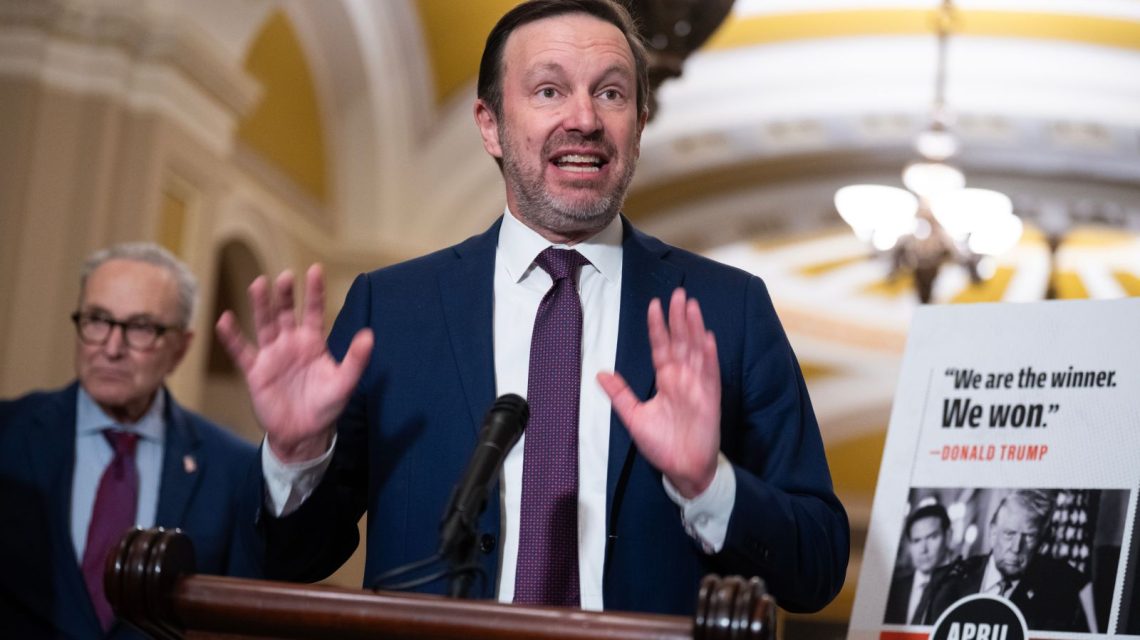
Senator Chris Murphy suggested on Sunday that increasing the federal minimum wage might be crucial for rebuilding the Democratic coalition. He believes this could help regain working-class voters who previously supported President Donald Trump. In an interview on NBC News’ Meet the Press, the Connecticut Democrat outlined his proposal to raise the federal minimum wage to $25 an hour, labeling it a ‘unifying issue’ that could gain cross-party support.
‘People don’t think this version of capitalism has worked. And it hasn’t,’ Murphy explained. ‘Currently, 40 percent of Americans working full-time lack enough savings for an emergency car repair.’
The federal minimum wage has been stuck at $7.25 an hour since 2009. Murphy’s initiative highlights the ongoing debate in the Democratic Party about balancing progressive economic policies with wider electoral attraction before upcoming election cycles.
A Proposal for a ‘Living Wage’
Murphy’s newly introduced legislation, the “Living Wage for All Act,” aims to gradually phase in a $25-an-hour minimum wage over several years. Large corporate employers would be required to reach the $25 wage by 2032, while smaller businesses would have until 2039.
The plan proposes an initial jump, raising the federal wage from $7.25 to $12 per hour right after enactment. Currently, no state mandates a $25 minimum wage; Washington state leads with about $17 per hour.
‘Economic analysis suggests that gradually raising the minimum wage to $25 an hour could actually create more jobs than it eliminates,’ Murphy stated, countering job loss concerns.
Murphy added: ‘Democrats suggest a minimum wage of about $27. Republicans and independents say about $26. A $25 wage aligns with what is needed to pay bills in the U.S. It’s an idea that appeals to Trump voters.’
Despite these arguments, some economists and business groups warn of potential risks, such as reduced hiring, increased automation, and higher consumer prices. Small businesses might face layoffs or closures. The research on these outcomes is mixed depending on the pace and magnitude of wage increases.
The bill also plans for continuous wage adjustment. Once the $25 target is met, the wage would align annually with two-thirds of the national median wage to match economic growth.
Targeting Disaffected Trump Voters
This proposal appears as Democrats strategize to reclaim working-class voters, attracted to Trump in the 2024 election. Murphy noted these voters are driven by economic dissatisfaction rather than strong partisan loyalty.
‘Many Trump voters feel the economy is rigged and saw Trump as a solution,’ Murphy said. ‘They now view him as a false populist and might listen to Democrats, especially those advocating higher wages and stronger unions.’
Murphy encouraged Democrats to emphasize economic issues like wage increases while staying adaptable on social topics. ‘Our party should welcome Trump voters who may not agree on issues like gun control and climate change,’ he said.
Murphy also dismissed embracing socialism despite some support among Democratic voters. Instead, he promotes ‘common good capitalism.’
The Cost-of-Living Squeeze
This legislative push comes during a prolonged cost-of-living crisis. Essentials like housing and food are increasing faster than typical wage growth. According to the Urban Institute, home prices have surged 81 percent since 2017, and rents have increased 54 percent. The median U.S. home price in 2024 stood at $412,500, requiring an annual income of $126,700—far above average household earnings.
Food costs rose 3.2 percent in 2025, continuing to burden lower- and middle-income households. Although overall inflation has moderated to 4.2 percent annually, the expenses for shelter and food disproportionately affect these groups.
Murphy argued the gap between wages and living expenses necessitates significant economic action. ‘In this affluent and powerful country, full-time workers should pay their bills,’ Murphy emphasized.
Despite the compelling arguments, the bill faces significant political challenges in a divided Washington. Congressional Republicans warn that large wage increases could hurt economic growth and incite inflation.
 Austin Democrats Criticized for Comments on ICE Shooting
  Trump’s Speech Targets Iran’s Nuclear Ambitions at U.N.
  Impact of Tariffs on Everyday Products
  Senator Bernie Moreno Urges DOJ to Address Drug Policy Enabling Forced Abortions
  Karoline Leavitt Offers Insights on Trump’s Calls With Putin and Xi
  Curtis Pushes for Investigation into Trump Jr. and Biden