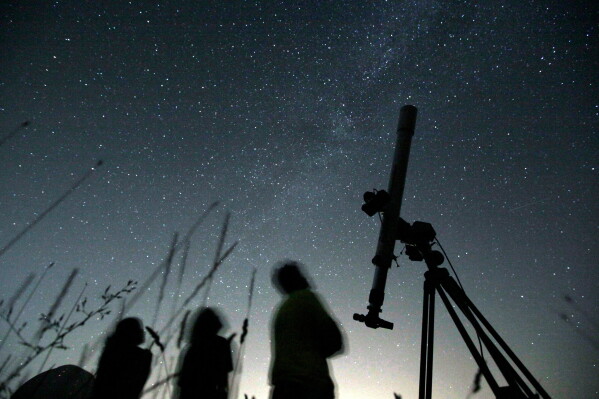
Cape Canaveral, Florida, USA (AP) — NASA is embarking on a daring rescue mission to save an aging space telescope known as Swift, which is losing its altitude. The operation, valued at $30 million, will commence this week with the launch of a robotic savior.
NASA has contracted Katalyst Space Technologies, a startup company, to elevate Swift Observatory to a higher orbit where it can continue its quest for cosmic explosions. A space vehicle, equipped with three robotic arms and built by Katalyst, will track Swift after launching from an atoll in the Marshall Islands, Pacific, via a Pegasus rocket deployed from an aircraft. The launch could happen on Tuesday.
Swift has been surveying the cosmos since its launch in 2004. However, rapid descent due to intense solar activity demands immediate relocation to a stable orbit for survival. NASA’s Hubble Space Telescope, also in peril, might follow suit.
Similar to Swift, Hubble is losing altitude with the Sun’s continuous flare activity. Katalyst Space’s CEO, Ghonhee Lee, revealed that their company’s next-generation robot—still under development—could potentially salvage Hubble, a much larger telescope, in a few years.
China previously attempted a similar mission, successfully elevating a satellite to a higher graveyard orbit four years ago. Lee remarked to The Associated Press, “This is the first American space robot to attempt something like this. NASA has several veteran observatories, all of which can benefit from a service like this. Our mission demonstrates that this approach is feasible.”
Katalyst’s autonomous spacecraft, named Link, will take about a month to rendezvous with Swift and capture it; elevating its orbit from the current 360 kilometers (224 miles) to the desired 600 kilometers (373 miles) will take a further couple of months. The gamma-ray observatory, weighing 1.6 tons, must be above 300 kilometers (185 miles) for the rescue to succeed. It is projected to reach a point of no return in October, according to the latest estimates.
Link, comparable in size to a small kitchen refrigerator and featuring solar panels spanning 12 meters (40 feet), is equipped with three arms, each spanning just over 1 meter (3 feet). Each arm has two gripping claws similar to LEGO minifigure hands.
If successful, Swift may resume operations by September, according to Lee. With a value of hundreds of millions of dollars, Swift was not designed for repairs or retrieval by human or robotic hands, posing a significant challenge, say company officials, who acknowledge no assurance of mission success.
NASA contracted with Katalyst last September under two stipulations: the mission must be time-sensitive yet avoid exacerbating the situation. Nine months later, the company is prepared for action. “I must be honest; no one expected this to be possible. No one thought we could reach the point we are at today,” expressed Shawn Domagal-Goldman, NASA’s astrophysics division director.
NASA has extended Swift’s operating time by shutting down all scientific instruments to slow its descent. Observations ceased in February.
Nicky Fox, NASA’s director of scientific missions, asserted that the mission is worthwhile. “If Swift reenters, we lose the telescope and significant capacity,” she said. “We’re not budgeted currently to construct a replacement.”
Swift holds special significance, explained Domagal-Goldman. True to its English translation, Swift is designed to pivot rapidly to capture new astronomical events, such as gamma-ray bursts and exploding stars. With forthcoming discoveries expected from launches of the Webb and Roman Space Telescopes, Swift’s recovery would enable it to be a pivotal “first responder” for NASA.
Katalyst views Swift as a launchpad for a new business in space repairs. The next-generation robotic rescuer, set for flight next year, will handle satellites at altitudes of up to 35,800 kilometers (22,300 miles). Lee envisions hundreds of robots orbiting one day, not only repairing and elevating satellites but refueling them and establishing solar farms, data centers, and other platforms.
Hubble, 36 years old, benefited from repeated services by astronauts during the space shuttle era. It might be aided by Katalyst’s boost in 2028, prolonging its life. “It’s a national treasure,” Fox said. “People love Hubble.”
The Department of Health and Science of The Associated Press receives support from the Department of Scientific Education at the Howard Hughes Medical Institute and the Robert Wood Johnson Foundation. The AP is wholly responsible for all content.
This story was translated from English by an AP editor with generative AI assistance.
 Venezuelan Leadership at the United Nations
  Congressional Inaction Amid AI Concerns
  Ontario Synagogue Shooting During Yom Kippur Leaves One Officer and Shooter Injured
  Pope Leo XIV’s Upcoming Visit to Latin America: An Overview
  Rising Demand for Data Centers Driven by AI Development
  Ukraine Deploys Ground Robots in ‘Operation Vivaldi’