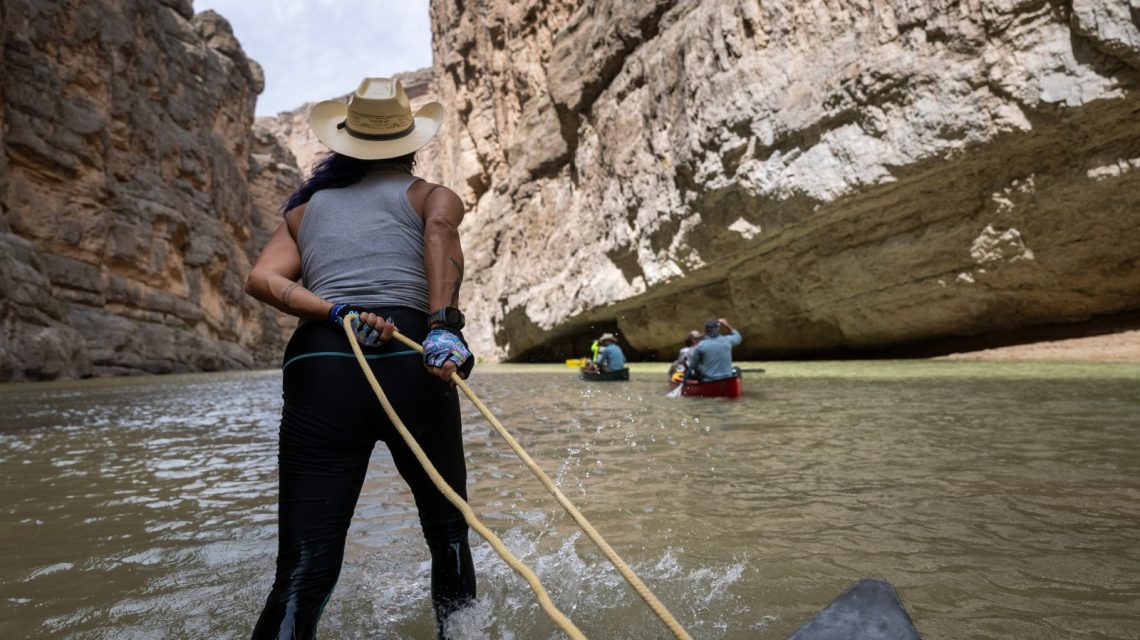
More than 140 Texas businesses, outfitters, and recreation groups are voicing concerns over the Trump administration’s plans to construct vehicle barriers and roads through Big Bend National Park. They fear these changes could harm the region’s tourism economy. A coalition of local officials, law enforcement leaders, and outdoor businesses is opposing the project.
In a letter to Republican Senators John Cornyn and Ted Cruz and Governor Greg Abbott, the groups urged Texas leaders to halt the “needless construction” of border barriers along the Rio Grande. They argue that these plans would permanently harm one of Texas’s key recreation areas, while offering little security benefit. “To Washington D.C., this is just another construction project. But to all of us in West Texas, it’s a matter of our survival,” Billy Bartko, owner of Far Flung Outdoor Center, stated.
Customs and Border Protection is moving forward with plans to install vehicle barriers at river access points in the Big Bend region. This follows the Department of Homeland Security’s decision to waive several environmental and cultural protections to expedite construction. Governor Abbott’s press secretary expressed support for all necessary tools and strategies to aid federal border security goals.
Impact on Tourism
The letter highlights that access to the Rio Grande is crucial for the regional outdoor recreation economy. This economy supports various sectors such as outfitters, guides, lodging providers, and retailers across rural West Texas. The coalition warns that barriers could obstruct launch and take-out points used by outfitters and recreational visitors. Locations potentially affected include Lajitas, Talley, Solis, La Linda, and Dryden Crossing.
The economic stakes are significant. Big Bend National Park attracted 561,459 visitors in 2024, according to National Park Service data. Visitors spent approximately $56.8 million in nearby communities and generated around $63.7 million in economic output for the region.
Sara Ryza of the Big Bend Tourism Alliance emphasized the area’s reliance on tourism income from outdoor recreation, stating, “Every room booked, meal ordered, and gas tank filled keeps our regional economy going.”
Broad Opposition
Opposition to the border wall extends beyond environmental groups. The letter mentions that all five sheriffs in the Big Bend border region opposed barrier construction, arguing that natural obstacles already make crossings difficult. Additionally, 14 Texas border county judges requested tailored security measures for the region’s unique geography.
Seven former superintendents of Big Bend National Park have urged Homeland Security to reject legal waivers enabling construction. A petition opposing construction gathered over 150,000 signatures.
Border Crossings Data
Critics focus on the relatively low number of migrant encounters recorded in this sector compared to other parts of the southern border. The Big Bend Sector covers about 517 miles of the U.S.-Mexico border, over a quarter of the Southwest border. Yet, it accounted for only 3,096 apprehensions in fiscal year 2025, approximately 1.3 percent of all apprehensions along the southern border that year.
The business coalition highlights the minimal activity inside Big Bend National Park. Apprehensions inside the park amounted to just 0.045 percent of total southwest border apprehensions in 2025.
Supporters of the project argue that security issues persist. DHS cited encounters with over 89,000 migrants in the sector between fiscal years 2021 and 2025, along with drug seizures, as reasons for additional infrastructure.
Business Requests
The letter asks Cornyn, Cruz, and Abbott to take three actions: stop vehicle barriers from blocking public access to the Rio Grande, amend border construction contracts to rely on technology instead of physical barriers, and urge DHS to revoke legal waivers for the project.
Big Bend already has a developed border-security network, including surveillance operated by CBP, the National Park Service, and local law enforcement. The groups propose expanding technologies like remote monitoring and aerial surveillance to enhance security without restricting river access.
The letter concludes, “Big Bend National Park and the Rio Grande Wild and Scenic River are our shared natural heritage. We are asking you, our elected representatives, to protect our livelihoods, our river, and one of our state’s most treasured landscapes from needless and permanent destruction.”
 Concerns in U.S.-China Relations Ahead of Summit
  German Chancellor Friedrich Merz Vows to Continue Amid Election Losses
  Nikole Hannah-Jones Reflects on School Choice and Its Impact
  Republican Senator Criticizes Trump’s $5,000 Check Proposal
  Trump’s Approach to Iran at the United Nations
  Trump’s Triumphal Arch Controversy