On July 4, 2026, Egypt announced two major archaeological finds. These discoveries at the Dakhla Oasis and Marina el-Alamein site are significant. They are expected to benefit Egypt’s vital tourism sector, known for antiquities sightseeing.
Byzantine-Era Discoveries at Dakhla Oasis
The first find offers insights into life during the Byzantine era in the fourth century. The Ministry of Tourism and Antiquities revealed that archaeologists uncovered a well-preserved residential city at the Dakhla Oasis. This city reflects urban development and economic activities of that time.
Key features include north-south thoroughfares crossing east-west streets. These formed open squares and public spaces. At the settlement’s head stands a basilica church from the mid-fourth century. Nearby, remnants of two watchtowers were found, serving as protection for the outskirts.
The site, in Egypt’s New Valley province, is currently on UNESCO’s Tentative List. It is a candidate for World Heritage status. Discoveries include a heavily fortified structure with thick walls and numerous houses. These houses feature reception halls and vaulted roofs.
Among the structures was the house of Tisous, a church deacon. This house likely served as a house church before the basilica’s construction. Archaeologists also found bread ovens, kitchens, and stone grinding tools, suggesting food production activities.
Notable artifacts include bronze coins featuring portraits of Byzantine emperors and Christian symbols. Gold coins from Emperor Constantius II’s reign (337-361) were also discovered. Around 200 pottery fragments, known as ostraca, were found. These fragments detail commercial transactions and daily life activities.
Ancient Tombs Uncovered at Marina el-Alamein
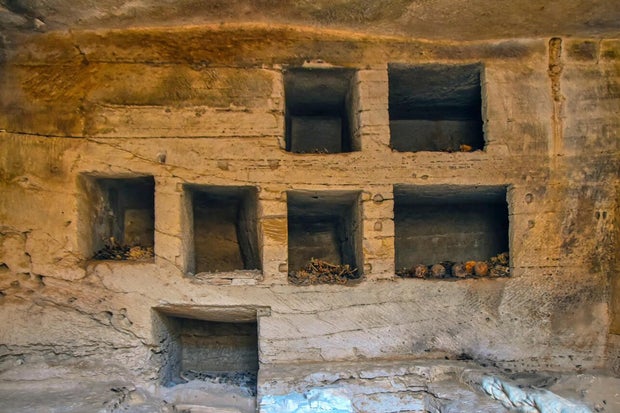
At the Marina el-Alamein site, archaeologists discovered 18 ancient tombs. This site is located about 62 miles west of Alexandria. Among the findings were 11 rock-cut tombs reaching depths of 26 feet and seven limestone-built tombs.
Items uncovered include pottery vessels, amphorae, lamps, plates, altars, and limestone basins. A significant find was an 8-foot-long granite sarcophagus containing skeletal remains, currently under study. Nearby, a plaster sphinx statue’s remains were also found.
Some of the deceased had four gold pieces, known as “the golden tongue,” placed in their mouths. This practice was linked to funerary beliefs of the period.
The Marina el-Alamein site, first unearthed in 1986, is close to the city of Alamein. It is believed to be the ancient Greco-Roman port city of Leukaspis, thriving from the second to fourth centuries. A tsunami in the fourth century devastated the city, home to wealthy merchants.
Impact on Tourism
Egypt’s tourism has been recovering after challenges since the 2011 uprising and the COVID-19 pandemic. In 2025, 19 million tourists visited Egypt, a 21% increase from the previous year. In the first four months of 2026, 6.1 million tourists visited, showing growth compared to the same period in 2025.
 Discover Five Simple Art Projects to Try at Home
  Chicagohenge: When Sunlight Aligns with City Streets
  Venezuelan Leadership at the United Nations
  Ontario Synagogue Shooting During Yom Kippur Leaves One Officer and Shooter Injured
  Pope Leo XIV’s Upcoming Visit to Latin America: An Overview
  Navy Veteran Generald Wilson Reflects on Emotional National Anthem Performance