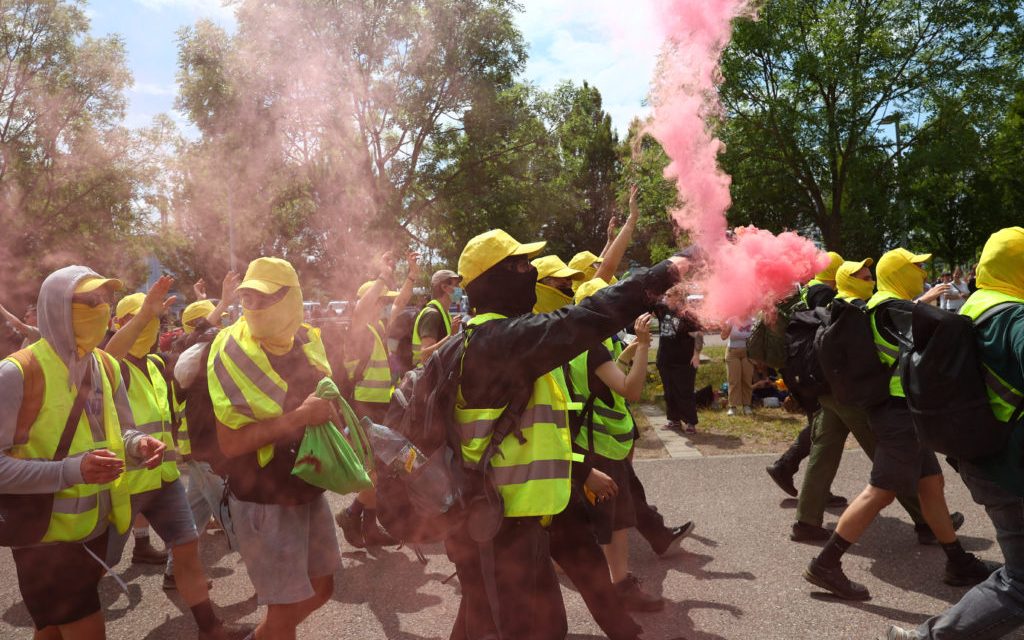
In Erfurt, Germany, the far-right Alternative for Germany (AfD) party held its national convention where leaders Alice Weidel and Tino Chrupalla were overwhelmingly reelected. Tens of thousands of protesters attempted to disrupt the meeting, and some clashed with police.
The AfD, seeking solidarity, extended the terms of Weidel and Chrupalla who have headed the party for four years. Weidel secured reelection with 81% of the vote, while Chrupalla received 70%. German political parties hold leadership elections every two years.
Demonstrations in Erfurt, where the convention took place, highlighted the divisions caused by the AfD. Despite the protests, the AfD has risen to become Germany’s largest opposition party and the strongest political force in the formerly communist eastern regions.
“There are no peaceful seated blockades. There are no democratic roadblocks. These troublemakers are the last resort of our political rivals,” Chrupalla stated during the event.
The conference coincided with the 100-year anniversary of a Nazi Party meeting nearby. Critics argue the timing carries significant symbolism, an accusation the AfD denies.
Protests Against AfD’s Rise
In February 2025, AfD finished second in the national election, receiving 20.8% of the vote, the best result for a far-right party in Germany since World War II. Support has increased, yet calls for its ban persist. Germany’s supreme court requires a high threshold for such actions.
Weidel recently called 2026 a ‘year of destiny’ for AfD; however, mainstream parties refuse to work with them, maintaining a ‘firewall’ against far-right alliances.
Protesters attended rallies in large numbers on Saturday, holding signs such as “Stop AfD Nazis” and “For Diversity, Against Nazis.” Lena Raupach, spokesperson for an anti-fascist group, commented on the group’s failed attempt to block the convention.
“We want a society based on solidarity where all people have equal opportunities and security,” Raupach stated.
Legal and Political Challenges
The Federal Office for the Protection of the Constitution labeled AfD as a right-wing extremist group, but suspended the designation due to a legal contest. The Cologne court barred the agency from using this label during the pending lawsuit, though AfD denies extremism accusations.
AfD benefits from the dissatisfaction with the government’s efforts to reform the economy. The party addresses broader issues beyond its traditional focus on immigration.
Upcoming Elections
AfD aims for a significant win in the September 6 state election in Saxony-Anhalt. The party hopes to gain 40% of the vote, possibly securing an absolute majority or attracting defectors from other parties.
“We will win. Maybe we’ll govern alone soon,” Chrupalla remarked, emphasizing the message it would send to the party’s opponents.
The party advocates lifting sanctions against Russia and opposes arms supplies to Ukraine. They have aligned with U.S. President Donald Trump’s approach, while criticizing the Iran conflict led by Trump and Israel.
Regional leader Björn Höcke reiterated the party’s desire to revitalize Germany, echoing Trump’s platform with “Make Germany Great Again” rhetoric.
A free press underpins a healthy democracy. Support trusted journalism and civil dialogue.
 Trump Delivers Warning to Iran, Cuba at UN General Assembly
  Lukashenko and Putin’s Unique Relationship and Belarus’ Strategic Role
  Alan Ritchson Faces Backlash Over Political Remarks
  Himalayan Pilgrimage: A Couple’s Narrow Escape and Lingering Questions
  Former CEO Sentenced for Bank Fraud and Sanctions Evasion
  Russia’s Potential Incursion Into Estonia: NATO’s Resilience Under Scrutiny