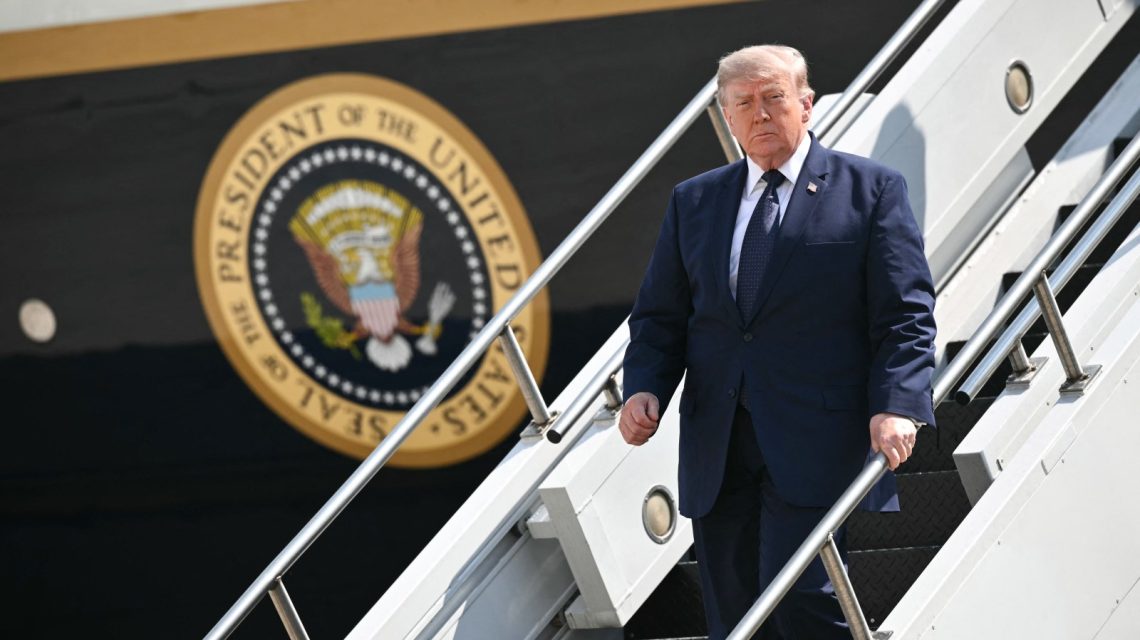
President Donald Trump’s net job approval rating has shown a slight improvement, reaching its highest level in three months according to a recent Napolitan News Service poll. While many Americans still express disapproval, the survey reveals that 44 percent approve of Trump’s performance, while 53 percent disapprove. This gives him a net approval rating of -9 percentage points, his best since April, indicating a modest shift in public opinion.
The poll also highlights a reduction in Trump’s disapproval rating, which has decreased to 53 percent, its lowest in three months. This suggests a slight softening in opposition, although a majority continues to view his performance negatively. The narrowing of his net deficit marks a significant change, given that the last time it was -9 percent or better was in an April poll, which showed a -8 percent net approval.
The survey, conducted by RMG Research, Inc., took place from July 6 to July 14, 2026, among 2,000 registered voters. It has a margin of error of 2.2 percent. When contacted for comment, White House Spokesman Davis Ingle emphasized Trump’s accomplishments. He stated that no other president has done more for the American people, citing efforts to create jobs, control inflation, and increase housing affordability.
Despite this slight improvement, other recent polls contrast with these findings. Some surveys show Trump’s approval at its lowest points during his second term. For example, a poll by The Economist/YouGov recorded Trump’s approval at 37 percent, against a 59 percent disapproval. Similarly, Echelon Insights found a 38 percent approval and a 61 percent disapproval.
Shifts in support among demographics are notable. While some polls indicate a slip in Trump’s approval among men, others show a decline among young voters. Approval among rural voters has, however, improved. As the 2026 congressional midterm elections approach, Trump’s approval ratings are crucial as they often hint at potential party performance.
Trump’s administration faces challenges both internationally and domestically. Recent tensions with Iran raise questions about the effectiveness of his foreign policy. Meanwhile, economic ratings have taken a hit as concerns over inflation and the cost of living rise, despite White House claims of easing price pressures and job growth. These challenges make the improvement in net approval note-worthy, but a majority still disapprove of his performance.
Upcoming factors like economic indicators and their impact on public opinion could shape Trump’s approval rating in the weeks ahead. Legal challenges, trade negotiations, and budget discussions are also likely to influence public perception. Ultimately, many Americans will consider whether their financial situations improve when evaluating Trump’s effectiveness in office.
 Trump Announces $15 Billion Iowa Steel Mill Investment
  Abdul El-Sayed’s Health-Focused Campaign in Michigan
  Plaintiffs Challenge Identity Representation in Kansas
  Turkey’s Strategic Moves in a Changing Middle East
  Trump’s Impact on Washington’s Landscape in His Second Term
  Washington’s Intense Focus on AI: Balancing Risks and Opportunities