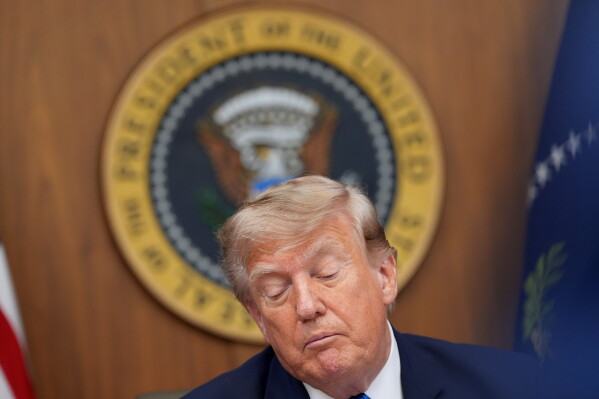
The White House announced on Friday that President Donald Trump is considering further strikes on Iran as the U.S. seeks compliance with a truce agreement involving the reopening of the Strait of Hormuz. The agreement was initially forged last month but quickly unraveled.
No U.S. attacks on Iran occurred overnight. However, Iran’s paramilitary Revolutionary Guard reported striking two more tankers in the Strait of Hormuz. Kuwait also intercepted drones linked to this conflict. In a separate development, Hamas has agreed to disarm, marking a potential shift in the Gaza conflict, although significant challenges persist.
Trump’s Consideration of New Strikes on Iran
White House press secretary Karoline Leavitt criticized Iran for violating a truce memorandum with the U.S. by attacking commercial ships and killing American soldiers. She emphasized that Trump demands Iran engage meaningfully to resolve the situation.
In statements made earlier on Friday, Trump indicated a desire for continued military action, suggesting a strong U.S. response until Iran acknowledges its limits. Meanwhile, Iran claimed responsibility for drone attacks on Kuwait, a nation hosting U.S. forces, and reported strikes on oil tankers in the crucial Strait of Hormuz.
Kuwait’s Defense Ministry confirmed shooting down multiple drones within its airspace. Iran’s state media stated that an air base in Kuwait was targeted in retaliation for previous U.S. actions.
Gaza: Deal on Hamas Disarmament
Hamas announced plans to disarm as part of a deal facilitated by Trump, which includes Israeli withdrawal from Gaza. Disarmament depends on establishing a Palestinian state, a proposal Israel’s government resists. Despite these negotiations, a series of Israeli airstrikes occurred in Gaza, causing casualties.
UN Secretary-General Antonio Guterres welcomed the agreement, stressing the necessity of its implementation. Despite this, Israel has yet to officially respond. The ceasefire, brokered by the U.S. last October, required Hamas to disarm and relinquish power to an independent Palestinian government while Israel was to withdraw in conjunction with an International Stabilization Force deployment. However, mutual accusations of violations have stalled progress.
The Gaza conflict started following a Hamas-led operation on October 7, 2023. Israel’s counteraction in Gaza has resulted in significant casualties.
Other Regional Developments
- Saudi Arabia proposed a defense alliance of 14 nations to enhance maritime security and protect trade routes in the Red Sea. The Iran conflict has disrupted global shipping. Concurrently, Yemen’s Houthi insurgents announced a blockade against Saudi Arabia, impacting trade routes further.
- Saudi Arabia’s Defense Ministry clarified that the alliance is defensive, inviting participation from any interested nation. Oman and the UAE did not support the message, whereas Turkey, Egypt, and Pakistan joined.
- Houthi representatives indicated that ship protection necessitates lifting the Saudi blockade on Yemen. Large demonstrations in Houthi-controlled regions showed support for these actions.
- In southern Lebanon, Israeli forces demolished an underground tunnel network at the Beaufort Castle, used by Hezbollah as a command center. This location holds historical significance and was recently recognized by UNESCO.
- Lebanese President Joseph Aoun criticized the Israeli operation as counterproductive ahead of planned negotiations in Rome. Future discussions aim to outline conditions for an Israeli withdrawal in exchange for Hezbollah disarmament.
Journalists Madhani and Becatoros contributed to this report, with Fatma Khaled reporting from Cairo.
 Himalayan Pilgrimage: A Couple’s Narrow Escape and Lingering Questions
  Former CEO Sentenced for Bank Fraud and Sanctions Evasion
  Russia’s Potential Incursion Into Estonia: NATO’s Resilience Under Scrutiny
  Senators Urge Action to Free Imprisoned Journalist in Iran
  Trump’s Address at UNGA and Key Political Developments
  Irish Athletes Urge Boycott Against Israel