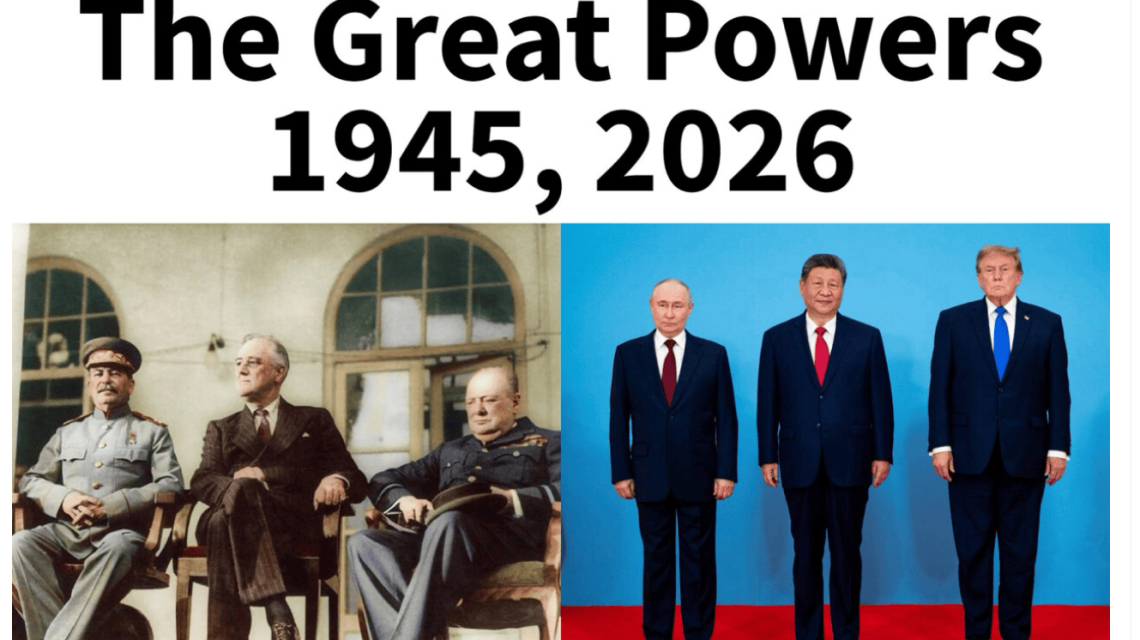
President Donald Trump shared an image on Saturday comparing himself, Chinese President Xi Jinping, and Russian President Vladimir Putin to the leaders at the 1945 Yalta Conference. This came after the trio held a summit in China. The graphic, posted on Trump’s Truth Social account, juxtaposed the wartime photo of U.S. President Franklin D. Roosevelt, British Prime Minister Winston Churchill, and Soviet leader Joseph Stalin with a photo of Putin, Xi, and Trump together.
Trump had already compared Thursday’s meeting in Shenzhen to Yalta, describing it as “bigger than Yalta.” The original Yalta Conference is seen in Eastern Europe as the point when Western powers permitted Soviet dominance over the region. In 1945, leaders negotiated Europe’s postwar arrangement, the United Nations’ role, and the Soviet Union’s involvement in the war against Japan. The Shenzhen summit, however, happened in a different context, raising concerns about major powers negotiating for smaller countries not represented.
A New Yalta?
Before the Shenzhen meeting at Kylin Villa on November 19, some in Ukraine and its European allies expressed worry over a potential “Yalta 2.0”. This 90-minute meeting was the first formal summit involving leaders from the U.S., China, and Russia. The resulting joint “peace declaration” did not include the major geopolitical agreements characteristic of Yalta.
The document reaffirmed that nuclear war cannot be won and should never be fought, committing to dialogue to reduce nuclear risks. Yet, no timeline or negotiations for a trilateral arms-reduction treaty were set. Beijing had previously resisted joining such a framework, citing its smaller nuclear arsenal compared to Washington and Moscow. Other commitments involved pursuing U.N. reforms, enhancing refined petroleum product supply, and ensuring state official immunity in international courts. However, no resolution was offered for Russia’s war in Ukraine or U.S. conflicts with Iran.
Trump, however, claimed the summit was successful, telling NBC News that it “went great” and rated it a “12” on a zero-to-10 scale. Following the talks, Trump participated in a Berlin meeting with U.S. envoys Jared Kushner, Steve Witkoff, Ukrainian President Volodymyr Zelensky, and over 40 European leaders supporting Ukraine. Trump conveyed discussions with Xi and Putin about finding a peaceful Ukraine war resolution, according to Witkoff.
German Chancellor Friedrich Merz remarked, “A Yalta format will not bring peace.” He cited historical division and stressed that such a separation should not recur.
Summit Perspectives
During the Shenzhen talks, Trump highlighted the meeting’s historical significance, asserting the duty of the three nations in tackling nuclear weapons and global security. Xi emphasized cooperation as crucial for international order, stating, “History tells us that peace among major countries brings stability to the world.” Meanwhile, Putin clarified, according to Reuters, “There was no division of the world into ‘spheres of influence’ at Yalta.” He added, “Yalta merely codified the existing reality,” suggesting that current conflicts similarly require acceptance of prevailing conditions.
For Kyiv, Putin’s mention of “realities on the ground” carries significance. Russian forces occupy around a fifth of Ukraine, with Moscow leveraging the phrase to push peace terms that Ukrainian officials reject. Ukrainian Foreign Minister Andrii Sybiha wrote on X that “Shenzhen is not the Yalta of Putin’s dreams,” urging Putin to concede and end the unwinnable war.
Future Diplomatic Concerns
The Shenzhen declaration, without advancements on the Ukraine conflict or major disagreements among Washington, Beijing, and Moscow, leaves key diplomatic issues unresolved. Xi’s call for regular high-level deliberations and crisis-prevention mechanisms was not complemented by a follow-up schedule, leaving future dialogues uncertain.
The article by Newsweek was produced with assistance from Martyn, an AI tool. For more information, readers can contact Newsweek editors Steve Mollman and Anthony Murray.
 Pentagon Releases Declassified UFO Files with Intriguing Plans and Reports
 Sinaloa Violence Erupts After Capture of Cartel Leader
 Trump Urges Nvidia to Reinstate Huang Amid Controversy
 Canada and China Strengthen Trade Relations Amid U.S. Tensions
 Countering China Without Neglecting the Rohingya
 Unveiling Bigfoot: Government Documents Shed Light on Folklore