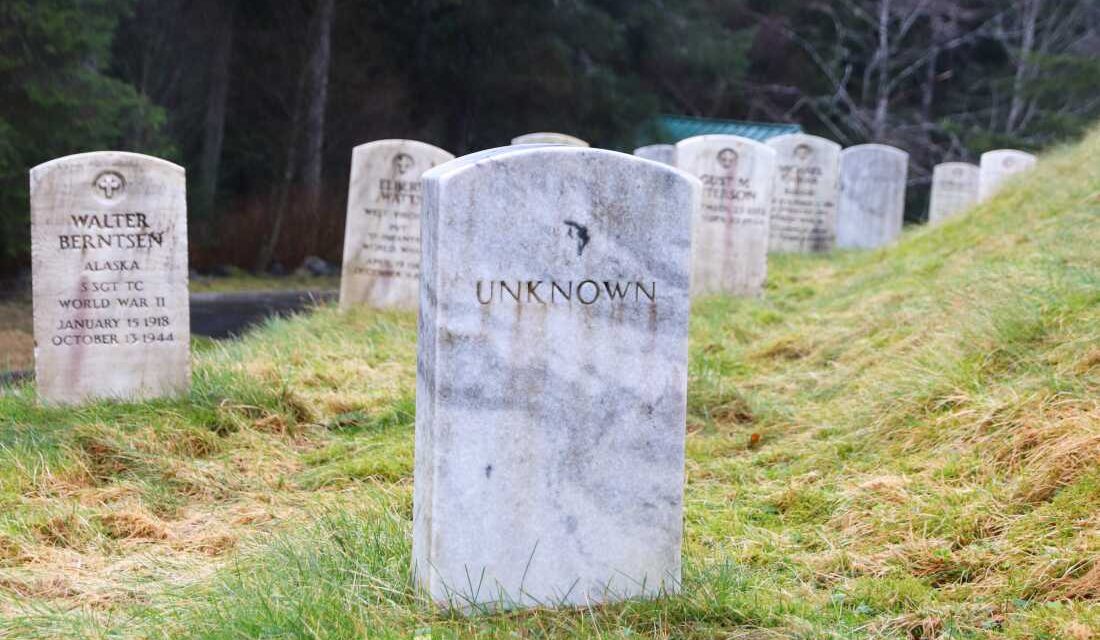
The headstone of an unidentified soldier, referred to as “X-3,” bears the word “Unknown” at Sitka National Cemetery in Sitka, Alaska. This soldier has remained unidentified for over eighty years. In June, service members, veterans, and others gathered in Sitka, Alaska to honor the disinterment and transport of this soldier’s remains.
“X-3” is among more than 81,000 U.S. service members whose remains have been lost or remain unidentified. The largest numbers of missing personnel come from World War II, the Vietnam War, and the Korean War. The Department of Defense oversees identifying these missing service members, a challenging task due to the scarcity of findings on U.S. soil. In states like Alaska and Hawaii, where WWII military activities occurred, more unidentified soldiers remain. Around 120 unidentified servicemen are in Alaska, with over 1,900 in Hawaii.
Hope McKenney reports that the remains of “X-3” were transported from Sitka to a Midwest forensic laboratory. The story of X-3 traces back to June 3, 1942, during Japan’s bombing of Unalaska in the Aleutian Islands. A U.S. military aircraft, carrying service members, crashed near Cold Bay. Sixteen soldiers were aboard, but only six bodies were recovered by a local fur trapper. The unidentified soldier “X-3” was later relocated to Sitka.
Efforts to identify X-3 gained momentum through advocacy from Michael Livingston, a WWII historian, and Chris Pfeiffer, a relative of one of the missing soldiers. Pfeiffer, a military veteran, suspects his great uncle, 2nd Lt. Eugene Christensen, could be X-3.
Pfeiffer collated extensive documentation on the crash and his uncle, advocating for the Department of Defense to examine X-3’s remains. Despite the uncertainty around the identity, Pfeiffer expresses hope for closure, as many relatives have died without knowing the fate of Lt. Christensen.
Aaron Cummings, from the Defense POW/MIA Accounting Agency (DPAA), highlights the difficulty in prioritizing missions due to limited resources. Cummings emphasizes family interest as a critical factor in mission prioritization.
In late June, a DPAA recovery team, which included an archeologist and a dental expert, exhumed X-3’s grave. The team was cautious, given the grave’s history in rain-soaked Sitka soil. They faced challenges, including a failed prior attempt on another grave. Fortunately, X-3’s remains were intact, secured in a wooden casket lined with metal.
The next step involves using historical data and modern techniques like DNA testing to determine X-3’s identity. Should “X-3” be Christensen, Pfeiffer plans to inter him in Nebraska, alongside family members. Irrespective of X-3’s identity, the endeavor underscores the nation’s commitment to bringing service members home and providing closure for their families.
 A Family’s Journey Through Cancer and Loss
  The Unlikely Intrigue of a 1990 NBA Trading Card
 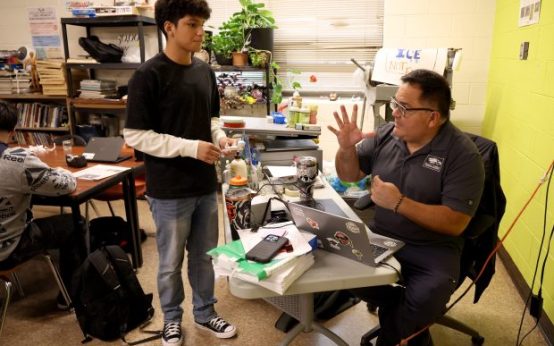 Celebrating Day of the Dead: Students Craft Calaveras in Pilsen
  Family Conflict over Sentimental Necklace
  Cindy Crawford’s Son Presley Gerber Dies at 27
 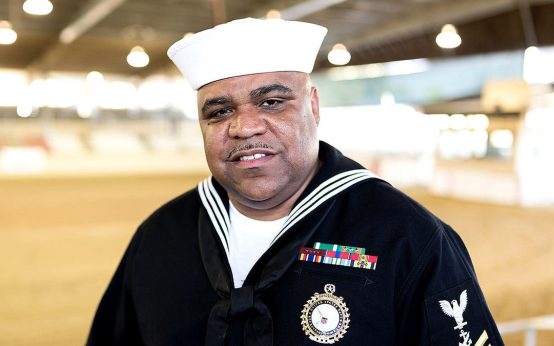 Navy Veteran Generald Wilson Reflects on Emotional National Anthem Performance