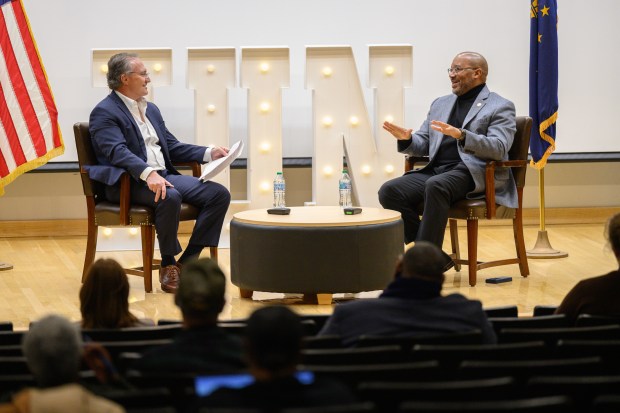
Chancellor Arrick Jackson of Indiana University Northwest credits his military service as crucial to his career in higher education. He highlighted how military discipline helped him manage multiple challenges effectively. This experience fostered persistence, discipline, and strategic thinking, which are essential in his current role.
Jackson spoke about his six-year service in the U.S. Army during an interview with Patrick Russell, founder and director of the Making History Project. This session was part of the Veterans Week programming at IUN conducted on November 11, 2026.
The Making History Project, a Florida-based nonprofit, captures veterans’ stories through in-person video interviews. These are archived in the U.S. Library of Congress. Since 2015, Russell has completed over 100 interviews to preserve such narratives.
During the interview, Jackson shared details about his early life in Saginaw, Michigan. He enlisted in the U.S. Army in 1987, serving twice, once as an airborne officer in field artillery and again as a noncommissioned officer in military intelligence, reaching the rank of sergeant.
Jackson recounted how both biological parents passed away before his ninth birthday, prompting a resolve to face life’s challenges independently. His initial career goal was in criminal justice. He noted, “At 9 or 10, realizing the necessity of self-reliance made a lasting impact.” He experienced family military ties, though they weren’t prominent due to the Vietnam War’s backlash.
After graduating high school at 16, Jackson intended to join the military but adhered to his adoptive mother’s wish to attend school for a year first. He candidly recalled informing his mother of his decision to enlist; she responded by removing his bed as a form of acknowledgment.
Jackson’s military training included learning to jump from aircraft, which was a unique experience. Yet, he also voiced concern over the potential dangers and briefly requested reassignment to a less risky position. He was rebuffed, learning “quit” isn’t part of an airborne soldier’s lexicon.
His second enlistment involved military intelligence assignments in Germany and Korea, where he volunteered at an orphanage and pursued reading and studying. These experiences inspired him to further his education, obtain a doctorate, and enter academia.
When asked about education’s role in democracy, Jackson emphasized its necessity. He asserted that an educated populace benefits the nation. His mother’s insistence on education ingrained a commitment to civic engagement in him and his siblings.
Russell concluded the session, acknowledging Jackson’s societal contributions by quoting his aspiration for his children to recognize his impactful life. He confirmed Jackson had achieved this objective.
 Suspect Detained for Assault at University of Texas Turning Point USA Event
 Creative Classroom Projects: Exploring Handcrafted Art
 A Journey of Residential Cruising with the Villa Vie Odyssey
 Patrick and Brittany Mahomes Expect Fourth Child
 Navigating Family Dynamics After Divorce
 Veterans Find New Purpose Through Business Initiatives