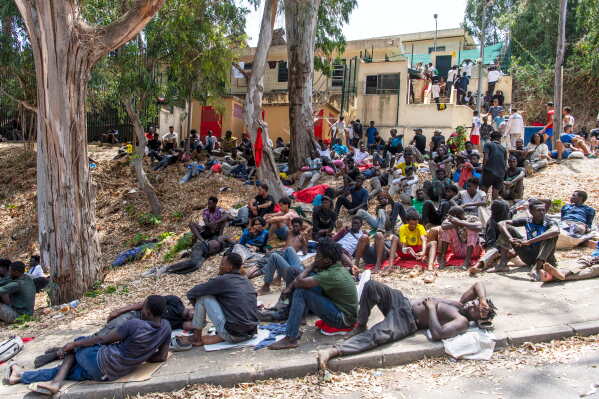
Ceuta, Spain – On Saturday, Spain erected a 500-meter-long barrier at the sea border between Ceuta, its territory in North Africa, and neighboring Morocco. This action followed a significant breach of the frontier earlier in the week by tens of thousands of migrants.
At least 67 migrants tragically lost their lives, some drowning and others killed in a stampede as they attempted to cross a breakwater barrier, reported the Spanish government. Prime Minister Pedro Sánchez criticized some EU leaders for their reactions, describing calls for Spain’s suspension from the Schengen zone as being motivated by prejudice, misinformation, ignorance, or political interests.
A few weary migrants reached Ceuta’s Tarajal beach Saturday morning, where soldiers escorted them back across the border. The majority of the 50,000 to 60,000 migrants who entered Ceuta between Thursday and Friday quickly returned.
Spanish Interior Minister Fernando Grande-Marlaska stated, “We are relentless against those who break the law.” He defended Spain and Morocco’s heavy border security and dismissed any suggestion that Morocco posed a threat. Grande-Marlaska stressed that cooperation with Morocco helped Spain manage the crisis within 24 hours, and described Morocco as a reliable partner.
Morocco is not a threat to Ceuta or the rest of Spain. It is a reliable partner.
said Marlaska.EU Leaders Demand a Unified Response
Twenty-two EU country leaders demanded a coordinated response to the situation. They sent a letter to EU officials, urging the Irish presidency to swiftly organize a videoconference with interior ministers. The letter emphasized the need to prevent uncontrolled mass crossings and the perception that illegal entry can lead to legal stay.
EU interior ministers were also urged to convene to establish a shared response, with Sánchez stating that border security is a common responsibility among all member states, not just those on the frontline. Italy’s Premier Giorgia Meloni threatened temporary suspension of Italy’s Schengen agreement with Spain and imposed border checks on arrivals from Spain.
Sánchez warned against divisive reactions, saying, “In the current international context, the EU cannot afford this kind of selfish, polarizing, and unlawful reaction.”
Return of Migrants to Morocco
By Saturday, hundreds had returned to Morocco voluntarily, describing degrading treatment in Ceuta. Migrants navigated through an informal entry point monitored by Moroccan authorities. Most migrants were Moroccan, with fewer from sub-Saharan regions. Many were hungry, injured, and expressed having faced difficult conditions.
Migrant Ouail Lamzeiz returned after experiencing hunger and seeking shelter at a migrant center, which failed. His friend, Salah Eddine El Arrage, claimed Spanish police beat him, driving his decision to return. Othmane El Merzoug asked bystanders to call his family for financial help to return home.
Along Ceuta’s Tarajal beach, local sunbathers overlooked the masses heading back to Morocco, revealing a contrast in daily life. Local resident Mohamed Abdelatif, 21, expressed concern about the disruption to the city’s peace due to the border rush.
The reality is, it’s not good.
said Abdelatif.Ceuta and Nearby Areas Face Residual Effects
The road from the Moroccan town of Fnideq to the border showed signs of unrest. Burned-out vehicles and the smell of smoke were prominent. Police barriers directed traffic towards the crossing, with water cannons stationed nearby.
Ceuta President Juan Jesús Vivas stated that life in the city has been disrupted by recent events but mentioned the satisfactory beginning of people’s return process.
In Tangier, 75 kilometers west of Ceuta, the main railway station became a temporary rest area for returning migrants, some sleeping on the ground. Abdalah, a migrant, recalled failed attempts to cross and hunger struggles near Ceuta’s border.
Some migrants in Ceuta remained determined to stay, despite challenging conditions. Mohamed Hatri emphasized their resolved stance, despite barriers to resources urging them to return.
——
Oubachir reported from Fnideq, Morocco. Renata Brito in Barcelona, Spain, and Elena Becatoros in Athens, Greece contributed to this report.
 Haitian Community in Maryland Faces Uncertainty After TPS Ends
  Strait of Hormuz Deal Near Amid Tensions
  Trump Warns Iran of Strong U.S. Response if Talks Fail
  Taiwan Launches Significant Military Drills Amid Rising Tensions
  Deadly Russian Missile Strikes in Kyiv Region
  Ongoing Strife in Gaza: Challenges and Stakeholders’ Responses