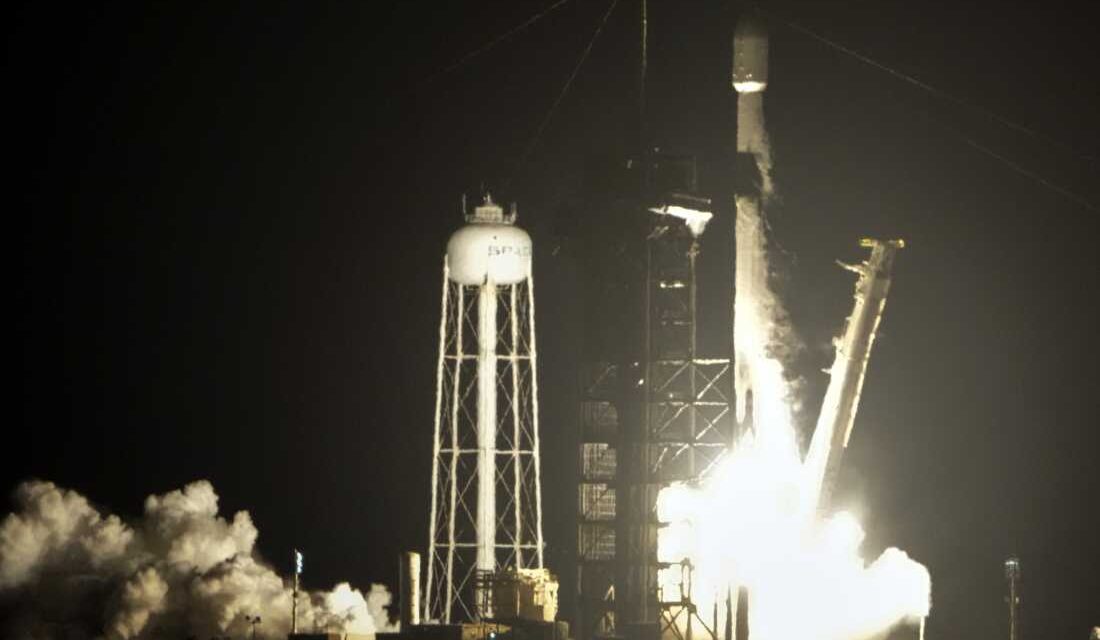
The Kennedy Space Center witnessed the liftoff of a SpaceX Falcon 9 rocket from pad 39A on January 15, 2025. The rocket’s mission involved transporting a payload of lunar landers and scientific instruments to the moon.
A piece of this rocket is now expected to impact the moon on Wednesday. John Raoux captured the event for AP, providing visual evidence. Scientists predict the collision will occur at 2:35 a.m. ET, with the debris reaching a speed exceeding 5,000 miles per hour, according to Bill Gray, who specializes in space-tracking software.
The debris, which is part of the rocket’s upper structure and comparable to a five-story building in size, will strike the moon’s sunlit side. This area faces Earth and will be partially illuminated near the Einstein Crater’s northwestern portion. Gray indicates this impact may create a crater approximately 17 meters in diameter.
SpaceX’s intention was not for this remnant to hit the moon. As cited in the Associated Press, NPR attempted to get a comment from SpaceX but has yet to receive feedback.
The Lunar Reconnaissance Orbiter (LRO) at NASA Goddard Space Flight Center will monitor the moon’s surface prior and subsequent to the impact. Brent Garry, a project scientist for the LRO, elaborated on the future observations. “Post-impact, we may gain further insights on its location. We will engage in additional targeting a week after the incident,” Garry explained during NASA’s Solar System Exploration Research Virtual Institute (SSERVI) dialogue.
The visibility of the impact remains uncertain. According to researchers, detecting even a dust plume could challenge professional telescopes. Bill Gray suggested that rocks displaced by this event could generate a visible “plume” against the moon’s dark surface.
Researchers agree that observing such incidents is rare and propose an opportunity for scientific inquiry. Ben Fernando of Los Alamos National Laboratory encouraged observation despite the challenges: “While you won’t see it with binoculars, appropriate equipment could prove beneficial at the right time.”