
The unexpected crash of an abandoned SpaceX rocket booster has sparked interest in planetary science. The impact is set to offer vital data on how high-speed impacts affect the Moon’s surface. While placing man-made objects on the Moon isn’t new, dating back to the 1950s, this latest instance offers a broader perspective on our interactions with extraterrestrial landscapes.
Space exploration often employs a narrative akin to colonialism, where space is seen as terra nullius or land belonging to no one. The Moon becomes a wilderness where states and corporations leave traces like flags or discarded components. This mindset mirrors colonial practices that dismissed existing land claims on Earth.
As private tycoons like Elon Musk and Jeff Bezos enter space projects, outer space is morphing into a playground for the rich. Unlike state agencies, private firms are less bound by governance, treating space as an unchecked experimental zone. Yet, the absence of life on the Moon does not absolve us of ethical duties in these endeavors.
As an Ojibwe scholar specializing in environmental governance, I perceive the Moon as a relational presence, a perspective shared by many Indigenous groups. Many Indigenous communities have challenged unethical space activities, such as lunar burials or using the Moon as a waste site.
This opposition’s core argument is that the Moon should not be seen as a blank slate for exploitation but respected as a relative. Dismissing Indigenous concerns as anti-science is misguided. Notably, NASA’s collaboration with the Navajo Nation shows that scientific research and ethical practices can coexist.
The focus should be on stewardship, not exploration itself. There’s little to learn from a debris-laden crash when natural meteor impacts are informative yet sustainable. With Earth’s pressing environmental crises due to human activity, our space approaches need revisiting. Exporting environmental issues to the Moon hinders knowledge and expands ecological harm.
Space exploration calls for global accountability and ethical management. Corporate leaders should not dictate cosmic regulations. True advancement involves incorporating marginalized voices, including Indigenous communities and those from the Global South, ensuring space remains a shared responsibility.
Niiyokamigaabaw Deondre Smiles, an upcoming Assistant Professor of Indigenous Studies at Bemidji State University, belongs to the Leech Lake Band of Ojibwe. Their research spans Indigenous perspectives on environmental interactions, political ecology, and space geographies. Their writings delve into colonialism and space, with works like a Society+Space essay and a chapter in the “Routledge Handbook of Outer Space Studies.” These opinions are their own.
 NASA’s New Space Telescope Launch: A Breakthrough in Cosmic Exploration
 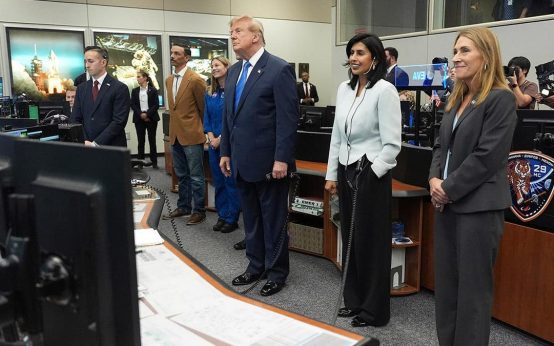 Trump’s Call with ISS Astronauts and Honors at NASA
  Anticipated Northern Lights Due to Solar Activity
  NASA’s Nancy Grace Roman Telescope Prepares for Launch
  Rare Deep Partial Lunar Eclipse Visible Across the U.S.
  China Delays Chang’e-7 Lunar Mission Plans