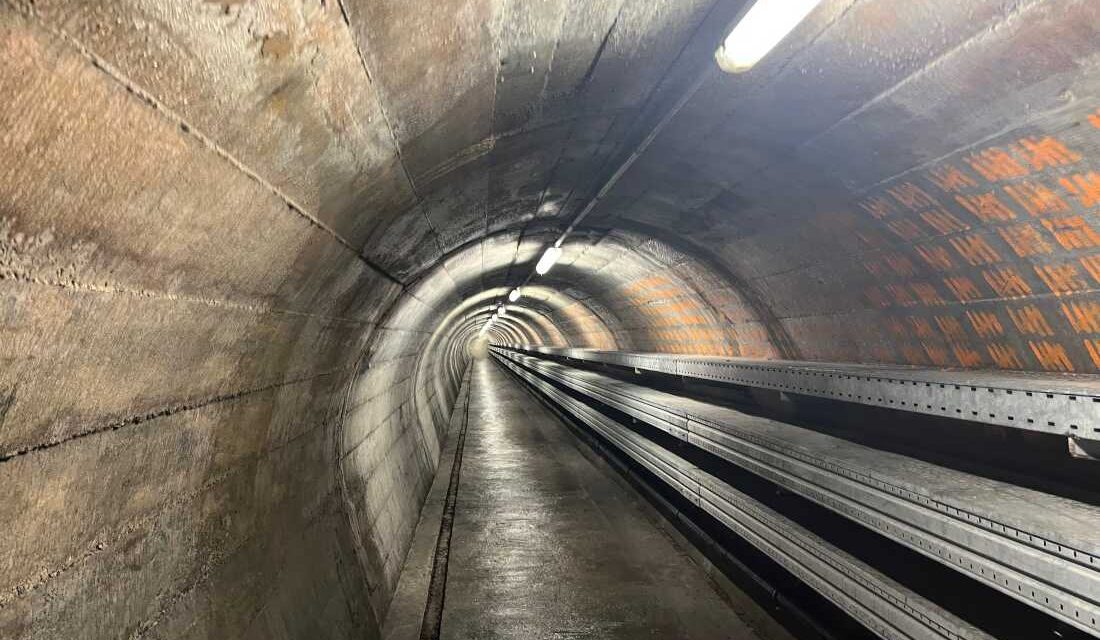
In Lucerne, Switzerland, the Sonnenberg nuclear bunker features a tunnel that leads to a vast underground complex. Originally built to accommodate 20,000 people, it stands as the largest underground nuclear bunker worldwide, constructed in the 1970s amid the Cold War. The entrance of this bunker is discreetly placed within a children’s playground, presenting an innocent appearance that masks its fortified purpose.
Sonnenberg Bunker
Zora Schelbert, the Sonnenberg Bunker guide, leads visitors through this narrow, well-lit tunnel that descends towards the bunker built to harbor a significant part of Lucerne’s population during nuclear war. Back then, this represented a third of the city’s residents. Schelbert noted, “Back then, 20,000 people constituted a third of our city’s inhabitants,” highlighting the bunker’s critical role.
Strategic Planning
Swiss officials anticipated that Switzerland, given its neutral stance, would likely not face direct nuclear strikes but would need protection against fallout from surrounding non-neutral countries. To address this, they equipped the bunker with diesel-powered generators sufficient for two weeks of operation. Schelbert explains, “After two weeks, no more food, no more water, no more power.” The duration of shelter stay depends on the external situation, illustrated by recent conflicts in places like Ukraine or Israel.
Nationwide Effort
Post-Cold War, Switzerland did not dismantle its shelters but expanded them, ensuring space for all of its 9 million citizens. The country now boasts over 370,000 nuclear bomb shelters. In 2011, after the Fukushima Daiichi nuclear disaster, Swiss lawmakers voted to preserve this network, valuing it as a national reserve for emergencies.
Regulations and Civil Uses
Each residential building in Switzerland must feature a bunker with adequate blast doors and ventilation or allocate funds towards nearby state-run bunkers. Swiss citizens contribute fees ranging from $1,700 to approximately $3,500 for bunker maintenance and construction. In times of peace, these bunkers serve other purposes, such as wine cellars, saunas, or storage, like the one at the University of Bern.
Educational Integration
History professor Silvia Berger Ziauddin discusses Switzerland’s bunker history, noting their symbolic significance as islands of calm amidst chaos. She describes civil defense education where students engage with bunkers through drawings, films, and overnight stays. The imagery they create reflects a divide between the chaos above and security below.
Reality Versus Imagery
Berger Ziauddin warns that actual bunker life contrasts sharply with these imagined scenarios. At the Sonnenberg bunker, accommodations include a hospital and prison cells, highlighting practical challenges if fully utilized. Due to logistical concerns, the bunker’s capacity was reduced in 2002 to 2,000 people.
Alternative Uses
Facilities like the Sonnenberg bunker have been repurposed for overflow housing for refugees and the homeless, though not without controversy. It has yet to fulfill its intended purpose of shielding against nuclear fallout, yet Switzerland allocates millions annually for maintenance, ensuring readiness.
Report contribution by Esme Nicholson from Berlin.
 Roman Empire’s Road Network Study Challenges ‘All Roads Lead to Rome’
  Tensions Rise in South China Sea After Ship Collision
  Where is Austin Tice?
  Trump’s Speech Targets Iran’s Nuclear Ambitions at U.N.
  U.S., Denmark, and Greenland Sign New Security Agreement
  U.S. Military Aircraft Crash at Spangdahlem Air Base