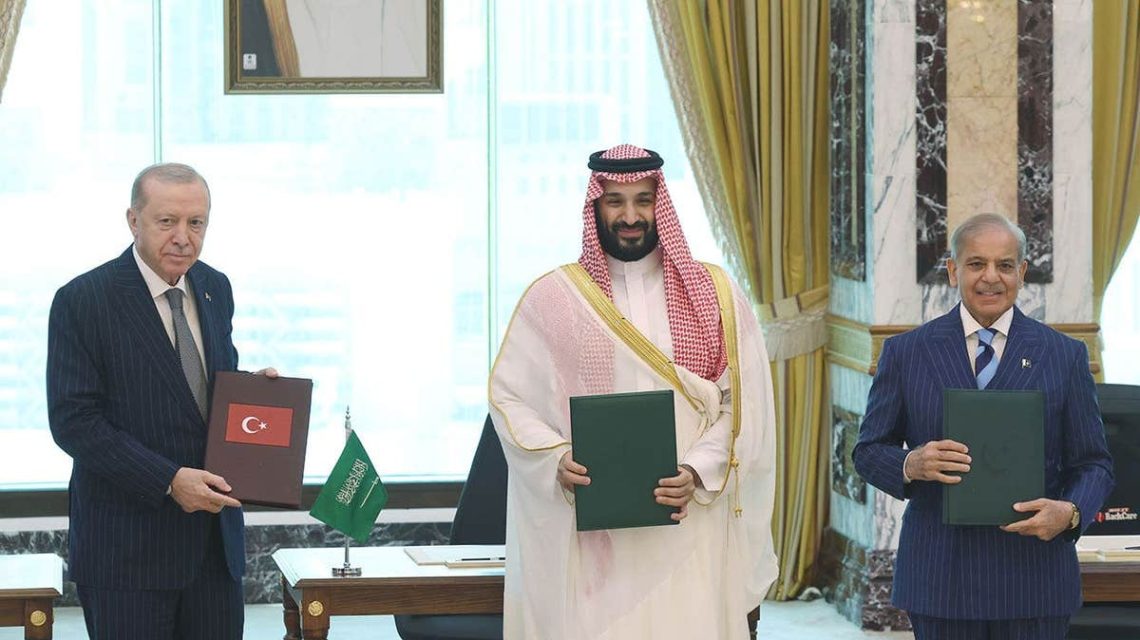
A recently signed defense pact involving Saudi Arabia, Turkey, and Pakistan is generating discussion about whether it represents a new regional alliance that could counterbalance the U.S.-backed arrangements centered on Israel and the Abraham Accords. Alternatively, it might create a novel framework for shared security responsibilities among U.S. partners.
Saudi Arabia, Turkey, and Pakistan, all having long-standing security ties with the United States, enter into this agreement with different objectives. Together, they may influence the region’s power dynamics.
Strategic Interests
In November 2025, Saudi Arabia signed a Strategic Defense Agreement with the United States and was recognized as a major non-NATO ally. However, Riyadh did not secure a treaty-level U.S. defense guarantee, potentially prompting this new pact as a precaution against potential uncertainties in U.S. security commitments.
For Pakistan, a nuclear-armed state, the pact offers enhanced energy security, Saudi investment, and greater regional influence. However, the possibility of its nuclear deterrent extending to its partners remains unclear. Turkey, a NATO member, benefits from a larger defense market and a boost in strategic influence amid rising tensions with Israel.
The Agreement
The Mecca Joint Defence Agreement was signed by Saudi Crown Prince Mohammed bin Salman, Turkish President Recep Tayyip Erdoğan, and Pakistani Prime Minister Shehbaz Sharif on August 7, 2026. It aims to strengthen collective deterrence and states that an armed attack on one nation will be considered an attack on all three.
Turkish Foreign Minister Hakan Fidan stated that the agreement is “technically the same” as NATO’s Article 5, although the specifics of assistance after an attack will still be determined by a new ministerial committee. A general secretariat will be established in Saudi Arabia.
Potential Expansion and Reactions
The alliance may expand beyond its initial members, with Egypt as a potential participant. Discussions over the pact lasted nearly three years before finalization.
Iran has downplayed the agreement as a threat, interpreting it as a regional shift toward self-reliance in security matters. Iranian officials noted that the pact reflects efforts to reduce dependency on external powers.
Sector Analysis
Experts like Sinan Ciddi have expressed skepticism about whether the pact amounts to a NATO-style alliance, noting that each country has its own motives. For Saudi Arabia, it’s a way to ensure security amid questions about U.S. commitments. Pakistan gains strategic depth, while Turkey finds new defense cooperation opportunities.
Pakistani Prime Minister Shehbaz Sharif, during his visit to Saudi Arabia, emphasized that expanding ties with Turkey and Pakistan does not detract from the relationship with Washington. Official narratives reject the idea of forming a “Muslim NATO” or a Sunni alliance aimed at specific countries.
Broader Implications
The agreement is perceived as a complement to U.S. relationships rather than a counterbalance to ongoing regional treaties like the Abraham Accords. Enhanced cooperation with regional partners could lead to increased burden-sharing for the United States.
Raza Rumi highlighted that the pact offers Pakistan military and political advantages. The credibility of a mutual-defense guarantee will depend on developing planning and response systems.
The pact reveals regional dynamics and hedging strategies rather than permanent bloc formation. India is monitoring the situation closely, considering implications for its national security and regional stability.
Concerns arise that new security alignments could result in heightened regional tensions, prompting countries like Israel, Greece, and Cyprus to deepen their cooperation in response.
 Poland Prepares for Potential Conflict Amid Rising Tensions with Russia
  Drones Redefine Warfare in Ukraine
  Israel Condemns British Green Party’s View on Zionism
  U.S. Military Executes Lethal Strike on Suspected Drug-Trafficking Vessel in Caribbean
  U.S. Actions in the Strait of Hormuz Face Sustainability Challenges
  Escalating Violence in French Student Protests: A Call for Peaceful Solutions