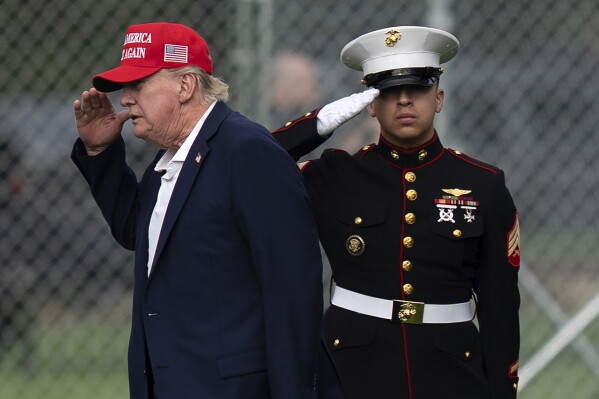
South Korea expressed its desire for renewed diplomatic engagement between the United States and North Korea on Monday. This comes as U.S. President Donald Trump’s command to reduce military drills with South Korea raised concerns about the allies’ preparedness against potential threats from North Korea.
Trump justified the decision by highlighting his positive relationship with North Korean leader Kim Jong Un. He aimed to reengage with Kim, who perceives U.S.-South Korean military exercises as preparations for invasion. However, experts believe Kim, reinforced by his advancing nuclear capabilities and growing military connections with Russia, will likely not return to negotiations unless assured significant U.S. concessions.
The 11-day Ulchi Freedom Shield exercises commenced as planned on Monday, with uncertainties about the extent of the training scale-back. Trump’s decision bewildered many in South Korea, a crucial ally where national security is paramount due to nuclear threats from North Korea.
Trump stated in a social media post that these exercises are expensive and send a hostile signal to North Korea, which he described as unthreatening and respectful during his presidency. He tasked Defense Secretary Pete Hegseth with considerably reducing the exercises.
The move is seen as a shift by Trump against an ally in favor of a leader previously regarded as adversarial. Additionally, Trump’s administration has criticized NATO allies for perceived shortcomings in backing his stance against Iran while addressing Russian aggression in the Baltic region.
Many South Koreans’ trust in the U.S. has diminished following a tariff dispute initiated by Trump’s administration and his transactional security approach. South Korea’s presidential office expressed hopes for Trump and Kim’s friendly connection to foster meaningful dialogue between the U.S. and North Korea, contributing to peace and stability on the Korean Peninsula. It affirmed South Korea’s commitment to necessary diplomatic efforts.
South Korea and the U.S. are in discussions regarding contributions for restoring navigation freedom in the Strait of Hormuz, as per South Korea’s presidential office. President Lee has taken steps towards improving North Korea ties, including ceasing front-line broadcasts that played K-pop music and news.
President Lee recently extended an offer to conduct talks to officially conclude the 1950-53 Korean War, which ended in an armistice rather than a treaty. The conservative People Power Party criticized Lee for ignoring security concerns following Trump’s announcement while prioritizing hopes for U.S.-North Korea diplomacy.
North Korea has avoided discussions with South Korea and the U.S. and accelerated weapon testing since the collapse of high-stakes nuclear talks between Kim and Trump in 2019. Kim has reinforced his diplomatic standing by aligning with Russia over the Ukraine war and enhancing ties with China.
In September 2025, Kim signaled potential talk resumption with the U.S. if it stopped its focus on North Korea’s denuclearization. Experts suggest Kim seeks to use his nuclear arsenal to secure significant concessions, like extensive sanction relief. Trump’s recent social media comments on Kim reflect willingness to reconnect but North Korea is busy leveraging Russia’s conflict with Ukraine while modernizing its military.
Leif-Eric Easley, a professor at Ewha University in Seoul, noted downsizing the drills could impair alliance coordination, slow South Korea’s defense responsibility growth, and weaken deterrence against potential regional conflicts.
Duyeon Kim, a senior analyst at Washington’s Center for a New American Security, emphasized reducing joint drills could degrade military readiness against potential North Korean attacks. The exercises test tactics and irritate North Korea.
This year’s Ulchi Freedom Shield drills, akin to previous installments, engaged roughly 18,000 South Korean soldiers. The U.S. military incorporated lessons from recent North Korea’s battlefield experiences in Ukraine, while including a live-fire exercise to evaluate joint precision targeting and maneuvering, a wet gap crossing, and prepositioned equipment distribution.
North Korea’s Foreign Ministry accused the U.S. and South Korea of planning provocative drills and vowed to counter with enhanced deterrents. Recently, North Korea launched two ballistic missiles in potential protest against the exercises. Duyeon Kim stated North Korea exploits U.S.-South Korean drills for propaganda, portraying America as hostile and justifying its nuclear program.
This isn’t Trump’s first attempt at halting the drills. After his 2018 summit with Kim, Trump announced the suspension of U.S.-South Korean summer exercises, labeling them provocative and expensive.
Kim Dong-yub, a professor at the University of North Korean Studies in Seoul, remarked that North Korea feels less urgency to resume talks now compared to 2018 when engaging rivals.
He anticipated North Korea acknowledging Trump’s outreach but waiting for further indications of U.S. intent to reduce hostilities.
 Musician Zach Bryan Wears ‘Free Palestine’ Shirt at Gillette Stadium Concert
  Celebrity Comments Spark Controversy and Career Consequences
  Suspected Plague Outbreak in Siberia: A Detailed Report
  G7 Nations Agree to Release 100 Million Barrels of Oil Amid Rising Fuel Prices
  U.S. Initiates Military Reinforcement at Mexico Border
  Attempted Hijacking on FlyDubai Flight 1073