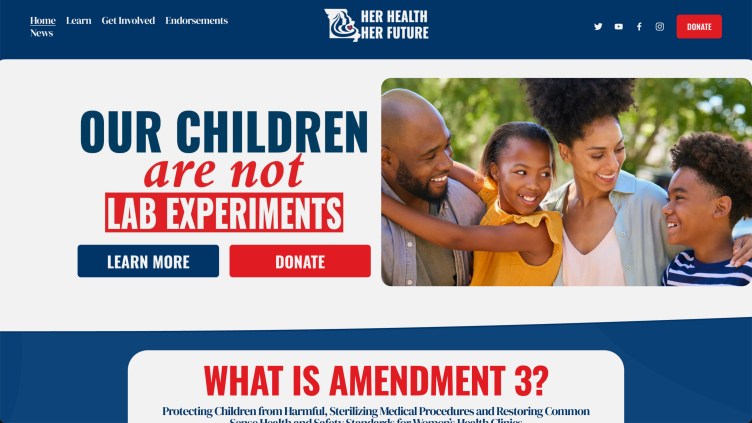
Two years ago, opponents of abortion in Missouri attempted to block Amendment 3, a ballot measure designed to protect reproductive rights in the state constitution. They inaccurately told voters it would allow surgeries for gender transition in minors, even though it would not. Despite these claims, voters approved Amendment 3, overturning a restrictive abortion ban enacted by the Republican-controlled legislature following the U.S. Supreme Court decision in 2022 to overturn Roe v. Wade.
Now, Missouri’s Republican leaders are working to reverse these newly established rights. They have placed another measure, also named Amendment 3, on the upcoming November ballot. This amendment aims to reinstate the abortion ban, allowing only limited exceptions, and to constitutionally prohibit gender transition care for minors. Although the state already banned surgeries and new prescriptions of puberty blockers and hormones since August 2023, this amendment would make these prohibitions permanent.
In Missouri, voters often use the initiative petition process to approve policies that Republican leaders oppose. This method has led to the expansion of Medicaid, legalization of marijuana, an increase in the minimum wage, and the restoration of abortion rights. Recent electoral defeats highlight a disconnect between the electorate and state Republican leaders.
More than 80% of voters rejected an attempt to make amending the state constitution nearly impossible, while over 83% opposed a plan to eliminate the state income tax.
Ken Warren, a political science professor emeritus at Saint Louis University, stated, “Republicans in Missouri are accustomed to dominating. They think they can do whatever they want, but voters continuously prove them wrong.”
The November amendment attempts to capitalize on misleading terms, strategic distraction, and a name recycling strategy. In 2024, Amendment 3 protected reproductive rights. The new measure asks voters to support another Amendment 3 to remove those rights. Republican leaders argue that the previous vote did not reflect voters’ intentions, maintaining that Missourians prefer a ban with exceptions for rape, incest, medical emergencies, and fetal anomalies while restricting gender transition care.
In 2024, the abortion rights measure passed by a small margin of 51.6% to 48.4%, indicating that a shift of around 48,000 voters could change the outcome. Critics refer to the inclusion of gender care as “ballot candy,” seeing it as a tactic to make the proposal more appealing. They argue the measure offers a redundant promise since gender transition surgeries for minors are largely banned in the state. Amendment 3 would ensure these restrictions are cemented into the state constitution indefinitely, affecting a small group of minors already under significant legal constraints.
Supporters focus on gender transition care rather than abortion rights to sway voter attention. Political messaging suggests that children are at risk, emphasizing the abolition of “lab experiments” and advocating for “common sense health and safety standards” at women’s clinics.
Her Health, Her Future, a political action committee led by Missouri First Lady Claudia Kehoe, actively campaigns for the amendment, arguing that it offers critical pro-life protections. However, campaign communications fail to mention that the amendment would repeal the rights granted by voters two years ago.
Polling results show the strategy may succeed; while nearly 60% of Missourians support legal abortion up to the first eight weeks, a higher percentage oppose gender transition treatments. In combination, the amendment appeals to about 47% of voters, with 40% against.
Critics, including Missouri Democrats, view this as a strategy to undermine the electorate’s intention. State Representative Raychel Proudie condemned the Republicans for consistently moving “goalposts” and employing deceptive tactics. The ballot summary originally written by lawmakers did not clarify the repeal of existing abortion rights but rather framed as enhancing women’s safety and protecting minors from transition procedures.
Courts intervened, finding the summary misleading. Secretary of State Denny Hoskins wrote revised language, defending his choice for neutral terminology. Courts subsequently revised his wording to state clearly that the amendment repeals 2024’s voter-approved reproductive rights. Despite appeals, the adjusted language highlights the potential effect on reproductive rights in Missouri.
Disputes extend beyond language to the obstruction of citizen-led measures. Hoskins blocked two measures from the ballot, citing unconstitutionality. This prompted legal challenges expected to advance to the state Supreme Court. The ongoing legal battles reflect tensions between Missouri voters and elected leaders determined to control the legislative outcome regarding abortion and gender transition care.
 The Challenges of Family Building in America
  Florida Grand Jury Report Highlights Misuse of Medicaid Funds
  Deportation of Father and Son Sparks Controversy
  Trump’s Stance on Data Centers Amid GOP Skepticism
  Republican National Committee Challenges New Jersey on Voter Roll Errors
  Police Raid at Home of Rep. Ilhan Omar’s Son Sparks Online Reactions