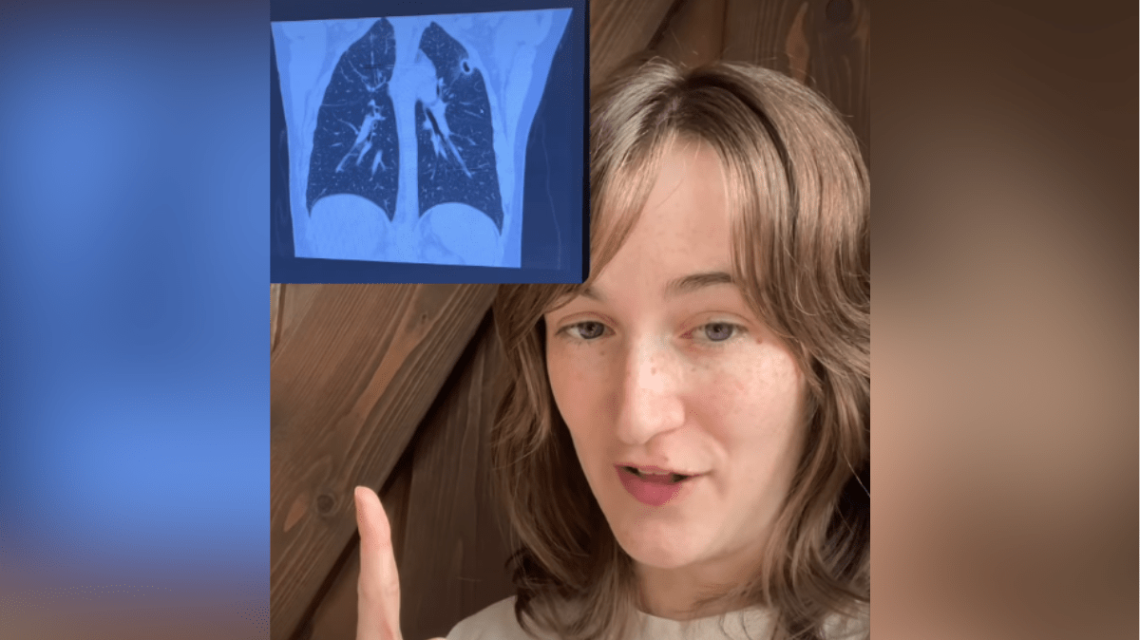
For years, a woman from Houston, Texas, faced a persistent cough that was initially believed to be related to ‘allergies.’ It wasn’t until an X-ray revealed a concerning finding that the truth unfolded. Autumn, who prefers not to disclose her full name, has encountered various health challenges throughout her life.
I was born with congenital heart defects, so my heart is severely deformed,
Autumn stated in an interview with Newsweek. I’ve undergone multiple open-heart surgeries to improve its function as much as possible, and they’ve really done an amazing job.
Despite these achievements, Autumn was dissatisfied with how her doctors handled a persistent cough dating back to 2018.
Being overlooked by medical professionals is a widespread issue. A 2022 MITRE-Harris Poll revealed that 52 percent of Americans felt their symptoms were disregarded or not taken seriously when seeking medical help.
When Autumn initially sought medical guidance for her coughing, she detailed the troubling symptoms she was experiencing. It was a productive cough with green and yellow sputum, and it tasted sour, kind of like it does when you have pneumonia,
she explained. The medical response indicated it was mere ‘allergies.’
During the pandemic, while receiving treatment for her heart ailment, Autumn requested support for her cough once again. Despite prior diagnoses of allergies, she was prompted to undergo a COVID test. I didn’t understand that leap in logic. If it sounded like my lungs had an infection beforehand, why couldn’t it still be an infection despite having it before COVID?
Autumn voiced.
Autumn consulted with two different doctors over five years, aiming to acquire effective assistance. None of the approaches worked. I tried all the allergy medications, and nothing changed,
she recounted. Still a productive cough, yellow and green sputum, and extreme fatigue.
Numerous symptoms, including fatigue, were attributed to her heart condition, though she had routinely exercised prior to her illness.
Following her cardiac ablation, meant to tackle arrhythmia, Autumn developed pneumonia. Despite receiving therapy for pneumonia, the cough endured and eventually intensified. I started coughing up blood and decided to see a new doctor,
she reported. Upon visiting the new physician, they evaluated previous X-rays, identified abnormalities in the lungs, and arranged for a CT scan.
At long last, Autumn was diagnosed with Valley fever, a fungal ailment stemming from inhaling Coccidioides spores present in certain southwestern U.S. soil. Symptoms can mimic those of allergies, colds, or flu, often resulting in misdiagnosis. While many recover without medications, Valley fever possesses the potential to become severe. The Centers for Disease Control and Prevention reports that 5 to 10 percent of patients develop prolonged lung complications; around 1 percent experience the life-endangering form that spreads beyond the lungs.
Autumn is scheduled for lung surgery in October to manage the fungal infection. Concurrently, she will undergo cardiac catheterization to examine heart valve pressure attributed to the lung complications.
By narrating her journey, Autumn aims to motivate individuals to rely on their instincts and pursue medical attention. She advocates for medical professionals to address implicit biases within their practices, urging them to combat these issues energetically. Women often get dismissed by doctors, and it’s frightening and frustrating,
she conveyed. But even though it’s hard not to be discouraged, we have to keep trying in the hope that we find someone who listens to us.
 The Importance of Balance Training for Health and Longevity
  CDC Issues Food Safety Alert on Alfalfa Sprouts
  Stroke Survivor Shares Overlooked Warning Signs
  Alfalfa Sprout Recall Due to E. coli and Salmonella Outbreak
  Lessons from a Labor and Delivery Nurse on Effective Support During Childbirth
  A Personal Journey Through Health Challenges and Discovery