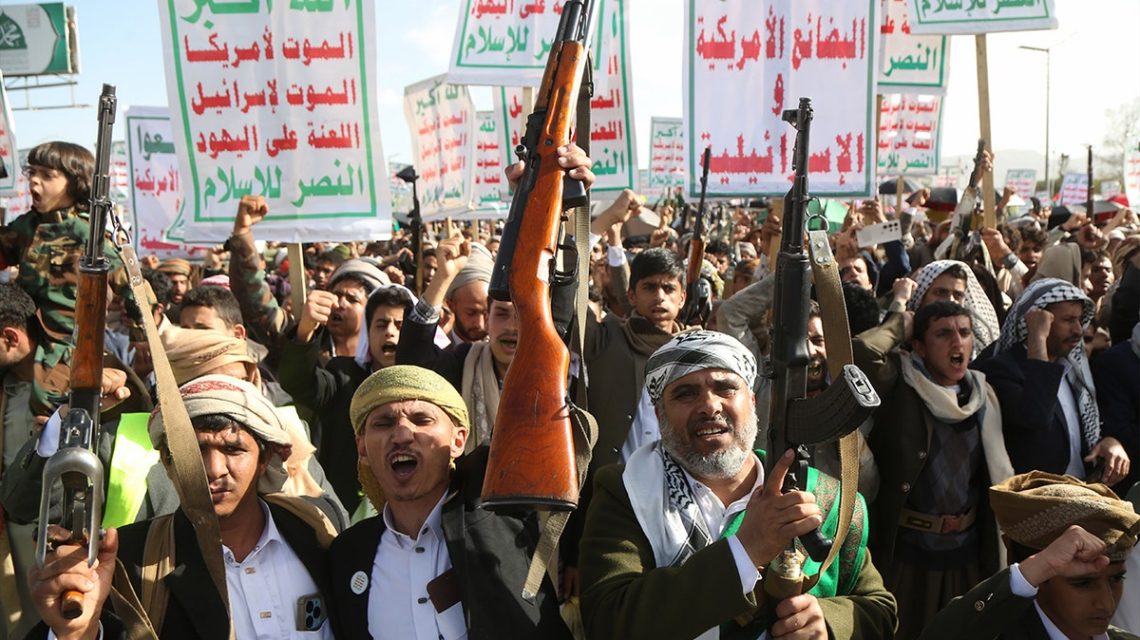
The Houthi group has made significant territorial gains along Yemen’s Red Sea coast, taking control of the strategic port city of Mocha and advancing toward the Bab el-Mandeb Strait. This strait is crucial for connecting the Red Sea with the Gulf of Aden, serving as a vital artery for global maritime trade and energy shipments. For the Trump administration, the expansion of Houthi territory presents a complex financial challenge alongside the military concerns. Efforts to disrupt the financial flow to Iran and its proxies are intensifying, focusing on the Houthis’ use of sanctions-evasion networks and control over ports and trade routes that also support millions of Yemenis, posing a tricky problem for the Treasury Department: How can funds be cut off without disrupting civilian supplies of food and fuel?
Saudi officials have urged President Trump to take military action as the Houthi advance threatens regional stability. The group cautioned they might shut the Bab Al-Mandeb Strait using missile-drone attacks if Gulf nations joined the U.S.-Israel conflict against Iran.
The financial strength of the Houthis is deep and daunting, according to Adam Rousselle, founder of Between the Lines Research. He explained that the Houthis operate through a well-capitalized network extending beyond Yemen itself. In his research for the Global Network on Extremism and Technology, Rousselle mapped out a comprehensive financing system utilizing ports under Houthi control, tariffs, Iranian oil, hawala networks, cryptocurrency exchanges, and foreign facilitators across Russia, Turkey, and Southeast Asia.
The control of ports plays a central role in the Houthis’ revenue generation due to Yemen’s dependency on imports. Rousselle’s report detailed how the Houthis impose significant tariffs on goods entering territories they control. Their recent territorial acquisitions are expected to further bolster their economic power.
Nadwa Al-Dawsari, a Middle East Institute associate fellow and Yemen expert, emphasized in recent congressional testimony the importance of territory to the Houthis. According to her, control over significant land and resources, a large population, and infrastructure enables them to resist external pressures and develop sophisticated military capabilities. The territorial base allows the group to recruit, generate revenue, manufacture and store weapons, control smuggling routes, and recover capabilities diminished by airstrikes and sanctions.
The financial connections the Houthis have cultivated are far from simple. Tehran’s relationship with the Houthis involves more than mere financial gifts. It positions them within a broader Iranian commercial network. Despite being impacted by sanctions, the Houthis have adapted their operations to navigate restrictions effectively. Treasury estimates suggest their yearly oil sales alone generate over $2 billion, with additional monthly shipments from Iranian-affiliated companies.
Despite sanctions, domestic financial extraction remains insulated from outside interference, according to Miad Maleki from the Foundation for Defense of Democracies.
Sa’id al-Jamal, identified by the Treasury as a critical financial officer for the Houthis, runs an international network trading Iranian commodities to fund the group. The scope of this network’s activities is vast, involving weapon procurement and millions of dollars in digital transactions.
The involvement of international actors like Russia and China highlights the Houthis’ evolving alliances beyond Iran. Reports indicate Russian support supplying targeting information used by the Houthis and transferring Russian petroleum to Houthi-controlled tankers. Although China’s role is more indirect, commercial actors affiliated with China appear connected to Houthi financial activities.
The complexity of the Houthi financial network poses a strategic challenge to U.S. efforts aimed at isolating Iran economically. Experts argue that Washington needs to target points where Houthi finances intersect with formal financial systems, like international banks and exchange houses, while considering humanitarian implications.
Yemen remains a critical humanitarian region, with Houthi control over ports and infrastructure essential for civilian supplies. The task is to disrupt funds without exacerbating humanitarian issues. The overarching challenge extends beyond Yemen, affecting similarly sanctioned groups globally capable of exploiting financial systems beyond regulatory reach.
Effie Lachter, a seasoned reporter with a focus on global affairs, human rights, and conflicts, has contributed significantly to uncovering critical issues around the world.
 Uganda Rejoins Prince Harry’s Invictus Games After King’s Aide Intervenes
  Saudi Arabia Faces Oil Export Challenges After Pipeline Closure
  Daring Rescue of U.S. Air Force Officers in Iran
  Houthis Capture Perim Island, Raising Concerns at Key Shipping Chokepoint
  Ms. Rachel Criticizes Silence on Palestinian Children’s Deaths
  Trump Sparks Controversy Over Northern Ireland Comments