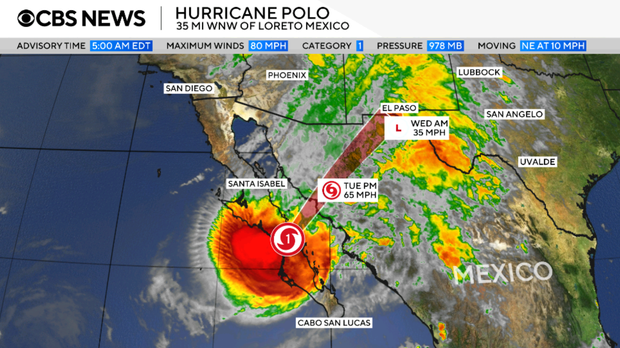
The National Hurricane Center reported that Hurricane Polo is expected to affect the southwestern United States after moving across Mexico. More than 30 million residents from Arizona to Iowa face potential flash flood risks. In southern New Mexico, heavy rain has already caused road flooding, trapping drivers until conditions improved. The rain will persist as the storm advances through the region following landfall.
Hurricane Polo’s Path
Polo is currently progressing northeastward across Mexico’s Baja California Sur at approximately 10 miles per hour. This pattern is expected to persist with increasing speed. The storm’s core will traverse the Gulf of California before a second landfall in Sonora, Mexico. By Wednesday morning, it is predicted to approach El Paso, Texas, as a weakened storm with 35-mile-per-hour winds. Its strength will continue to decrease as it advances across the Southwest.
Flash Flood Watches
Flash flood watches are in effect from Phoenix, Arizona, to Des Moines, Iowa, affecting over 14 million Americans. Some areas may experience rainfall of up to two inches per hour. The National Weather Service Prediction Center emphasizes a potential significant flash flood threat from the Four Corners Region to the Central Plains. Albuquerque, New Mexico, is particularly at risk of substantial rainfall, potentially receiving about two inches.
Rainfall in southern Colorado and along portions of the I-35 corridor will extend into Wednesday. Areas in Texas, including Dallas, might encounter rain through Thursday, with potential rainfall exceeding seven inches in certain locations.
The Active Pacific Region
Previously reaching Category 4 and 5, Hurricane Polo underwent extreme rapid intensification, with wind speeds increasing by over 58 mph in 24 hours. Wind speeds escalated from 45 mph to 150 mph between Sept. 21 and Sept. 22, considered a drastic increase by the NHC. Polo’s winds peaked at 180 mph, matching Hurricane Rick of 2009 as the third-strongest storm on record in the region. It held the second-strongest hurricane central pressure in the Eastern Pacific, following Hurricane Patricia of 2015.
Warm waters, moist air, and reduced wind shear have facilitated storm development in the Pacific. Strong El Niño conditions have also heightened tropical cyclone activity. Another significant storm, Hurricane Nolo, recently moved past Hawaii’s Big Island, delivering heavy rain and winds over the weekend.
 Family Struggles with Tragic Loss Amid Deportation Proceedings
  Hawaii Faces Intense Hurricane Season Amidst Record El Niño
  Maritime Expert Investigates Nantucket Shipwreck Exposed by Nor’easter
  Incident on USS Dwight D. Eisenhower Injures U.S. Service Members
  Preserving the Legacy of the American Red Wolf with ‘Ghost Genes’
  Marine Markers and Military Ordnance Discovered on California Beaches